| Record Information |
|---|
| Version | 2.0 |
|---|
| Created at | 2022-09-06 15:34:11 UTC |
|---|
| Updated at | 2022-09-06 15:34:11 UTC |
|---|
| NP-MRD ID | NP0233824 |
|---|
| Secondary Accession Numbers | None |
|---|
| Natural Product Identification |
|---|
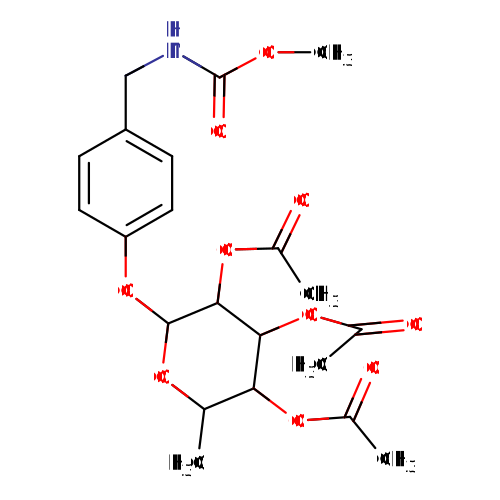
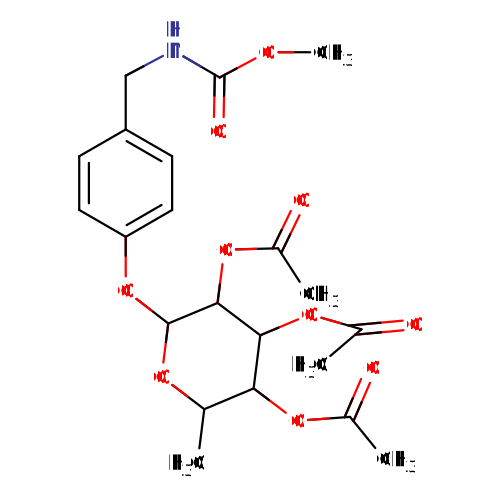
| Common Name | n-[(4-{[3,4,5-tris(acetyloxy)-6-methyloxan-2-yl]oxy}phenyl)methyl]methoxycarboximidic acid |
|---|
| Description | 1-Isobutanol belongs to the class of organic compounds known as phenolic glycosides. These are organic compounds containing a phenolic structure attached to a glycosyl moiety. Some examples of phenolic structures include lignans, and flavonoids. Among the sugar units found in natural glycosides are D-glucose, L-Fructose, and L rhamnose. Isobutanol (IUPAC nomenclature: 2-Methylpropan-1-ol) is an organic compound with the formula (CH3)2CHCH2OH (sometimes represented as i-BuOH). 1-Isobutanol is an extremely weak basic (essentially neutral) compound (based on its pKa). In March 2009, the Canadian government announced a ban on isobutanol use in cosmetics. Outside of the human body, 1-Isobutanol has been detected, but not quantified in, a few different foods, such as fats and oils, green vegetables, and herbs and spices. This could make 1-isobutanol a potential biomarker for the consumption of these foods. The host's highly active amino acid biosynthetic pathway is shifted to alcohol production. In Reppe carbonylation, the same products are obtained, but the hydrogenation is effected by the water-gas shift reaction. Two methods are practiced industrially, hydroformylation is more common and generates a mixture of isobutyraldehydes:CH3CHCH2 + CO + H2 → CH3CH2CH2CHOThe reaction is catalyzed by cobalt or rhodium complexes. n-[(4-{[3,4,5-tris(acetyloxy)-6-methyloxan-2-yl]oxy}phenyl)methyl]methoxycarboximidic acid is found in Moringa oleifera. Isobutyl esters of phthalic, adipic, and related dicarboxylic acids are common plasticizers. |
|---|
| Structure | COC(=O)NCC1=CC=C(OC2OC(C)C(OC(C)=O)C(OC(C)=O)C2OC(C)=O)C=C1 InChI=1S/C21H27NO10/c1-11-17(29-12(2)23)18(30-13(3)24)19(31-14(4)25)20(28-11)32-16-8-6-15(7-9-16)10-22-21(26)27-5/h6-9,11,17-20H,10H2,1-5H3,(H,22,26) |
|---|
| Synonyms | | Value | Source |
|---|
| N-[(4-{[3,4,5-tris(acetyloxy)-6-methyloxan-2-yl]oxy}phenyl)methyl]methoxycarboximidate | Generator |
|
|---|
| Chemical Formula | C21H27NO10 |
|---|
| Average Mass | 453.4398 Da |
|---|
| Monoisotopic Mass | 453.16350 Da |
|---|
| IUPAC Name | 4,5-bis(acetyloxy)-6-(4-{[(methoxycarbonyl)amino]methyl}phenoxy)-2-methyloxan-3-yl acetate |
|---|
| Traditional Name | 4,5-bis(acetyloxy)-6-(4-{[(methoxycarbonyl)amino]methyl}phenoxy)-2-methyloxan-3-yl acetate |
|---|
| CAS Registry Number | Not Available |
|---|
| SMILES | COC(=O)NCC1=CC=C(OC2OC(C)C(OC(C)=O)C(OC(C)=O)C2OC(C)=O)C=C1 |
|---|
| InChI Identifier | InChI=1S/C21H27NO10/c1-11-17(29-12(2)23)18(30-13(3)24)19(31-14(4)25)20(28-11)32-16-8-6-15(7-9-16)10-22-21(26)27-5/h6-9,11,17-20H,10H2,1-5H3,(H,22,26) |
|---|
| InChI Key | LCQPFOZNYVLABG-UHFFFAOYSA-N |
|---|
| Experimental Spectra |
|---|
|
| Not Available | | Predicted Spectra |
|---|
|
| | Spectrum Type | Description | Depositor ID | Depositor Organization | Depositor | Deposition Date | View |
|---|
| 1D NMR | 13C NMR Spectrum (1D, 25 MHz, H2O, predicted) | Wishart Lab | Wishart Lab | David Wishart | 2021-06-20 | View Spectrum | | 1D NMR | 1H NMR Spectrum (1D, 100 MHz, H2O, predicted) | Wishart Lab | Wishart Lab | David Wishart | 2021-06-20 | View Spectrum | | 1D NMR | 13C NMR Spectrum (1D, 252 MHz, H2O, predicted) | Wishart Lab | Wishart Lab | David Wishart | 2021-06-20 | View Spectrum | | 1D NMR | 1H NMR Spectrum (1D, 1000 MHz, H2O, predicted) | Wishart Lab | Wishart Lab | David Wishart | 2021-06-20 | View Spectrum | | 1D NMR | 13C NMR Spectrum (1D, 50 MHz, H2O, predicted) | Wishart Lab | Wishart Lab | David Wishart | 2021-06-20 | View Spectrum | | 1D NMR | 1H NMR Spectrum (1D, 200 MHz, H2O, predicted) | Wishart Lab | Wishart Lab | David Wishart | 2021-06-20 | View Spectrum | | 1D NMR | 13C NMR Spectrum (1D, 75 MHz, H2O, predicted) | Wishart Lab | Wishart Lab | David Wishart | 2021-06-20 | View Spectrum | | 1D NMR | 1H NMR Spectrum (1D, 300 MHz, H2O, predicted) | Wishart Lab | Wishart Lab | David Wishart | 2021-06-20 | View Spectrum | | 1D NMR | 13C NMR Spectrum (1D, 101 MHz, H2O, predicted) | Wishart Lab | Wishart Lab | David Wishart | 2021-06-20 | View Spectrum | | 1D NMR | 1H NMR Spectrum (1D, 400 MHz, H2O, predicted) | Wishart Lab | Wishart Lab | David Wishart | 2021-06-20 | View Spectrum | | 1D NMR | 13C NMR Spectrum (1D, 126 MHz, H2O, predicted) | Wishart Lab | Wishart Lab | David Wishart | 2021-06-20 | View Spectrum | | 1D NMR | 1H NMR Spectrum (1D, 500 MHz, H2O, predicted) | Wishart Lab | Wishart Lab | David Wishart | 2021-06-20 | View Spectrum | | 1D NMR | 13C NMR Spectrum (1D, 151 MHz, H2O, predicted) | Wishart Lab | Wishart Lab | David Wishart | 2021-06-20 | View Spectrum | | 1D NMR | 1H NMR Spectrum (1D, 600 MHz, H2O, predicted) | Wishart Lab | Wishart Lab | David Wishart | 2021-06-20 | View Spectrum | | 1D NMR | 13C NMR Spectrum (1D, 176 MHz, H2O, predicted) | Wishart Lab | Wishart Lab | David Wishart | 2021-06-20 | View Spectrum | | 1D NMR | 1H NMR Spectrum (1D, 700 MHz, H2O, predicted) | Wishart Lab | Wishart Lab | David Wishart | 2021-06-20 | View Spectrum | | 1D NMR | 13C NMR Spectrum (1D, 201 MHz, H2O, predicted) | Wishart Lab | Wishart Lab | David Wishart | 2021-06-20 | View Spectrum | | 1D NMR | 1H NMR Spectrum (1D, 800 MHz, H2O, predicted) | Wishart Lab | Wishart Lab | David Wishart | 2021-06-20 | View Spectrum | | 1D NMR | 13C NMR Spectrum (1D, 226 MHz, H2O, predicted) | Wishart Lab | Wishart Lab | David Wishart | 2021-06-20 | View Spectrum | | 1D NMR | 1H NMR Spectrum (1D, 900 MHz, H2O, predicted) | Wishart Lab | Wishart Lab | David Wishart | 2021-06-20 | View Spectrum |
| | Chemical Shift Submissions |
|---|
|
| Not Available | | Species |
|---|
| Species of Origin | |
|---|
| Chemical Taxonomy |
|---|
| Description | Belongs to the class of organic compounds known as phenolic glycosides. These are organic compounds containing a phenolic structure attached to a glycosyl moiety. Some examples of phenolic structures include lignans, and flavonoids. Among the sugar units found in natural glycosides are D-glucose, L-Fructose, and L rhamnose. |
|---|
| Kingdom | Organic compounds |
|---|
| Super Class | Organic oxygen compounds |
|---|
| Class | Organooxygen compounds |
|---|
| Sub Class | Carbohydrates and carbohydrate conjugates |
|---|
| Direct Parent | Phenolic glycosides |
|---|
| Alternative Parents | |
|---|
| Substituents | - Phenolic glycoside
- Hexose monosaccharide
- O-glycosyl compound
- Tricarboxylic acid or derivatives
- Phenol ether
- Phenoxy compound
- Monocyclic benzene moiety
- Benzenoid
- Monosaccharide
- Oxane
- Methylcarbamate
- Carbamic acid ester
- Carboxylic acid ester
- Carbonic acid derivative
- Carboxylic acid derivative
- Oxacycle
- Organoheterocyclic compound
- Acetal
- Hydrocarbon derivative
- Organopnictogen compound
- Organic oxide
- Organic nitrogen compound
- Carbonyl group
- Organonitrogen compound
- Aromatic heteromonocyclic compound
|
|---|
| Molecular Framework | Aromatic heteromonocyclic compounds |
|---|
| External Descriptors | Not Available |
|---|
| Physical Properties |
|---|
| State | Not Available |
|---|
| Experimental Properties | | Property | Value | Reference |
|---|
| Melting Point | Not Available | Not Available | | Boiling Point | Not Available | Not Available | | Water Solubility | Not Available | Not Available | | LogP | Not Available | Not Available |
|
|---|
| Predicted Properties | |
|---|