| Record Information |
|---|
| Version | 2.0 |
|---|
| Created at | 2022-09-06 11:47:11 UTC |
|---|
| Updated at | 2022-09-06 11:47:11 UTC |
|---|
| NP-MRD ID | NP0231097 |
|---|
| Secondary Accession Numbers | None |
|---|
| Natural Product Identification |
|---|
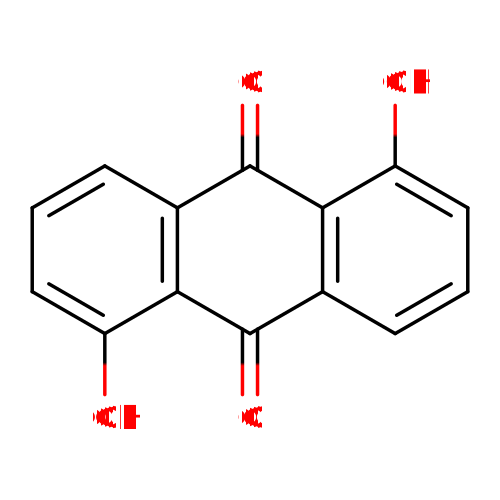
| Common Name | anthrarufin |
|---|
| Description | Anthrarufin, also known as az-u or 1,5-dhaq, belongs to the class of organic compounds known as anthraquinones. These are organic compounds containing either anthracene-9,10-quinone, 1,4-anthraquinone, or 1,2-anthraquinone. Anthrarufin is an extremely weak basic (essentially neutral) compound (based on its pKa). anthrarufin was first documented in 1986 (PMID: 3267459). A dihydroxyanthraquinone that is anthracene-9,10-dione substituted by hydroxy groups at positions 1 and 5 (PMID: 17971722) (PMID: 18728697) (PMID: 20541965). |
|---|
| Structure | OC1=CC=CC2=C1C(=O)C1=C(C(O)=CC=C1)C2=O InChI=1S/C14H8O4/c15-9-5-1-3-7-11(9)14(18)8-4-2-6-10(16)12(8)13(7)17/h1-6,15-16H |
|---|
| Synonyms | | Value | Source |
|---|
| 1,5-Dihydroxy-9,10-anthracenedione | ChEBI | | 1,5-Dihydroxy-9,10-anthraquinone | ChEBI | | 1,5-Dihydroxyanthrachinon | ChEBI | | 1,5-Dihydroxyanthraquinone | ChEBI | | Az-u | ChEBI | | 1,5-DHAQ | MeSH |
|
|---|
| Chemical Formula | C14H8O4 |
|---|
| Average Mass | 240.2140 Da |
|---|
| Monoisotopic Mass | 240.04226 Da |
|---|
| IUPAC Name | 1,5-dihydroxy-9,10-dihydroanthracene-9,10-dione |
|---|
| Traditional Name | anthrarufin |
|---|
| CAS Registry Number | Not Available |
|---|
| SMILES | OC1=CC=CC2=C1C(=O)C1=C(C(O)=CC=C1)C2=O |
|---|
| InChI Identifier | InChI=1S/C14H8O4/c15-9-5-1-3-7-11(9)14(18)8-4-2-6-10(16)12(8)13(7)17/h1-6,15-16H |
|---|
| InChI Key | JPICKYUTICNNNJ-UHFFFAOYSA-N |
|---|
| Experimental Spectra |
|---|
|
| Not Available | | Predicted Spectra |
|---|
|
| | Spectrum Type | Description | Depositor ID | Depositor Organization | Depositor | Deposition Date | View |
|---|
| 1D NMR | 13C NMR Spectrum (1D, 25 MHz, H2O, predicted) | Wishart Lab | Wishart Lab | David Wishart | 2021-06-20 | View Spectrum | | 1D NMR | 1H NMR Spectrum (1D, 100 MHz, H2O, predicted) | Wishart Lab | Wishart Lab | David Wishart | 2021-06-20 | View Spectrum | | 1D NMR | 13C NMR Spectrum (1D, 252 MHz, H2O, predicted) | Wishart Lab | Wishart Lab | David Wishart | 2021-06-20 | View Spectrum | | 1D NMR | 1H NMR Spectrum (1D, 1000 MHz, H2O, predicted) | Wishart Lab | Wishart Lab | David Wishart | 2021-06-20 | View Spectrum | | 1D NMR | 13C NMR Spectrum (1D, 50 MHz, H2O, predicted) | Wishart Lab | Wishart Lab | David Wishart | 2021-06-20 | View Spectrum | | 1D NMR | 1H NMR Spectrum (1D, 200 MHz, H2O, predicted) | Wishart Lab | Wishart Lab | David Wishart | 2021-06-20 | View Spectrum | | 1D NMR | 13C NMR Spectrum (1D, 75 MHz, H2O, predicted) | Wishart Lab | Wishart Lab | David Wishart | 2021-06-20 | View Spectrum | | 1D NMR | 1H NMR Spectrum (1D, 300 MHz, H2O, predicted) | Wishart Lab | Wishart Lab | David Wishart | 2021-06-20 | View Spectrum | | 1D NMR | 13C NMR Spectrum (1D, 101 MHz, H2O, predicted) | Wishart Lab | Wishart Lab | David Wishart | 2021-06-20 | View Spectrum | | 1D NMR | 1H NMR Spectrum (1D, 400 MHz, H2O, predicted) | Wishart Lab | Wishart Lab | David Wishart | 2021-06-20 | View Spectrum | | 1D NMR | 13C NMR Spectrum (1D, 126 MHz, H2O, predicted) | Wishart Lab | Wishart Lab | David Wishart | 2021-06-20 | View Spectrum | | 1D NMR | 1H NMR Spectrum (1D, 500 MHz, H2O, predicted) | Wishart Lab | Wishart Lab | David Wishart | 2021-06-20 | View Spectrum | | 1D NMR | 13C NMR Spectrum (1D, 151 MHz, H2O, predicted) | Wishart Lab | Wishart Lab | David Wishart | 2021-06-20 | View Spectrum | | 1D NMR | 1H NMR Spectrum (1D, 600 MHz, H2O, predicted) | Wishart Lab | Wishart Lab | David Wishart | 2021-06-20 | View Spectrum | | 1D NMR | 13C NMR Spectrum (1D, 176 MHz, H2O, predicted) | Wishart Lab | Wishart Lab | David Wishart | 2021-06-20 | View Spectrum | | 1D NMR | 1H NMR Spectrum (1D, 700 MHz, H2O, predicted) | Wishart Lab | Wishart Lab | David Wishart | 2021-06-20 | View Spectrum | | 1D NMR | 13C NMR Spectrum (1D, 201 MHz, H2O, predicted) | Wishart Lab | Wishart Lab | David Wishart | 2021-06-20 | View Spectrum | | 1D NMR | 1H NMR Spectrum (1D, 800 MHz, H2O, predicted) | Wishart Lab | Wishart Lab | David Wishart | 2021-06-20 | View Spectrum | | 1D NMR | 13C NMR Spectrum (1D, 226 MHz, H2O, predicted) | Wishart Lab | Wishart Lab | David Wishart | 2021-06-20 | View Spectrum | | 1D NMR | 1H NMR Spectrum (1D, 900 MHz, H2O, predicted) | Wishart Lab | Wishart Lab | David Wishart | 2021-06-20 | View Spectrum |
| | Chemical Shift Submissions |
|---|
|
| Not Available | | Species |
|---|
| Species of Origin | Not Available |
|---|
| Chemical Taxonomy |
|---|
| Description | Belongs to the class of organic compounds known as anthraquinones. These are organic compounds containing either anthracene-9,10-quinone, 1,4-anthraquinone, or 1,2-anthraquinone. |
|---|
| Kingdom | Organic compounds |
|---|
| Super Class | Benzenoids |
|---|
| Class | Anthracenes |
|---|
| Sub Class | Anthraquinones |
|---|
| Direct Parent | Anthraquinones |
|---|
| Alternative Parents | |
|---|
| Substituents | - Anthraquinone
- 9,10-anthraquinone
- Aryl ketone
- 1-hydroxy-4-unsubstituted benzenoid
- 1-hydroxy-2-unsubstituted benzenoid
- Vinylogous acid
- Ketone
- Organic oxygen compound
- Organic oxide
- Hydrocarbon derivative
- Organooxygen compound
- Aromatic homopolycyclic compound
|
|---|
| Molecular Framework | Aromatic homopolycyclic compounds |
|---|
| External Descriptors | |
|---|
| Physical Properties |
|---|
| State | Not Available |
|---|
| Experimental Properties | | Property | Value | Reference |
|---|
| Melting Point | Not Available | Not Available | | Boiling Point | Not Available | Not Available | | Water Solubility | Not Available | Not Available | | LogP | Not Available | Not Available |
|
|---|
| Predicted Properties | |
|---|
| General References | - Chairungsi N, Jumpatong K, Suebsakwong P, Sengpracha W, Phutdhawong W, Buddhasukh D: Electrocoagulation of quinone pigments. Molecules. 2006 Jul 14;11(7):514-22. doi: 10.3390/11070514. [PubMed:17971722 ]
- Sparks SM, Chen CL, Martin SF: Tandem Intramolecular Benzyne-Furan Cycloadditions. Total Synthesis of Vineomycinone B(2) Methyl Ester. Tetrahedron. 2007 Aug 27;63(35):8619-8635. doi: 10.1016/j.tet.2007.04.031. [PubMed:18728697 ]
- Nguyen DD, Jones NC, Hoffmann SV, Spanget-Larsen J: Synchrotron radiation linear dichroism (SRLD) investigation of the electronic transitions of quinizarin, chrysazin, and anthrarufin. Spectrochim Acta A Mol Biomol Spectrosc. 2010 Sep 15;77(1):279-86. doi: 10.1016/j.saa.2010.05.023. Epub 2010 May 24. [PubMed:20541965 ]
- Kawai K, Mori H, Sugie S, Yoshimi N, Inoue T, Nakamaru T, Nozawa Y, Matsushima T: Genotoxicity in the hepatocyte/DNA repair test and toxicity to liver mitochondria of 1-hydroxyanthraquinone and several dihydroxyanthraquinones. Cell Biol Toxicol. 1986 Dec;2(4):457-67. doi: 10.1007/BF00117848. [PubMed:3267459 ]
- LOTUS database [Link]
|
|---|