| Record Information |
|---|
| Version | 2.0 |
|---|
| Created at | 2022-09-06 07:43:39 UTC |
|---|
| Updated at | 2022-09-06 07:43:39 UTC |
|---|
| NP-MRD ID | NP0228177 |
|---|
| Secondary Accession Numbers | None |
|---|
| Natural Product Identification |
|---|
| Common Name | lisoleucine |
|---|
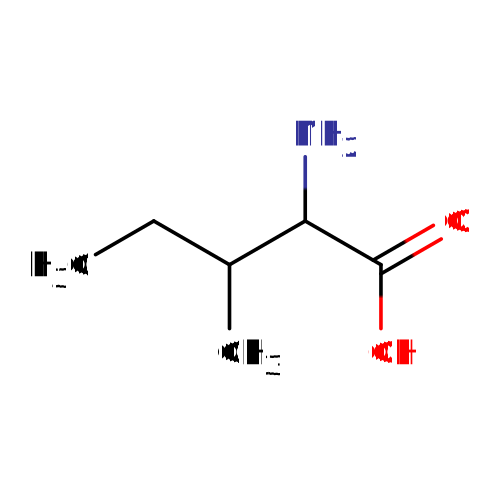
| Description | (±)-Erythro-Isoleucine, also known as (+/-)-isoleucine or (+/-)-erythro-form, belongs to the class of organic compounds known as isoleucine and derivatives. Isoleucine and derivatives are compounds containing isoleucine or a derivative thereof resulting from reaction of isoleucine at the amino group or the carboxy group, or from the replacement of any hydrogen of glycine by a heteroatom (±)-erythro-Isoleucine is a very strong basic compound (based on its pKa) (±)-erythro-Isoleucine is a bitter and odorless tasting compound. Outside of the human body, (±)-erythro-Isoleucine is found, on average, in the highest concentration within a few different foods, such as caseins, milk (cow), and beluga whales and in a lower concentration in garden onions, other soy products, and sweet cherries (±)-erythro-Isoleucine has also been detected, but not quantified in, several different foods, such as soursops, oxheart cabbages, alpine sweetvetchs, mugworts, and roselles. This could make (±)-erythro-isoleucine a potential biomarker for the consumption of these foods. The ratio of leucine to other BCAA is greatest in pork, where leucine is 7 to 8 g and the other BCAA together are only 3 to 4 g (http://Www.Dcnutrition.Com). The BCAA are not without side effects. Valine, in particular, has been established as a useful supplemental therapy to the ailing liver. Branched-chain amino acids (BCAA) are essential amino acids whose carbon structure is marked by a branch point. BCAA supplementation as therapy, both oral and intravenous, in human health and disease holds great promise. lisoleucine is found in Antirrhinum majus, Castanea sativa, Catha edulis, Claviceps purpurea, Colchicum trigynum, Daphnia magna, Glycine max, Pogostemon cablin, Puccinia graminis, Stellaria media, Vicia sativa and Viscum album. lisoleucine was first documented in 2000 (PMID: 10944265). Aromatic amino acids (AAA)-tyrosine, tryptophan, and phenylalanine (as well as methionine) are increased in these conditions. |
|---|
| Structure | InChI=1S/C6H13NO2/c1-3-4(2)5(7)6(8)9/h4-5H,3,7H2,1-2H3,(H,8,9) |
|---|
| Synonyms | | Value | Source |
|---|
| (+/-)-erythro-form | HMDB | | (+/-)-isoleucine | HMDB | | FEMA 3295 | HMDB | | Isoleucine | HMDB | | 2-Amino-3-methylpentanoic acid | MeSH |
|
|---|
| Chemical Formula | C6H13NO2 |
|---|
| Average Mass | 131.1729 Da |
|---|
| Monoisotopic Mass | 131.09463 Da |
|---|
| IUPAC Name | 2-amino-3-methylpentanoic acid |
|---|
| Traditional Name | L(+)-isoleucine |
|---|
| CAS Registry Number | Not Available |
|---|
| SMILES | CCC(C)C(N)C(O)=O |
|---|
| InChI Identifier | InChI=1S/C6H13NO2/c1-3-4(2)5(7)6(8)9/h4-5H,3,7H2,1-2H3,(H,8,9) |
|---|
| InChI Key | AGPKZVBTJJNPAG-UHFFFAOYSA-N |
|---|
| Experimental Spectra |
|---|
|
| Not Available | | Predicted Spectra |
|---|
|
| | Spectrum Type | Description | Depositor ID | Depositor Organization | Depositor | Deposition Date | View |
|---|
| 1D NMR | 13C NMR Spectrum (1D, 25 MHz, H2O, predicted) | Wishart Lab | Wishart Lab | David Wishart | 2021-06-20 | View Spectrum | | 1D NMR | 1H NMR Spectrum (1D, 100 MHz, H2O, predicted) | Wishart Lab | Wishart Lab | David Wishart | 2021-06-20 | View Spectrum | | 1D NMR | 13C NMR Spectrum (1D, 252 MHz, H2O, predicted) | Wishart Lab | Wishart Lab | David Wishart | 2021-06-20 | View Spectrum | | 1D NMR | 1H NMR Spectrum (1D, 1000 MHz, H2O, predicted) | Wishart Lab | Wishart Lab | David Wishart | 2021-06-20 | View Spectrum | | 1D NMR | 13C NMR Spectrum (1D, 50 MHz, H2O, predicted) | Wishart Lab | Wishart Lab | David Wishart | 2021-06-20 | View Spectrum | | 1D NMR | 1H NMR Spectrum (1D, 200 MHz, H2O, predicted) | Wishart Lab | Wishart Lab | David Wishart | 2021-06-20 | View Spectrum | | 1D NMR | 13C NMR Spectrum (1D, 75 MHz, H2O, predicted) | Wishart Lab | Wishart Lab | David Wishart | 2021-06-20 | View Spectrum | | 1D NMR | 1H NMR Spectrum (1D, 300 MHz, H2O, predicted) | Wishart Lab | Wishart Lab | David Wishart | 2021-06-20 | View Spectrum | | 1D NMR | 13C NMR Spectrum (1D, 101 MHz, H2O, predicted) | Wishart Lab | Wishart Lab | David Wishart | 2021-06-20 | View Spectrum | | 1D NMR | 1H NMR Spectrum (1D, 400 MHz, H2O, predicted) | Wishart Lab | Wishart Lab | David Wishart | 2021-06-20 | View Spectrum | | 1D NMR | 13C NMR Spectrum (1D, 126 MHz, H2O, predicted) | Wishart Lab | Wishart Lab | David Wishart | 2021-06-20 | View Spectrum | | 1D NMR | 1H NMR Spectrum (1D, 500 MHz, H2O, predicted) | Wishart Lab | Wishart Lab | David Wishart | 2021-06-20 | View Spectrum | | 1D NMR | 13C NMR Spectrum (1D, 151 MHz, H2O, predicted) | Wishart Lab | Wishart Lab | David Wishart | 2021-06-20 | View Spectrum | | 1D NMR | 1H NMR Spectrum (1D, 600 MHz, H2O, predicted) | Wishart Lab | Wishart Lab | David Wishart | 2021-06-20 | View Spectrum | | 1D NMR | 13C NMR Spectrum (1D, 176 MHz, H2O, predicted) | Wishart Lab | Wishart Lab | David Wishart | 2021-06-20 | View Spectrum | | 1D NMR | 1H NMR Spectrum (1D, 700 MHz, H2O, predicted) | Wishart Lab | Wishart Lab | David Wishart | 2021-06-20 | View Spectrum | | 1D NMR | 13C NMR Spectrum (1D, 201 MHz, H2O, predicted) | Wishart Lab | Wishart Lab | David Wishart | 2021-06-20 | View Spectrum | | 1D NMR | 1H NMR Spectrum (1D, 800 MHz, H2O, predicted) | Wishart Lab | Wishart Lab | David Wishart | 2021-06-20 | View Spectrum | | 1D NMR | 13C NMR Spectrum (1D, 226 MHz, H2O, predicted) | Wishart Lab | Wishart Lab | David Wishart | 2021-06-20 | View Spectrum | | 1D NMR | 1H NMR Spectrum (1D, 900 MHz, H2O, predicted) | Wishart Lab | Wishart Lab | David Wishart | 2021-06-20 | View Spectrum |
| | Chemical Shift Submissions |
|---|
|
| Not Available | | Species |
|---|
| Species of Origin | |
|---|
| Chemical Taxonomy |
|---|
| Description | Belongs to the class of organic compounds known as isoleucine and derivatives. Isoleucine and derivatives are compounds containing isoleucine or a derivative thereof resulting from reaction of isoleucine at the amino group or the carboxy group, or from the replacement of any hydrogen of glycine by a heteroatom. |
|---|
| Kingdom | Organic compounds |
|---|
| Super Class | Organic acids and derivatives |
|---|
| Class | Carboxylic acids and derivatives |
|---|
| Sub Class | Amino acids, peptides, and analogues |
|---|
| Direct Parent | Isoleucine and derivatives |
|---|
| Alternative Parents | |
|---|
| Substituents | - Isoleucine or derivatives
- Alpha-amino acid
- Branched fatty acid
- Methyl-branched fatty acid
- Fatty acid
- Fatty acyl
- Amino acid
- Carboxylic acid
- Monocarboxylic acid or derivatives
- Organopnictogen compound
- Primary amine
- Organooxygen compound
- Organonitrogen compound
- Organic nitrogen compound
- Primary aliphatic amine
- Carbonyl group
- Organic oxygen compound
- Amine
- Organic oxide
- Hydrocarbon derivative
- Aliphatic acyclic compound
|
|---|
| Molecular Framework | Aliphatic acyclic compounds |
|---|
| External Descriptors | |
|---|
| Physical Properties |
|---|
| State | Not Available |
|---|
| Experimental Properties | | Property | Value | Reference |
|---|
| Melting Point | Not Available | Not Available | | Boiling Point | Not Available | Not Available | | Water Solubility | Not Available | Not Available | | LogP | Not Available | Not Available |
|
|---|
| Predicted Properties | |
|---|