| Record Information |
|---|
| Version | 2.0 |
|---|
| Created at | 2022-09-06 04:01:53 UTC |
|---|
| Updated at | 2022-09-06 04:01:53 UTC |
|---|
| NP-MRD ID | NP0225340 |
|---|
| Secondary Accession Numbers | None |
|---|
| Natural Product Identification |
|---|
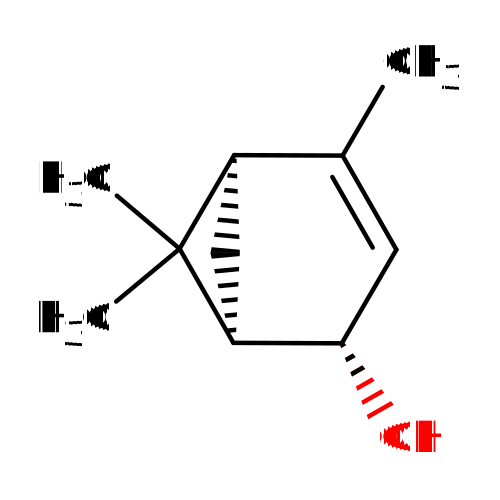
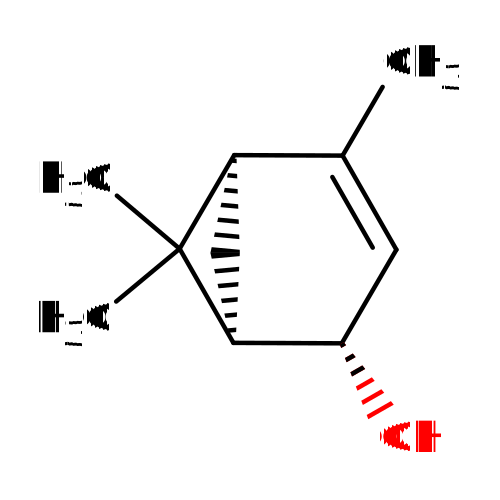
| Common Name | (1r,2s,5r)-4,6,6-trimethylbicyclo[3.1.1]hept-3-en-2-ol |
|---|
| Description | Trans-Verbenol belongs to the class of organic compounds known as bicyclic monoterpenoids. These are monoterpenoids containing exactly 2 rings, which are fused to each other. (1r,2s,5r)-4,6,6-trimethylbicyclo[3.1.1]hept-3-en-2-ol is found in Achillea abrotanoides, Anthemis aciphylla, Artemisia herba-alba, Artemisia judaica, Artemisia sericea, Brassica nigra, Commiphora gurreh, Echinophora tournefortii, Gutierrezia sarothrae, Helminthotheca echioides, Ips cembrae, Lavandula stoechas, Micromeria biflora, Micromeria cristata, Mosla chinensis, Myrtus communis, Peumus boldus, Pityophthorus pityographus, Stevia rebaudiana, Teucrium polium and Vitex agnus-castus. (1r,2s,5r)-4,6,6-trimethylbicyclo[3.1.1]hept-3-en-2-ol was first documented in 2021 (PMID: 33923848). Based on a literature review a small amount of articles have been published on trans-Verbenol (PMID: 35807301) (PMID: 35200079) (PMID: 34808354). |
|---|
| Structure | CC1=C[C@H](O)[C@@H]2C[C@H]1C2(C)C InChI=1S/C10H16O/c1-6-4-9(11)8-5-7(6)10(8,2)3/h4,7-9,11H,5H2,1-3H3/t7-,8+,9+/m1/s1 |
|---|
| Synonyms | Not Available |
|---|
| Chemical Formula | C10H16O |
|---|
| Average Mass | 152.2370 Da |
|---|
| Monoisotopic Mass | 152.12012 Da |
|---|
| IUPAC Name | (1R,2S,5R)-4,6,6-trimethylbicyclo[3.1.1]hept-3-en-2-ol |
|---|
| Traditional Name | (1R,2S,5R)-4,6,6-trimethylbicyclo[3.1.1]hept-3-en-2-ol |
|---|
| CAS Registry Number | Not Available |
|---|
| SMILES | CC1=C[C@H](O)[C@@H]2C[C@H]1C2(C)C |
|---|
| InChI Identifier | InChI=1S/C10H16O/c1-6-4-9(11)8-5-7(6)10(8,2)3/h4,7-9,11H,5H2,1-3H3/t7-,8+,9+/m1/s1 |
|---|
| InChI Key | WONIGEXYPVIKFS-VGMNWLOBSA-N |
|---|
| Experimental Spectra |
|---|
|
| Not Available | | Predicted Spectra |
|---|
|
| | Spectrum Type | Description | Depositor ID | Depositor Organization | Depositor | Deposition Date | View |
|---|
| 1D NMR | 13C NMR Spectrum (1D, 25 MHz, H2O, predicted) | Wishart Lab | Wishart Lab | David Wishart | 2021-06-20 | View Spectrum | | 1D NMR | 1H NMR Spectrum (1D, 100 MHz, H2O, predicted) | Wishart Lab | Wishart Lab | David Wishart | 2021-06-20 | View Spectrum | | 1D NMR | 13C NMR Spectrum (1D, 252 MHz, H2O, predicted) | Wishart Lab | Wishart Lab | David Wishart | 2021-06-20 | View Spectrum | | 1D NMR | 1H NMR Spectrum (1D, 1000 MHz, H2O, predicted) | Wishart Lab | Wishart Lab | David Wishart | 2021-06-20 | View Spectrum | | 1D NMR | 13C NMR Spectrum (1D, 50 MHz, H2O, predicted) | Wishart Lab | Wishart Lab | David Wishart | 2021-06-20 | View Spectrum | | 1D NMR | 1H NMR Spectrum (1D, 200 MHz, H2O, predicted) | Wishart Lab | Wishart Lab | David Wishart | 2021-06-20 | View Spectrum | | 1D NMR | 13C NMR Spectrum (1D, 75 MHz, H2O, predicted) | Wishart Lab | Wishart Lab | David Wishart | 2021-06-20 | View Spectrum | | 1D NMR | 1H NMR Spectrum (1D, 300 MHz, H2O, predicted) | Wishart Lab | Wishart Lab | David Wishart | 2021-06-20 | View Spectrum | | 1D NMR | 13C NMR Spectrum (1D, 101 MHz, H2O, predicted) | Wishart Lab | Wishart Lab | David Wishart | 2021-06-20 | View Spectrum | | 1D NMR | 1H NMR Spectrum (1D, 400 MHz, H2O, predicted) | Wishart Lab | Wishart Lab | David Wishart | 2021-06-20 | View Spectrum | | 1D NMR | 13C NMR Spectrum (1D, 126 MHz, H2O, predicted) | Wishart Lab | Wishart Lab | David Wishart | 2021-06-20 | View Spectrum | | 1D NMR | 1H NMR Spectrum (1D, 500 MHz, H2O, predicted) | Wishart Lab | Wishart Lab | David Wishart | 2021-06-20 | View Spectrum | | 1D NMR | 13C NMR Spectrum (1D, 151 MHz, H2O, predicted) | Wishart Lab | Wishart Lab | David Wishart | 2021-06-20 | View Spectrum | | 1D NMR | 1H NMR Spectrum (1D, 600 MHz, H2O, predicted) | Wishart Lab | Wishart Lab | David Wishart | 2021-06-20 | View Spectrum | | 1D NMR | 13C NMR Spectrum (1D, 176 MHz, H2O, predicted) | Wishart Lab | Wishart Lab | David Wishart | 2021-06-20 | View Spectrum | | 1D NMR | 1H NMR Spectrum (1D, 700 MHz, H2O, predicted) | Wishart Lab | Wishart Lab | David Wishart | 2021-06-20 | View Spectrum | | 1D NMR | 13C NMR Spectrum (1D, 201 MHz, H2O, predicted) | Wishart Lab | Wishart Lab | David Wishart | 2021-06-20 | View Spectrum | | 1D NMR | 1H NMR Spectrum (1D, 800 MHz, H2O, predicted) | Wishart Lab | Wishart Lab | David Wishart | 2021-06-20 | View Spectrum | | 1D NMR | 13C NMR Spectrum (1D, 226 MHz, H2O, predicted) | Wishart Lab | Wishart Lab | David Wishart | 2021-06-20 | View Spectrum | | 1D NMR | 1H NMR Spectrum (1D, 900 MHz, H2O, predicted) | Wishart Lab | Wishart Lab | David Wishart | 2021-06-20 | View Spectrum |
| | Chemical Shift Submissions |
|---|
|
| Not Available | | Species |
|---|
| Species of Origin | |
|---|
| Chemical Taxonomy |
|---|
| Description | Belongs to the class of organic compounds known as bicyclic monoterpenoids. These are monoterpenoids containing exactly 2 rings, which are fused to each other. |
|---|
| Kingdom | Organic compounds |
|---|
| Super Class | Lipids and lipid-like molecules |
|---|
| Class | Prenol lipids |
|---|
| Sub Class | Monoterpenoids |
|---|
| Direct Parent | Bicyclic monoterpenoids |
|---|
| Alternative Parents | |
|---|
| Substituents | - Pinane monoterpenoid
- Bicyclic monoterpenoid
- Secondary alcohol
- Organic oxygen compound
- Hydrocarbon derivative
- Organooxygen compound
- Alcohol
- Aliphatic homopolycyclic compound
|
|---|
| Molecular Framework | Aliphatic homopolycyclic compounds |
|---|
| External Descriptors | Not Available |
|---|
| Physical Properties |
|---|
| State | Not Available |
|---|
| Experimental Properties | | Property | Value | Reference |
|---|
| Melting Point | Not Available | Not Available | | Boiling Point | Not Available | Not Available | | Water Solubility | Not Available | Not Available | | LogP | Not Available | Not Available |
|
|---|
| Predicted Properties | |
|---|
| General References | - Mendes D, Branco S, Paiva MR, Schutz S, Mateus EP, Gomes da Silva M: Unveiling Chemical Cues of Insect-Tree and Insect-Insect Interactions for the Eucalyptus Weevil and Its Egg Parasitoid by Multidimensional Gas Chromatographic Methods. Molecules. 2022 Jun 23;27(13). pii: molecules27134042. doi: 10.3390/molecules27134042. [PubMed:35807301 ]
- Ayub MA, Hanif MA, Blanchfield J, Zubair M, Abid MA, Saleh MT: Chemical composition and antimicrobial activity of Boswellia serrata oleo-gum-resin essential oil extracted by superheated steam. Nat Prod Res. 2022 Feb 24:1-6. doi: 10.1080/14786419.2022.2044327. [PubMed:35200079 ]
- Ramakrishnan R, Hradecky J, Roy A, Kalinova B, Mendezes RC, Synek J, Blaha J, Svatos A, Jirosova A: Metabolomics and transcriptomics of pheromone biosynthesis in an aggressive forest pest Ips typographus. Insect Biochem Mol Biol. 2022 Jan;140:103680. doi: 10.1016/j.ibmb.2021.103680. Epub 2021 Nov 19. [PubMed:34808354 ]
- Gimenes L, Silva JCRL, Facanali R, Hantao LW, Siqueira WJ, Marques MOM: Essential Oils of New Lippia alba Genotypes Analyzed by Flow-Modulated Comprehensive Two-Dimensional Gas Chromatography (GCxGC) and Chemometric Analysis. Molecules. 2021 Apr 16;26(8):2332. doi: 10.3390/molecules26082332. [PubMed:33923848 ]
- LOTUS database [Link]
|
|---|