| Record Information |
|---|
| Version | 2.0 |
|---|
| Created at | 2022-09-06 02:54:43 UTC |
|---|
| Updated at | 2022-09-06 02:54:43 UTC |
|---|
| NP-MRD ID | NP0224530 |
|---|
| Secondary Accession Numbers | None |
|---|
| Natural Product Identification |
|---|
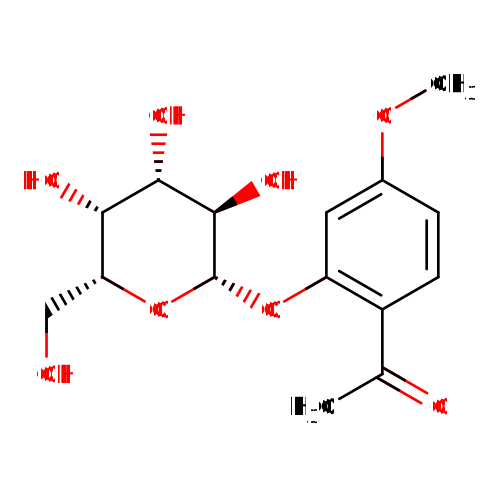
| Common Name | 1-(4-methoxy-2-{[(2s,3r,4s,5r,6r)-3,4,5-trihydroxy-6-(hydroxymethyl)oxan-2-yl]oxy}phenyl)ethanone |
|---|
| Description | Paeonoside belongs to the class of organic compounds known as phenolic glycosides. These are organic compounds containing a phenolic structure attached to a glycosyl moiety. Some examples of phenolic structures include lignans, and flavonoids. Among the sugar units found in natural glycosides are D-glucose, L-Fructose, and L rhamnose. 1-(4-methoxy-2-{[(2s,3r,4s,5r,6r)-3,4,5-trihydroxy-6-(hydroxymethyl)oxan-2-yl]oxy}phenyl)ethanone is found in Paeonia daurica, Paeonia suffruticosa and Rhodiola wallichiana. 1-(4-methoxy-2-{[(2s,3r,4s,5r,6r)-3,4,5-trihydroxy-6-(hydroxymethyl)oxan-2-yl]oxy}phenyl)ethanone was first documented in 2004 (PMID: 15595414). Based on a literature review a small amount of articles have been published on Paeonoside (PMID: 34199016) (PMID: 22070681) (PMID: 16343840). |
|---|
| Structure | COC1=CC=C(C(C)=O)C(O[C@@H]2O[C@H](CO)[C@H](O)[C@H](O)[C@H]2O)=C1 InChI=1S/C15H20O8/c1-7(17)9-4-3-8(21-2)5-10(9)22-15-14(20)13(19)12(18)11(6-16)23-15/h3-5,11-16,18-20H,6H2,1-2H3/t11-,12+,13+,14-,15-/m1/s1 |
|---|
| Synonyms | Not Available |
|---|
| Chemical Formula | C15H20O8 |
|---|
| Average Mass | 328.3170 Da |
|---|
| Monoisotopic Mass | 328.11582 Da |
|---|
| IUPAC Name | 1-(4-methoxy-2-{[(2S,3R,4S,5R,6R)-3,4,5-trihydroxy-6-(hydroxymethyl)oxan-2-yl]oxy}phenyl)ethan-1-one |
|---|
| Traditional Name | 1-(4-methoxy-2-{[(2S,3R,4S,5R,6R)-3,4,5-trihydroxy-6-(hydroxymethyl)oxan-2-yl]oxy}phenyl)ethanone |
|---|
| CAS Registry Number | Not Available |
|---|
| SMILES | COC1=CC=C(C(C)=O)C(O[C@@H]2O[C@H](CO)[C@H](O)[C@H](O)[C@H]2O)=C1 |
|---|
| InChI Identifier | InChI=1S/C15H20O8/c1-7(17)9-4-3-8(21-2)5-10(9)22-15-14(20)13(19)12(18)11(6-16)23-15/h3-5,11-16,18-20H,6H2,1-2H3/t11-,12+,13+,14-,15-/m1/s1 |
|---|
| InChI Key | AVIUTYMRHHBXPB-GZBLMMOJSA-N |
|---|
| Experimental Spectra |
|---|
|
| Not Available | | Predicted Spectra |
|---|
|
| Not Available | | Chemical Shift Submissions |
|---|
|
| Not Available | | Species |
|---|
| Species of Origin | |
|---|
| Chemical Taxonomy |
|---|
| Description | Belongs to the class of organic compounds known as phenolic glycosides. These are organic compounds containing a phenolic structure attached to a glycosyl moiety. Some examples of phenolic structures include lignans, and flavonoids. Among the sugar units found in natural glycosides are D-glucose, L-Fructose, and L rhamnose. |
|---|
| Kingdom | Organic compounds |
|---|
| Super Class | Organic oxygen compounds |
|---|
| Class | Organooxygen compounds |
|---|
| Sub Class | Carbohydrates and carbohydrate conjugates |
|---|
| Direct Parent | Phenolic glycosides |
|---|
| Alternative Parents | |
|---|
| Substituents | - Phenolic glycoside
- Alkyl-phenylketone
- Hexose monosaccharide
- O-glycosyl compound
- Acetophenone
- Phenylketone
- Phenoxy compound
- Anisole
- Methoxybenzene
- Benzoyl
- Aryl alkyl ketone
- Aryl ketone
- Phenol ether
- Alkyl aryl ether
- Monocyclic benzene moiety
- Benzenoid
- Monosaccharide
- Oxane
- Ketone
- Secondary alcohol
- Ether
- Organoheterocyclic compound
- Acetal
- Oxacycle
- Polyol
- Alcohol
- Organic oxide
- Hydrocarbon derivative
- Aldehyde
- Primary alcohol
- Aromatic heteromonocyclic compound
|
|---|
| Molecular Framework | Aromatic heteromonocyclic compounds |
|---|
| External Descriptors | Not Available |
|---|
| Physical Properties |
|---|
| State | Not Available |
|---|
| Experimental Properties | | Property | Value | Reference |
|---|
| Melting Point | Not Available | Not Available | | Boiling Point | Not Available | Not Available | | Water Solubility | Not Available | Not Available | | LogP | Not Available | Not Available |
|
|---|
| Predicted Properties | |
|---|
| General References | - Park KR, Lee JY, Cho M, Hong JT, Yun HM: Biological Mechanisms of Paeonoside in the Differentiation of Pre-Osteoblasts and the Formation of Mineralized Nodules. Int J Mol Sci. 2021 Jun 27;22(13). pii: ijms22136899. doi: 10.3390/ijms22136899. [PubMed:34199016 ]
- Lin B: Polyphenols and neuroprotection against ischemia and neurodegeneration. Mini Rev Med Chem. 2011 Dec;11(14):1222-38. doi: 10.2174/13895575111091222. [PubMed:22070681 ]
- Chen G, Zhang L, Zhu Y: Determination of glycosides and sugars in Moutan Cortex by capillary electrophoresis with electrochemical detection. J Pharm Biomed Anal. 2006 Apr 11;41(1):129-34. doi: 10.1016/j.jpba.2005.11.001. Epub 2005 Dec 15. [PubMed:16343840 ]
- Li G, Seo CS, Lee KS, Kim HJ, Chang HW, Jung JS, Song DK, Son JK: Protective constituents against sepsis in mice from the root cortex of Paeonia suffruticosa. Arch Pharm Res. 2004 Nov;27(11):1123-6. doi: 10.1007/BF02975116. [PubMed:15595414 ]
- LOTUS database [Link]
|
|---|