| Record Information |
|---|
| Version | 2.0 |
|---|
| Created at | 2022-09-05 22:48:45 UTC |
|---|
| Updated at | 2022-09-05 22:48:45 UTC |
|---|
| NP-MRD ID | NP0221276 |
|---|
| Secondary Accession Numbers | None |
|---|
| Natural Product Identification |
|---|
| Common Name | desmethylxanthohumol |
|---|
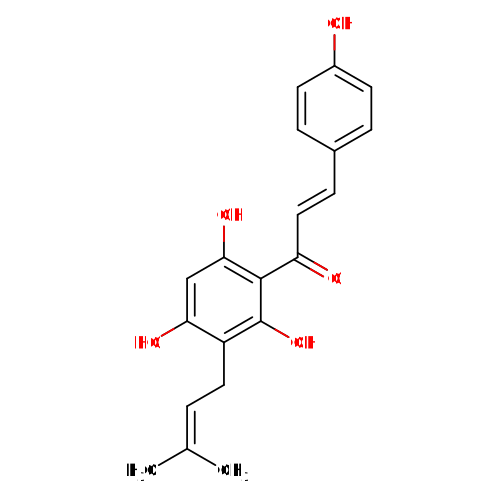
| Description | Desmethylxanthohumol belongs to the class of organic compounds known as 3-prenylated chalcones. These are chalcones featuring a C5-isoprenoid unit at the 3-position. Desmethylxanthohumol is an extremely weak basic (essentially neutral) compound (based on its pKa). Outside of the human body, Desmethylxanthohumol has been detected, but not quantified in, alcoholic beverages. This could make desmethylxanthohumol a potential biomarker for the consumption of these foods. Cinnamic acid is oxidized by cinnamate-4-hydroxylase and loaded onto Coenzyme A (CoA) by 4-coumarate CoA ligase to yield 4-hydroxy-cinnamoyl CoA, the starter unit for PKS extension. This molecule is extended three times with malonyl CoA, cyclized through a Claisen condensation, and aromatized through tautomerization to form naringenin chalcone (chalconaringenin). Xanthohumol can be extracted with pressurized hot water. L-Phenylalanine serves as the starting material, which is converted to cinnamic acid by the PLP-dependent phenylalanine ammonia lyase. During the brewing process, xanthohumol and other prenylated flavonoids are lost as they are converted to the corresponding flavanones. Xanthohumol is a prenylated chalconoid derived from a plant type III PKS, and is synthesized in the glandular trichromes of hop cones. Total syntheses of xanthohumol and derivatives have been achieved, though extraction from hops remains a primary source. desmethylxanthohumol is found in Helichrysum felinum, Helichrysum forskahlii, Humulus lupulus and Sophora flavescens. desmethylxanthohumol was first documented in 2012 (PMID: 21912858). In the case of xanthohumol, a prenyltransferase called Humulus lupulus prenyltransferase 1 (HlPT-1) attaches a molecule of dimethylallyl pyrophosphate from the DXP pathway (PMID: 23947133). |
|---|
| Structure | CC(C)=CCC1=C(O)C(C(=O)\C=C\C2=CC=C(O)C=C2)=C(O)C=C1O InChI=1S/C20H20O5/c1-12(2)3-9-15-17(23)11-18(24)19(20(15)25)16(22)10-6-13-4-7-14(21)8-5-13/h3-8,10-11,21,23-25H,9H2,1-2H3/b10-6+ |
|---|
| Synonyms | | Value | Source |
|---|
| 3-(4-Hydroxyphenyl)-1-[2,4,6-trihydroxy-3-(3-methyl-2-butenyl)phenyl]-2-propen-1-one | HMDB | | 1-(2,4-Dihydroxy-6-methoxy-3-(3-methyl-2-butenyl)phenyl)-3-(4-hydroxyphenyl)-2-propen-1-one | MeSH | | Xanthohumol | MeSH |
|
|---|
| Chemical Formula | C20H20O5 |
|---|
| Average Mass | 340.3698 Da |
|---|
| Monoisotopic Mass | 340.13107 Da |
|---|
| IUPAC Name | (2E)-3-(4-hydroxyphenyl)-1-[2,4,6-trihydroxy-3-(3-methylbut-2-en-1-yl)phenyl]prop-2-en-1-one |
|---|
| Traditional Name | desmethylxanthohumol |
|---|
| CAS Registry Number | Not Available |
|---|
| SMILES | CC(C)=CCC1=C(O)C(C(=O)\C=C\C2=CC=C(O)C=C2)=C(O)C=C1O |
|---|
| InChI Identifier | InChI=1S/C20H20O5/c1-12(2)3-9-15-17(23)11-18(24)19(20(15)25)16(22)10-6-13-4-7-14(21)8-5-13/h3-8,10-11,21,23-25H,9H2,1-2H3/b10-6+ |
|---|
| InChI Key | FUSADYLVRMROPL-UXBLZVDNSA-N |
|---|
| Experimental Spectra |
|---|
|
| Not Available | | Predicted Spectra |
|---|
|
| Not Available | | Chemical Shift Submissions |
|---|
|
| Not Available | | Species |
|---|
| Species of Origin | |
|---|
| Chemical Taxonomy |
|---|
| Description | Belongs to the class of organic compounds known as 3-prenylated chalcones. These are chalcones featuring a C5-isoprenoid unit at the 3-position. |
|---|
| Kingdom | Organic compounds |
|---|
| Super Class | Phenylpropanoids and polyketides |
|---|
| Class | Linear 1,3-diarylpropanoids |
|---|
| Sub Class | Chalcones and dihydrochalcones |
|---|
| Direct Parent | 3-prenylated chalcones |
|---|
| Alternative Parents | |
|---|
| Substituents | - 3-prenylated chalcone
- 2'-hydroxychalcone
- Cinnamylphenol
- Hydroxycinnamic acid or derivatives
- Acylphloroglucinol derivative
- Benzenetriol
- Phloroglucinol derivative
- Benzoyl
- Aryl ketone
- Styrene
- 1-hydroxy-4-unsubstituted benzenoid
- 1-hydroxy-2-unsubstituted benzenoid
- Phenol
- Monocyclic benzene moiety
- Benzenoid
- Acryloyl-group
- Vinylogous acid
- Enone
- Alpha,beta-unsaturated ketone
- Ketone
- Polyol
- Organic oxygen compound
- Hydrocarbon derivative
- Organic oxide
- Organooxygen compound
- Aromatic homomonocyclic compound
|
|---|
| Molecular Framework | Aromatic homomonocyclic compounds |
|---|
| External Descriptors | |
|---|
| Physical Properties |
|---|
| State | Not Available |
|---|
| Experimental Properties | | Property | Value | Reference |
|---|
| Melting Point | Not Available | Not Available | | Boiling Point | Not Available | Not Available | | Water Solubility | Not Available | Not Available | | LogP | Not Available | Not Available |
|
|---|
| Predicted Properties | |
|---|
| General References | - Zhang WK, Wang SB, Fu CY, Li P, Xu JK: [Flavonoids from Humulus lupulus]. Zhongguo Zhong Yao Za Zhi. 2013 May;38(10):1539-42. [PubMed:23947133 ]
- Gatica-Arias A, Farag MA, Stanke M, Matousek J, Wessjohann L, Weber G: Flavonoid production in transgenic hop (Humulus lupulus L.) altered by PAP1/MYB75 from Arabidopsis thaliana L. Plant Cell Rep. 2012 Jan;31(1):111-9. doi: 10.1007/s00299-011-1144-5. Epub 2011 Sep 13. [PubMed:21912858 ]
- LOTUS database [Link]
|
|---|