| Record Information |
|---|
| Version | 2.0 |
|---|
| Created at | 2022-09-05 22:39:51 UTC |
|---|
| Updated at | 2022-09-05 22:39:51 UTC |
|---|
| NP-MRD ID | NP0221161 |
|---|
| Secondary Accession Numbers | None |
|---|
| Natural Product Identification |
|---|
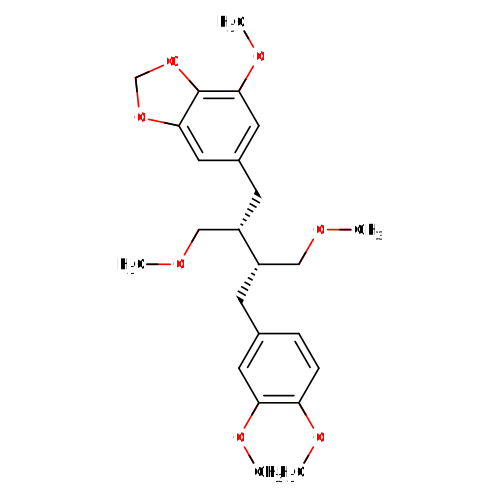
| Common Name | 6-[(2r,3r)-3-[(3,4-dimethoxyphenyl)methyl]-4-methoxy-2-(methoxymethyl)butyl]-4-methoxy-2h-1,3-benzodioxole |
|---|
| Description | Niranthin belongs to the class of organic compounds known as dibenzylbutane lignans. These are lignan compounds containing a 2,3-dibenzylbutane moiety. 6-[(2r,3r)-3-[(3,4-dimethoxyphenyl)methyl]-4-methoxy-2-(methoxymethyl)butyl]-4-methoxy-2h-1,3-benzodioxole is found in Phyllanthus amarus, Phyllanthus niruri, Phyllanthus urinaria and Phyllanthus virgatus. 6-[(2r,3r)-3-[(3,4-dimethoxyphenyl)methyl]-4-methoxy-2-(methoxymethyl)butyl]-4-methoxy-2h-1,3-benzodioxole was first documented in 2020 (PMID: 33322824). Based on a literature review a small amount of articles have been published on Niranthin (PMID: 33259591) (PMID: 33525733) (PMID: 35425482) (PMID: 34986779). |
|---|
| Structure | COC[C@H](CC1=CC=C(OC)C(OC)=C1)[C@H](COC)CC1=CC(OC)=C2OCOC2=C1 InChI=1S/C24H32O7/c1-25-13-18(8-16-6-7-20(27-3)21(10-16)28-4)19(14-26-2)9-17-11-22(29-5)24-23(12-17)30-15-31-24/h6-7,10-12,18-19H,8-9,13-15H2,1-5H3/t18-,19-/m0/s1 |
|---|
| Synonyms | Not Available |
|---|
| Chemical Formula | C24H32O7 |
|---|
| Average Mass | 432.5130 Da |
|---|
| Monoisotopic Mass | 432.21480 Da |
|---|
| IUPAC Name | 6-[(2R,3R)-3-[(3,4-dimethoxyphenyl)methyl]-4-methoxy-2-(methoxymethyl)butyl]-4-methoxy-2H-1,3-benzodioxole |
|---|
| Traditional Name | 6-[(2R,3R)-3-[(3,4-dimethoxyphenyl)methyl]-4-methoxy-2-(methoxymethyl)butyl]-4-methoxy-2H-1,3-benzodioxole |
|---|
| CAS Registry Number | Not Available |
|---|
| SMILES | COC[C@H](CC1=CC=C(OC)C(OC)=C1)[C@H](COC)CC1=CC(OC)=C2OCOC2=C1 |
|---|
| InChI Identifier | InChI=1S/C24H32O7/c1-25-13-18(8-16-6-7-20(27-3)21(10-16)28-4)19(14-26-2)9-17-11-22(29-5)24-23(12-17)30-15-31-24/h6-7,10-12,18-19H,8-9,13-15H2,1-5H3/t18-,19-/m0/s1 |
|---|
| InChI Key | RCFGIEPQSDGMJJ-OALUTQOASA-N |
|---|
| Experimental Spectra |
|---|
|
| Not Available | | Predicted Spectra |
|---|
|
| | Spectrum Type | Description | Depositor ID | Depositor Organization | Depositor | Deposition Date | View |
|---|
| 1D NMR | 13C NMR Spectrum (1D, 25 MHz, H2O, predicted) | Wishart Lab | Wishart Lab | David Wishart | 2021-06-20 | View Spectrum | | 1D NMR | 1H NMR Spectrum (1D, 100 MHz, H2O, predicted) | Wishart Lab | Wishart Lab | David Wishart | 2021-06-20 | View Spectrum | | 1D NMR | 13C NMR Spectrum (1D, 252 MHz, H2O, predicted) | Wishart Lab | Wishart Lab | David Wishart | 2021-06-20 | View Spectrum | | 1D NMR | 1H NMR Spectrum (1D, 1000 MHz, H2O, predicted) | Wishart Lab | Wishart Lab | David Wishart | 2021-06-20 | View Spectrum | | 1D NMR | 13C NMR Spectrum (1D, 50 MHz, H2O, predicted) | Wishart Lab | Wishart Lab | David Wishart | 2021-06-20 | View Spectrum | | 1D NMR | 1H NMR Spectrum (1D, 200 MHz, H2O, predicted) | Wishart Lab | Wishart Lab | David Wishart | 2021-06-20 | View Spectrum | | 1D NMR | 13C NMR Spectrum (1D, 75 MHz, H2O, predicted) | Wishart Lab | Wishart Lab | David Wishart | 2021-06-20 | View Spectrum | | 1D NMR | 1H NMR Spectrum (1D, 300 MHz, H2O, predicted) | Wishart Lab | Wishart Lab | David Wishart | 2021-06-20 | View Spectrum | | 1D NMR | 13C NMR Spectrum (1D, 101 MHz, H2O, predicted) | Wishart Lab | Wishart Lab | David Wishart | 2021-06-20 | View Spectrum | | 1D NMR | 1H NMR Spectrum (1D, 400 MHz, H2O, predicted) | Wishart Lab | Wishart Lab | David Wishart | 2021-06-20 | View Spectrum | | 1D NMR | 13C NMR Spectrum (1D, 126 MHz, H2O, predicted) | Wishart Lab | Wishart Lab | David Wishart | 2021-06-20 | View Spectrum | | 1D NMR | 1H NMR Spectrum (1D, 500 MHz, H2O, predicted) | Wishart Lab | Wishart Lab | David Wishart | 2021-06-20 | View Spectrum | | 1D NMR | 13C NMR Spectrum (1D, 151 MHz, H2O, predicted) | Wishart Lab | Wishart Lab | David Wishart | 2021-06-20 | View Spectrum | | 1D NMR | 1H NMR Spectrum (1D, 600 MHz, H2O, predicted) | Wishart Lab | Wishart Lab | David Wishart | 2021-06-20 | View Spectrum | | 1D NMR | 13C NMR Spectrum (1D, 176 MHz, H2O, predicted) | Wishart Lab | Wishart Lab | David Wishart | 2021-06-20 | View Spectrum | | 1D NMR | 1H NMR Spectrum (1D, 700 MHz, H2O, predicted) | Wishart Lab | Wishart Lab | David Wishart | 2021-06-20 | View Spectrum | | 1D NMR | 13C NMR Spectrum (1D, 201 MHz, H2O, predicted) | Wishart Lab | Wishart Lab | David Wishart | 2021-06-20 | View Spectrum | | 1D NMR | 1H NMR Spectrum (1D, 800 MHz, H2O, predicted) | Wishart Lab | Wishart Lab | David Wishart | 2021-06-20 | View Spectrum | | 1D NMR | 13C NMR Spectrum (1D, 226 MHz, H2O, predicted) | Wishart Lab | Wishart Lab | David Wishart | 2021-06-20 | View Spectrum | | 1D NMR | 1H NMR Spectrum (1D, 900 MHz, H2O, predicted) | Wishart Lab | Wishart Lab | David Wishart | 2021-06-20 | View Spectrum |
| | Chemical Shift Submissions |
|---|
|
| Not Available | | Species |
|---|
| Species of Origin | |
|---|
| Chemical Taxonomy |
|---|
| Description | Belongs to the class of organic compounds known as dibenzylbutane lignans. These are lignan compounds containing a 2,3-dibenzylbutane moiety. |
|---|
| Kingdom | Organic compounds |
|---|
| Super Class | Lignans, neolignans and related compounds |
|---|
| Class | Dibenzylbutane lignans |
|---|
| Sub Class | Not Available |
|---|
| Direct Parent | Dibenzylbutane lignans |
|---|
| Alternative Parents | |
|---|
| Substituents | - Dibenzylbutane lignan skeleton
- Dimethoxybenzene
- O-dimethoxybenzene
- Benzodioxole
- Anisole
- Phenoxy compound
- Phenol ether
- Methoxybenzene
- Alkyl aryl ether
- Benzenoid
- Monocyclic benzene moiety
- Acetal
- Ether
- Dialkyl ether
- Organoheterocyclic compound
- Oxacycle
- Organooxygen compound
- Organic oxygen compound
- Hydrocarbon derivative
- Aromatic heteropolycyclic compound
|
|---|
| Molecular Framework | Aromatic heteropolycyclic compounds |
|---|
| External Descriptors | Not Available |
|---|
| Physical Properties |
|---|
| State | Not Available |
|---|
| Experimental Properties | | Property | Value | Reference |
|---|
| Melting Point | Not Available | Not Available | | Boiling Point | Not Available | Not Available | | Water Solubility | Not Available | Not Available | | LogP | Not Available | Not Available |
|
|---|
| Predicted Properties | |
|---|
| General References | - de Oliveira MEBS, Sartoratto A, Carlos Cardoso J: In Vitro Calli Production Resulted in Different Profiles of Plant-Derived Medicinal Compounds in Phyllanthus amarus. Molecules. 2020 Dec 12;25(24):5895. doi: 10.3390/molecules25245895. [PubMed:33322824 ]
- Patel J, Nagar PS, Pal K, Singh R, Dhanani T, Patel V, Srivastava S, Kumar S: Comparative Profiling of Four Lignans (Phyllanthin, Hypophyllanthin, Nirtetralin, and Niranthin) in Nine Phyllanthus Species from India Using a Validated Reversed Phase HPLC-PDA Detection Method. J AOAC Int. 2021 May 21;104(2):485-497. doi: 10.1093/jaoacint/qsaa133. [PubMed:33259591 ]
- Abd Rani NZ, Lam KW, Jalil J, Mohamad HF, Mat Ali MS, Husain K: Mechanistic Studies of the Antiallergic Activity of Phyllanthus amarus Schum. & Thonn. and Its Compounds. Molecules. 2021 Jan 28;26(3):695. doi: 10.3390/molecules26030695. [PubMed:33525733 ]
- Ota R, Karasawa D, Oshima M, Watashi K, Shimasaki N, Nishii Y: Asymmetric total synthesis of four bioactive lignans using donor-acceptor cyclopropanes and bioassay of (-)- and (+)-niranthin against hepatitis B and influenza viruses. RSC Adv. 2022 Feb 7;12(8):4635-4639. doi: 10.1039/d2ra00499b. eCollection 2022 Feb 3. [PubMed:35425482 ]
- Chopade AR, Salunkhe VR, Patil PA, Burade MR, Somade PM, Mali SN, Pandey A: Antinociceptive Investigations of Niranthin in Complete Freund's Adjuvant-induced Chronic Pain in Mice. Recent Adv Inflamm Allergy Drug Discov. 2022 Jan 5. doi: 10.2174/2772270816666220105122956. [PubMed:34986779 ]
- LOTUS database [Link]
|
|---|