| Record Information |
|---|
| Version | 2.0 |
|---|
| Created at | 2022-09-05 21:27:42 UTC |
|---|
| Updated at | 2022-09-05 21:27:43 UTC |
|---|
| NP-MRD ID | NP0220212 |
|---|
| Secondary Accession Numbers | None |
|---|
| Natural Product Identification |
|---|
| Common Name | allocholic acid |
|---|
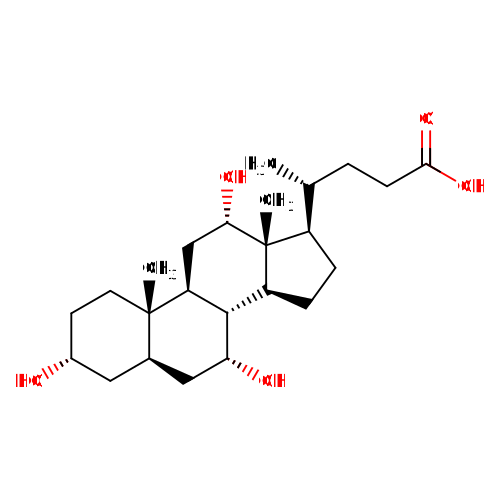
| Description | Allocholic acid, also known as allocholate or 5alpha-cholate, belongs to the class of organic compounds known as trihydroxy bile acids, alcohols and derivatives. These are prenol lipids structurally characterized by a bile acid or alcohol which bears three hydroxyl groups. allocholic acid is found in Petromyzon marinus. allocholic acid was first documented in 1962 (PMID: 14012853). Allocholic acid is a very hydrophobic molecule, practically insoluble (in water), and relatively neutral (PMID: 2079611) (PMID: 11344576) (PMID: 11041240) (PMID: 3660436) (PMID: 6825311) (PMID: 7150258). |
|---|
| Structure | [H][C@@]1(CC[C@@]2([H])[C@]3([H])[C@H](O)C[C@@]4([H])C[C@H](O)CC[C@]4(C)[C@@]3([H])C[C@H](O)[C@]12C)[C@H](C)CCC(O)=O InChI=1S/C24H40O5/c1-13(4-7-21(28)29)16-5-6-17-22-18(12-20(27)24(16,17)3)23(2)9-8-15(25)10-14(23)11-19(22)26/h13-20,22,25-27H,4-12H2,1-3H3,(H,28,29)/t13-,14-,15-,16-,17+,18+,19-,20+,22+,23+,24-/m1/s1 |
|---|
| Synonyms | | Value | Source |
|---|
| 3alpha,7alpha,12alpha-Trihydroxy-5alpha-cholanoic acid | ChEBI | | 5alpha-Cholic acid | ChEBI | | Allocholate | Kegg | | (3a,5a,7a,12a)-3,7,12-Trihydroxycholan-24-Oate | Generator | | (3a,5a,7a,12a)-3,7,12-Trihydroxycholan-24-Oic acid | Generator | | (3alpha,5alpha,7alpha,12alpha)-3,7,12-Trihydroxycholan-24-Oate | Generator | | (3Α,5α,7α,12α)-3,7,12-trihydroxycholan-24-Oate | Generator | | (3Α,5α,7α,12α)-3,7,12-trihydroxycholan-24-Oic acid | Generator | | 3a,7a,12a-Trihydroxy-5a-cholanoate | Generator | | 3a,7a,12a-Trihydroxy-5a-cholanoic acid | Generator | | 3alpha,7alpha,12alpha-Trihydroxy-5alpha-cholanoate | Generator | | 5a-Cholate | Generator | | 5a-Cholic acid | Generator | | 5alpha-Cholate | Generator | | (3alpha,5beta,7alpha,12alpha)-3,7,12-Trihydroxycholan-24-Oic acid | HMDB | | (3a,5b,7a,12a)-3,7,12-Trihydroxycholan-24-Oate | HMDB | | (3a,5b,7a,12a)-3,7,12-Trihydroxycholan-24-Oic acid | HMDB | | (3alpha,5beta,7alpha,12alpha)-3,7,12-Trihydroxycholan-24-Oate | HMDB | | (3Α,5β,7α,12α)-3,7,12-trihydroxycholan-24-Oate | HMDB | | (3Α,5β,7α,12α)-3,7,12-trihydroxycholan-24-Oic acid | HMDB | | 3a,7a,12a-Trihydroxy-5b-cholan-24-Oate | HMDB | | 3a,7a,12a-Trihydroxy-5b-cholan-24-Oic acid | HMDB | | 3a,7a,12a-Trihydroxycholanate | HMDB | | 3a,7a,12a-Trihydroxycholanic acid | HMDB | | 5alpha-Allocholic acid | HMDB | | 5Α-allocholic acid | HMDB | | Allocholic acid | HMDB |
|
|---|
| Chemical Formula | C24H40O5 |
|---|
| Average Mass | 408.5790 Da |
|---|
| Monoisotopic Mass | 408.28757 Da |
|---|
| IUPAC Name | (4R)-4-[(1S,2S,5R,7R,9R,10R,11S,14R,15R,16S)-5,9,16-trihydroxy-2,15-dimethyltetracyclo[8.7.0.0^{2,7}.0^{11,15}]heptadecan-14-yl]pentanoic acid |
|---|
| Traditional Name | (4R)-4-[(1S,2S,5R,7R,9R,10R,11S,14R,15R,16S)-5,9,16-trihydroxy-2,15-dimethyltetracyclo[8.7.0.0^{2,7}.0^{11,15}]heptadecan-14-yl]pentanoic acid |
|---|
| CAS Registry Number | Not Available |
|---|
| SMILES | [H][C@@]1(CC[C@@]2([H])[C@]3([H])[C@H](O)C[C@@]4([H])C[C@H](O)CC[C@]4(C)[C@@]3([H])C[C@H](O)[C@]12C)[C@H](C)CCC(O)=O |
|---|
| InChI Identifier | InChI=1S/C24H40O5/c1-13(4-7-21(28)29)16-5-6-17-22-18(12-20(27)24(16,17)3)23(2)9-8-15(25)10-14(23)11-19(22)26/h13-20,22,25-27H,4-12H2,1-3H3,(H,28,29)/t13-,14-,15-,16-,17+,18+,19-,20+,22+,23+,24-/m1/s1 |
|---|
| InChI Key | BHQCQFFYRZLCQQ-PGHAKIONSA-N |
|---|
| Experimental Spectra |
|---|
|
| Not Available | | Predicted Spectra |
|---|
|
| | Spectrum Type | Description | Depositor ID | Depositor Organization | Depositor | Deposition Date | View |
|---|
| 1D NMR | 13C NMR Spectrum (1D, 25 MHz, H2O, predicted) | Wishart Lab | Wishart Lab | David Wishart | 2021-06-20 | View Spectrum | | 1D NMR | 1H NMR Spectrum (1D, 100 MHz, H2O, predicted) | Wishart Lab | Wishart Lab | David Wishart | 2021-06-20 | View Spectrum | | 1D NMR | 13C NMR Spectrum (1D, 252 MHz, H2O, predicted) | Wishart Lab | Wishart Lab | David Wishart | 2021-06-20 | View Spectrum | | 1D NMR | 1H NMR Spectrum (1D, 1000 MHz, H2O, predicted) | Wishart Lab | Wishart Lab | David Wishart | 2021-06-20 | View Spectrum | | 1D NMR | 13C NMR Spectrum (1D, 50 MHz, H2O, predicted) | Wishart Lab | Wishart Lab | David Wishart | 2021-06-20 | View Spectrum | | 1D NMR | 1H NMR Spectrum (1D, 200 MHz, H2O, predicted) | Wishart Lab | Wishart Lab | David Wishart | 2021-06-20 | View Spectrum | | 1D NMR | 13C NMR Spectrum (1D, 75 MHz, H2O, predicted) | Wishart Lab | Wishart Lab | David Wishart | 2021-06-20 | View Spectrum | | 1D NMR | 1H NMR Spectrum (1D, 300 MHz, H2O, predicted) | Wishart Lab | Wishart Lab | David Wishart | 2021-06-20 | View Spectrum | | 1D NMR | 13C NMR Spectrum (1D, 101 MHz, H2O, predicted) | Wishart Lab | Wishart Lab | David Wishart | 2021-06-20 | View Spectrum | | 1D NMR | 1H NMR Spectrum (1D, 400 MHz, H2O, predicted) | Wishart Lab | Wishart Lab | David Wishart | 2021-06-20 | View Spectrum | | 1D NMR | 13C NMR Spectrum (1D, 126 MHz, H2O, predicted) | Wishart Lab | Wishart Lab | David Wishart | 2021-06-20 | View Spectrum | | 1D NMR | 1H NMR Spectrum (1D, 500 MHz, H2O, predicted) | Wishart Lab | Wishart Lab | David Wishart | 2021-06-20 | View Spectrum | | 1D NMR | 13C NMR Spectrum (1D, 151 MHz, H2O, predicted) | Wishart Lab | Wishart Lab | David Wishart | 2021-06-20 | View Spectrum | | 1D NMR | 1H NMR Spectrum (1D, 600 MHz, H2O, predicted) | Wishart Lab | Wishart Lab | David Wishart | 2021-06-20 | View Spectrum | | 1D NMR | 13C NMR Spectrum (1D, 176 MHz, H2O, predicted) | Wishart Lab | Wishart Lab | David Wishart | 2021-06-20 | View Spectrum | | 1D NMR | 1H NMR Spectrum (1D, 700 MHz, H2O, predicted) | Wishart Lab | Wishart Lab | David Wishart | 2021-06-20 | View Spectrum | | 1D NMR | 13C NMR Spectrum (1D, 201 MHz, H2O, predicted) | Wishart Lab | Wishart Lab | David Wishart | 2021-06-20 | View Spectrum | | 1D NMR | 1H NMR Spectrum (1D, 800 MHz, H2O, predicted) | Wishart Lab | Wishart Lab | David Wishart | 2021-06-20 | View Spectrum | | 1D NMR | 13C NMR Spectrum (1D, 226 MHz, H2O, predicted) | Wishart Lab | Wishart Lab | David Wishart | 2021-06-20 | View Spectrum | | 1D NMR | 1H NMR Spectrum (1D, 900 MHz, H2O, predicted) | Wishart Lab | Wishart Lab | David Wishart | 2021-06-20 | View Spectrum |
| | Chemical Shift Submissions |
|---|
|
| Not Available | | Species |
|---|
| Species of Origin | |
|---|
| Chemical Taxonomy |
|---|
| Description | Belongs to the class of organic compounds known as trihydroxy bile acids, alcohols and derivatives. These are prenol lipids structurally characterized by a bile acid or alcohol which bears three hydroxyl groups. |
|---|
| Kingdom | Organic compounds |
|---|
| Super Class | Lipids and lipid-like molecules |
|---|
| Class | Steroids and steroid derivatives |
|---|
| Sub Class | Bile acids, alcohols and derivatives |
|---|
| Direct Parent | Trihydroxy bile acids, alcohols and derivatives |
|---|
| Alternative Parents | |
|---|
| Substituents | - Trihydroxy bile acid, alcohol, or derivatives
- 3-hydroxysteroid
- 12-hydroxysteroid
- 7-hydroxysteroid
- 3-alpha-hydroxysteroid
- Hydroxysteroid
- Cyclic alcohol
- Secondary alcohol
- Carboxylic acid derivative
- Carboxylic acid
- Polyol
- Monocarboxylic acid or derivatives
- Organic oxide
- Alcohol
- Organic oxygen compound
- Hydrocarbon derivative
- Carbonyl group
- Organooxygen compound
- Aliphatic homopolycyclic compound
|
|---|
| Molecular Framework | Aliphatic homopolycyclic compounds |
|---|
| External Descriptors | |
|---|
| Physical Properties |
|---|
| State | Not Available |
|---|
| Experimental Properties | | Property | Value | Reference |
|---|
| Melting Point | Not Available | Not Available | | Boiling Point | Not Available | Not Available | | Water Solubility | Not Available | Not Available | | LogP | Not Available | Not Available |
|
|---|
| Predicted Properties | |
|---|
| General References | - Kuramoto T, Furukawa Y, Nishina T, Sugimoto T, Mahara R, Tohma M, Kihira K, Hoshita T: Identification of short side chain bile acids in urine of patients with cerebrotendinous xanthomatosis. J Lipid Res. 1990 Oct;31(10):1895-902. [PubMed:2079611 ]
- Salen G, Tint GS, Eliav B, Deering N, Mosbach EH: Increased formation of ursodeoxycholic acid in patients treated with chenodeoxycholic acid. J Clin Invest. 1974 Feb;53(2):612-21. [PubMed:11344576 ]
- Kuramoto T, Miyamoto J, Konishi M, Hoshita T, Masul T, Une M: Bile acids in porcine fetal bile. Biol Pharm Bull. 2000 Oct;23(10):1143-6. doi: 10.1248/bpb.23.1143. [PubMed:11041240 ]
- Kihira K, Shimazu K, Kuwabara M, Yoshii M, Takeuchi H, Nakano I, Ozawa S, Onuki M, Hatta Y, Hoshita T: Bile acid profiles in bile, urine, and feces of a patient with cerebrotendinous xanthomatosis. Steroids. 1986 Jul-Aug;48(1-2):109-19. doi: 10.1016/0039-128x(86)90045-0. [PubMed:3660436 ]
- Amuro Y, Hayashi E, Endo T, Higashino K, Kishimoto S: Unusual trihydroxylated bile acids in urine of patients with liver cirrhosis. Clin Chim Acta. 1983 Jan 7;127(1):61-7. doi: 10.1016/0009-8981(83)90075-x. [PubMed:6825311 ]
- Clayton PT, Muller DP, Lawson AM: The bile acid composition of gastric contents from neonates with high intestinal obstruction. Biochem J. 1982 Sep 15;206(3):489-98. doi: 10.1042/bj2060489. [PubMed:7150258 ]
- Yun SS, Scott AP, Siefkes MJ, Li W: Development and application of an ELISA for a sex pheromone released by the male sea lamprey (Petromyzon marinus L.). Gen Comp Endocrinol. 2002 Dec;129(3):163-70. doi: 10.1016/s0016-6480(02)00517-8. [PubMed:12460600 ]
- Ali SS, Farhat H, Elliott WH: Bile acids. XLIX. Allocholic acid, the major bile acid of Uromastix hardwickii. J Lipid Res. 1976 Jan;17(1):21-4. [PubMed:1255017 ]
- Goto T, Holzinger F, Hagey LR, Cerre C, Ton-Nu HT, Schteingart CD, Steinbach JH, Shneider BL, Hofmann AF: Physicochemical and physiological properties of 5alpha-cyprinol sulfate, the toxic bile salt of cyprinid fish. J Lipid Res. 2003 Sep;44(9):1643-51. doi: 10.1194/jlr.M300155-JLR200. Epub 2003 Jun 16. [PubMed:12810826 ]
- ANDERSON IG, HASLEWOOD GA: Comparative studiesof 'bile salts'. 15. The natural occurrence and preparation of allocholic acid. Biochem J. 1962 Oct;85(1):236-42. doi: 10.1042/bj0850236. [PubMed:14012853 ]
- KARAVOLAS HJ, ELLIOTT WH, HSIA SL, DOISY EA Jr, MATSCHINER JT, THAYER SA, DOISY EA: BILE ACIDS. XXII. ALLOCHOLIC ACID, A METABOLITE OF 5-ALPHA-CHOLESTAN-3-BET-A-OL IN THE RAT. J Biol Chem. 1965 Apr;240:1568-72. [PubMed:14285492 ]
- Siefkes MJ, Li W: Electrophysiological evidence for detection and discrimination of pheromonal bile acids by the olfactory epithelium of female sea lampreys ( Petromyzon marinus). J Comp Physiol A Neuroethol Sens Neural Behav Physiol. 2004 Mar;190(3):193-9. doi: 10.1007/s00359-003-0484-1. Epub 2003 Dec 20. [PubMed:14689221 ]
- Venkatachalam KV: Petromyzonol sulfate and its derivatives: the chemoattractants of the sea lamprey. Bioessays. 2005 Feb;27(2):222-8. doi: 10.1002/bies.20155. [PubMed:15666352 ]
- Fine JM, Vrieze LA, Sorensen PW: Evidence that petromyzontid lampreys employ a common migratory pheromone that is partially comprised of bile acids. J Chem Ecol. 2004 Nov;30(11):2091-110. doi: 10.1023/b:joec.0000048776.16091.b1. [PubMed:15672658 ]
- LOTUS database [Link]
|
|---|