| Record Information |
|---|
| Version | 2.0 |
|---|
| Created at | 2022-09-05 20:47:38 UTC |
|---|
| Updated at | 2022-09-05 20:47:38 UTC |
|---|
| NP-MRD ID | NP0219703 |
|---|
| Secondary Accession Numbers | None |
|---|
| Natural Product Identification |
|---|
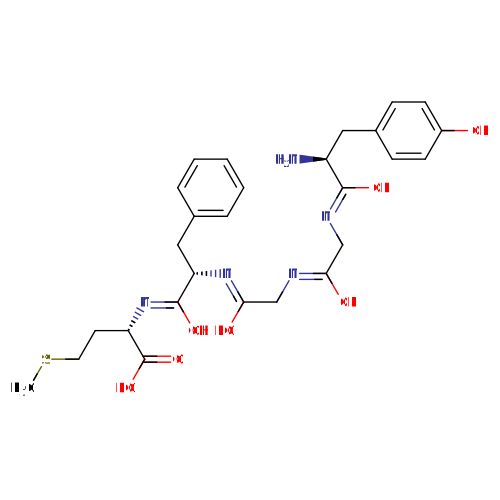
| Common Name | (2s)-2-{[(2s)-2-({2-[(2-{[(2s)-2-amino-1-hydroxy-3-(4-hydroxyphenyl)propylidene]amino}-1-hydroxyethylidene)amino]-1-hydroxyethylidene}amino)-1-hydroxy-3-phenylpropylidene]amino}-4-(methylsulfanyl)butanoic acid |
|---|
| Description | Metenkefalin belongs to the class of organic compounds known as oligopeptides. These are organic compounds containing a sequence of between three and ten alpha-amino acids joined by peptide bonds. The enkephalins are considered to be the primary endogenous ligands of the δ-opioid receptor, due to their high potency and selectivity for the site over the other endogenous opioids. Met-enkephalin is a pentapeptide with the amino acid sequence tyr-gly-gly-phe-met. Metenkefalin is a very strong basic compound (based on its pKa). Met-enkephalin has low bioavailability, is rapidly metabolized, and has a very short half-life (minutes). Met-enkephalin is found mainly in the adrenal medulla and throughout the central nervous system (CNS), including in the striatum, cerebral cortex, olfactory tubercle, hippocampus, septum, thalamus, and periaqueductal gray, as well as the dorsal horn of the spinal cord. Met-enkephalin was discovered and characterized by John Hughes, Hans Kosterlitz, et al. In 1975 after a search for endogenous ligands of the opioid receptors. It is through these receptors that met-enkephalin produces its opioid effects, such as analgesia and antidepressant-like effects. Met- and leu-enkephalin are metabolized by a variety of different enzymes, including aminopeptidase N (APN), neutral endopeptidase (NEP), dipeptidyl peptidase 3 (DPP3), carboxypeptidase A6 (CPA6), and angiotensin-converting enzyme (ACE). Proenkephalin A is first reduced by either one of two trypsin-like endopeptidase enzymes, prohormone convertase 1 (PC1) or prohormone convertase 2 (PC2); then, the resulting intermediates are further reduced by the enzyme carboxypeptidase E (CPE; previously known as enkephalin convertase (EC)). (2s)-2-{[(2s)-2-({2-[(2-{[(2s)-2-amino-1-hydroxy-3-(4-hydroxyphenyl)propylidene]amino}-1-hydroxyethylidene)amino]-1-hydroxyethylidene}amino)-1-hydroxy-3-phenylpropylidene]amino}-4-(methylsulfanyl)butanoic acid is found in Mytilus edulis. Proenkephalin A contains four sequences of met-enkephalin (at the following positions: 100–104; 107–111; 136–140; 210–214), And as a result, its cleavage generates four copies of met-enkephalin peptides at once. |
|---|
| Structure | CSCC[C@H](NC(=O)[C@H](CC1=CC=CC=C1)NC(=O)CNC(=O)CNC(=O)[C@@H](N)CC1=CC=C(O)C=C1)C(O)=O InChI=1S/C27H35N5O7S/c1-40-12-11-21(27(38)39)32-26(37)22(14-17-5-3-2-4-6-17)31-24(35)16-29-23(34)15-30-25(36)20(28)13-18-7-9-19(33)10-8-18/h2-10,20-22,33H,11-16,28H2,1H3,(H,29,34)(H,30,36)(H,31,35)(H,32,37)(H,38,39)/t20-,21-,22-/m0/s1 |
|---|
| Synonyms | | Value | Source |
|---|
| Methionine enkephalin | Kegg | | 5 Methionine enkephalin | MeSH | | Met(5)-enkephalin | MeSH | | Enkephalin, methionine | MeSH | | 5-Methionine enkephalin | MeSH | | Enkephalin, 5-methionine | MeSH | | Met enkephalin | MeSH |
|
|---|
| Chemical Formula | C27H35N5O7S |
|---|
| Average Mass | 573.6700 Da |
|---|
| Monoisotopic Mass | 573.22572 Da |
|---|
| IUPAC Name | (2S)-2-[(2S)-2-(2-{2-[(2S)-2-amino-3-(4-hydroxyphenyl)propanamido]acetamido}acetamido)-3-phenylpropanamido]-4-(methylsulfanyl)butanoic acid |
|---|
| Traditional Name | Met-enkephalin |
|---|
| CAS Registry Number | Not Available |
|---|
| SMILES | CSCC[C@H](NC(=O)[C@H](CC1=CC=CC=C1)NC(=O)CNC(=O)CNC(=O)[C@@H](N)CC1=CC=C(O)C=C1)C(O)=O |
|---|
| InChI Identifier | InChI=1S/C27H35N5O7S/c1-40-12-11-21(27(38)39)32-26(37)22(14-17-5-3-2-4-6-17)31-24(35)16-29-23(34)15-30-25(36)20(28)13-18-7-9-19(33)10-8-18/h2-10,20-22,33H,11-16,28H2,1H3,(H,29,34)(H,30,36)(H,31,35)(H,32,37)(H,38,39)/t20-,21-,22-/m0/s1 |
|---|
| InChI Key | YFGBQHOOROIVKG-FKBYEOEOSA-N |
|---|
| Experimental Spectra |
|---|
|
| Not Available | | Predicted Spectra |
|---|
|
| | Spectrum Type | Description | Depositor ID | Depositor Organization | Depositor | Deposition Date | View |
|---|
| 1D NMR | 13C NMR Spectrum (1D, 25 MHz, H2O, predicted) | Wishart Lab | Wishart Lab | David Wishart | 2021-06-20 | View Spectrum | | 1D NMR | 1H NMR Spectrum (1D, 100 MHz, H2O, predicted) | Wishart Lab | Wishart Lab | David Wishart | 2021-06-20 | View Spectrum | | 1D NMR | 13C NMR Spectrum (1D, 252 MHz, H2O, predicted) | Wishart Lab | Wishart Lab | David Wishart | 2021-06-20 | View Spectrum | | 1D NMR | 1H NMR Spectrum (1D, 1000 MHz, H2O, predicted) | Wishart Lab | Wishart Lab | David Wishart | 2021-06-20 | View Spectrum | | 1D NMR | 13C NMR Spectrum (1D, 50 MHz, H2O, predicted) | Wishart Lab | Wishart Lab | David Wishart | 2021-06-20 | View Spectrum | | 1D NMR | 1H NMR Spectrum (1D, 200 MHz, H2O, predicted) | Wishart Lab | Wishart Lab | David Wishart | 2021-06-20 | View Spectrum | | 1D NMR | 13C NMR Spectrum (1D, 75 MHz, H2O, predicted) | Wishart Lab | Wishart Lab | David Wishart | 2021-06-20 | View Spectrum | | 1D NMR | 1H NMR Spectrum (1D, 300 MHz, H2O, predicted) | Wishart Lab | Wishart Lab | David Wishart | 2021-06-20 | View Spectrum | | 1D NMR | 13C NMR Spectrum (1D, 101 MHz, H2O, predicted) | Wishart Lab | Wishart Lab | David Wishart | 2021-06-20 | View Spectrum | | 1D NMR | 1H NMR Spectrum (1D, 400 MHz, H2O, predicted) | Wishart Lab | Wishart Lab | David Wishart | 2021-06-20 | View Spectrum | | 1D NMR | 13C NMR Spectrum (1D, 126 MHz, H2O, predicted) | Wishart Lab | Wishart Lab | David Wishart | 2021-06-20 | View Spectrum | | 1D NMR | 1H NMR Spectrum (1D, 500 MHz, H2O, predicted) | Wishart Lab | Wishart Lab | David Wishart | 2021-06-20 | View Spectrum | | 1D NMR | 13C NMR Spectrum (1D, 151 MHz, H2O, predicted) | Wishart Lab | Wishart Lab | David Wishart | 2021-06-20 | View Spectrum | | 1D NMR | 1H NMR Spectrum (1D, 600 MHz, H2O, predicted) | Wishart Lab | Wishart Lab | David Wishart | 2021-06-20 | View Spectrum | | 1D NMR | 13C NMR Spectrum (1D, 176 MHz, H2O, predicted) | Wishart Lab | Wishart Lab | David Wishart | 2021-06-20 | View Spectrum | | 1D NMR | 1H NMR Spectrum (1D, 700 MHz, H2O, predicted) | Wishart Lab | Wishart Lab | David Wishart | 2021-06-20 | View Spectrum | | 1D NMR | 13C NMR Spectrum (1D, 201 MHz, H2O, predicted) | Wishart Lab | Wishart Lab | David Wishart | 2021-06-20 | View Spectrum | | 1D NMR | 1H NMR Spectrum (1D, 800 MHz, H2O, predicted) | Wishart Lab | Wishart Lab | David Wishart | 2021-06-20 | View Spectrum | | 1D NMR | 13C NMR Spectrum (1D, 226 MHz, H2O, predicted) | Wishart Lab | Wishart Lab | David Wishart | 2021-06-20 | View Spectrum | | 1D NMR | 1H NMR Spectrum (1D, 900 MHz, H2O, predicted) | Wishart Lab | Wishart Lab | David Wishart | 2021-06-20 | View Spectrum |
| | Chemical Shift Submissions |
|---|
|
| Not Available | | Species |
|---|
| Species of Origin | |
|---|
| Chemical Taxonomy |
|---|
| Description | Belongs to the class of organic compounds known as oligopeptides. These are organic compounds containing a sequence of between three and ten alpha-amino acids joined by peptide bonds. |
|---|
| Kingdom | Organic compounds |
|---|
| Super Class | Organic acids and derivatives |
|---|
| Class | Carboxylic acids and derivatives |
|---|
| Sub Class | Amino acids, peptides, and analogues |
|---|
| Direct Parent | Oligopeptides |
|---|
| Alternative Parents | |
|---|
| Substituents | - Alpha-oligopeptide
- Tyrosine or derivatives
- Phenylalanine or derivatives
- Methionine or derivatives
- N-acyl-alpha amino acid or derivatives
- N-acyl-alpha-amino acid
- N-acyl-l-alpha-amino acid
- Alpha-amino acid amide
- N-substituted-alpha-amino acid
- Alpha-amino acid or derivatives
- Amphetamine or derivatives
- 1-hydroxy-2-unsubstituted benzenoid
- Phenol
- Aralkylamine
- Hydroxy fatty acid
- Thia fatty acid
- Fatty acyl
- Monocyclic benzene moiety
- Benzenoid
- Fatty amide
- Secondary carboxylic acid amide
- Amino acid or derivatives
- Amino acid
- Carboxamide group
- Dialkylthioether
- Sulfenyl compound
- Carboxylic acid
- Thioether
- Monocarboxylic acid or derivatives
- Primary amine
- Amine
- Organopnictogen compound
- Organic oxygen compound
- Carbonyl group
- Organic nitrogen compound
- Hydrocarbon derivative
- Primary aliphatic amine
- Organic oxide
- Organosulfur compound
- Organooxygen compound
- Organonitrogen compound
- Aromatic homomonocyclic compound
|
|---|
| Molecular Framework | Aromatic homomonocyclic compounds |
|---|
| External Descriptors | |
|---|
| Physical Properties |
|---|
| State | Not Available |
|---|
| Experimental Properties | | Property | Value | Reference |
|---|
| Melting Point | Not Available | Not Available | | Boiling Point | Not Available | Not Available | | Water Solubility | Not Available | Not Available | | LogP | Not Available | Not Available |
|
|---|
| Predicted Properties | |
|---|