| Record Information |
|---|
| Version | 2.0 |
|---|
| Created at | 2022-09-05 17:36:47 UTC |
|---|
| Updated at | 2022-09-05 17:36:47 UTC |
|---|
| NP-MRD ID | NP0217303 |
|---|
| Secondary Accession Numbers | None |
|---|
| Natural Product Identification |
|---|
| Common Name | erythrosine |
|---|
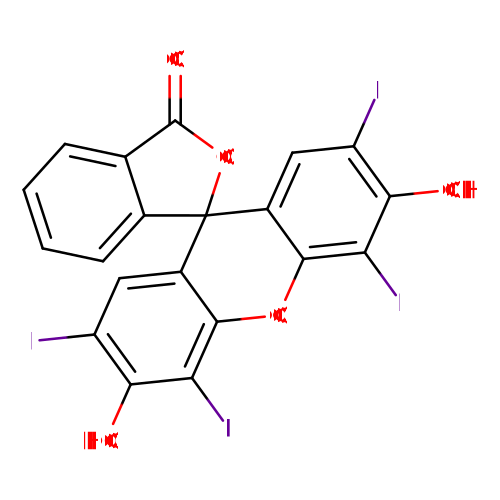
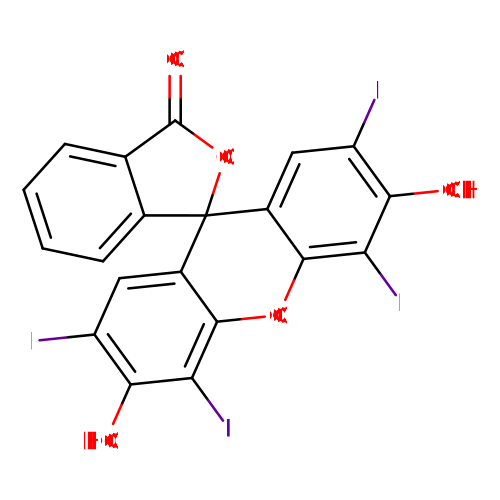
| Description | Erythrosine, also known as iodeosin or E127, belongs to the class of organic compounds known as xanthenes. These are polycyclic aromatic compounds containing a xanthene moiety, which consists of two benzene rings joined to each other by a pyran ring. While commonly used in most countries of the world, erythrosine is rarely used in the United States due to its known hazards, with Allura Red AC (Red #40) being generally used instead. It is also used to color pistachio shells. It is the disodium salt of 2,4,5,7-tetraiodofluorescein. Erythrosine is an extremely weak basic (essentially neutral) compound (based on its pKa). Its maximum absorbance is at 530 nm in an aqueous solution, and it is subject to photodegradation. It is commonly used in sweets and foods marketed to children such as cake icing and cake-decorating gels. ; It is used as a food coloring, in printing inks, as a biological stain, a dental plaque disclosing agent and a radiopaque medium. Erythrosine is a dye used in food and feed additives. Prohibited in U.S.A. erythrosine is found in Dianthus superbus. erythrosine was first documented in 2010 (PMID: 21180961). And Norway Erythrosine is a cherry-pink synthetic fluorone food coloring. |
|---|
| Structure | OC1=C(I)C2=C(C=C1I)C1(OC(=O)C3=C1C=CC=C3)C1=CC(I)=C(O)C(I)=C1O2 InChI=1S/C20H8I4O5/c21-11-5-9-17(13(23)15(11)25)28-18-10(6-12(22)16(26)14(18)24)20(9)8-4-2-1-3-7(8)19(27)29-20/h1-6,25-26H |
|---|
| Synonyms | | Value | Source |
|---|
| e127 | HMDB | | 2',4',5',7'-Tetraiodofluorescein | HMDB | | 2, 4,5,7-Tetraiodofluorescein | HMDB | | 2,4,5,7-Erythrosin | HMDB | | 2,4,5,7-Tetraiodofluorescein | HMDB | | 3',6'-Dihydroxy-2',4',5',7'-tetraiodospiro[isobenzofuran-1(3H),9'(9H)-xanthen]-3-one, 9ci | HMDB | | Aizen erythrosine | HMDB | | C.I. 45430 | HMDB | | C.I. acid red 51 | HMDB | | C.I. FOOD red 14 | HMDB | | Ceplac | HMDB | | Cogilor orange 211.10 | HMDB | | Cogilor orange 312.42 | HMDB | | Dianthine b | HMDB | | Erythrosine acid | HMDB | | Erythrosine, phenolic | HMDB | | FD And C red no. 3 | HMDB | | Felumin | HMDB | | FOOD Red no. 3 | HMDB | | Iodeosin | HMDB | | Iodeosine b | HMDB | | Iodofluorescein | HMDB | | Pyrosine b | HMDB | | Red 1427 | HMDB | | Tetraiodofluorescein | HMDB | | Trace | HMDB | | Erythrosin | MeSH | | FDC Red no. 3 | MeSH | | Erythrosin b | MeSH | | Erythrosine | MeSH | | Erythrosine b | MeSH | | F D And C #3 | MeSH |
|
|---|
| Chemical Formula | C20H8I4O5 |
|---|
| Average Mass | 835.8924 Da |
|---|
| Monoisotopic Mass | 835.65505 Da |
|---|
| IUPAC Name | 3',6'-dihydroxy-2',4',5',7'-tetraiodo-3H-spiro[2-benzofuran-1,9'-xanthene]-3-one |
|---|
| Traditional Name | erythrosine |
|---|
| CAS Registry Number | Not Available |
|---|
| SMILES | OC1=C(I)C2=C(C=C1I)C1(OC(=O)C3=C1C=CC=C3)C1=CC(I)=C(O)C(I)=C1O2 |
|---|
| InChI Identifier | InChI=1S/C20H8I4O5/c21-11-5-9-17(13(23)15(11)25)28-18-10(6-12(22)16(26)14(18)24)20(9)8-4-2-1-3-7(8)19(27)29-20/h1-6,25-26H |
|---|
| InChI Key | OALHHIHQOFIMEF-UHFFFAOYSA-N |
|---|
| Experimental Spectra |
|---|
|
| Not Available | | Predicted Spectra |
|---|
|
| Not Available | | Chemical Shift Submissions |
|---|
|
| Not Available | | Species |
|---|
| Species of Origin | |
|---|
| Chemical Taxonomy |
|---|
| Description | Belongs to the class of organic compounds known as xanthenes. These are polycyclic aromatic compounds containing a xanthene moiety, which consists of two benzene rings joined to each other by a pyran ring. |
|---|
| Kingdom | Organic compounds |
|---|
| Super Class | Organoheterocyclic compounds |
|---|
| Class | Benzopyrans |
|---|
| Sub Class | 1-benzopyrans |
|---|
| Direct Parent | Xanthenes |
|---|
| Alternative Parents | |
|---|
| Substituents | - Xanthene
- Diaryl ether
- Isobenzofuranone
- Benzofuranone
- Phthalide
- Isocoumaran
- Isobenzofuran
- 2-iodophenol
- Benzenoid
- Aryl halide
- Aryl iodide
- Carboxylic acid ester
- Lactone
- Oxacycle
- Carboxylic acid derivative
- Ether
- Monocarboxylic acid or derivatives
- Organic oxygen compound
- Organohalogen compound
- Organoiodide
- Organooxygen compound
- Hydrocarbon derivative
- Organic oxide
- Aromatic heteropolycyclic compound
|
|---|
| Molecular Framework | Aromatic heteropolycyclic compounds |
|---|
| External Descriptors | Not Available |
|---|
| Physical Properties |
|---|
| State | Not Available |
|---|
| Experimental Properties | | Property | Value | Reference |
|---|
| Melting Point | Not Available | Not Available | | Boiling Point | Not Available | Not Available | | Water Solubility | Not Available | Not Available | | LogP | Not Available | Not Available |
|
|---|
| Predicted Properties | |
|---|
| General References | - Costa AC, Chibebe Junior J, Pereira CA, Machado AK, Beltrame Junior M, Junqueira JC, Jorge AO: Susceptibility of planktonic cultures of Streptococcus mutans to photodynamic therapy with a light-emitting diode. Braz Oral Res. 2010 Oct-Dec;24(4):413-8. doi: 10.1590/s1806-83242010000400007. [PubMed:21180961 ]
- LOTUS database [Link]
|
|---|