| Record Information |
|---|
| Version | 2.0 |
|---|
| Created at | 2022-09-05 15:49:36 UTC |
|---|
| Updated at | 2022-09-05 15:49:36 UTC |
|---|
| NP-MRD ID | NP0216018 |
|---|
| Secondary Accession Numbers | None |
|---|
| Natural Product Identification |
|---|
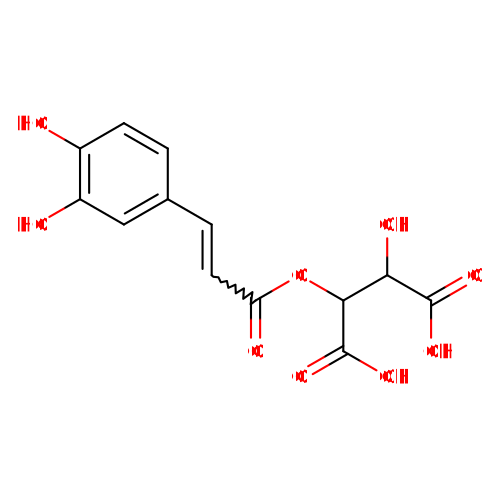
| Common Name | 2-{[3-(3,4-dihydroxyphenyl)prop-2-enoyl]oxy}-3-hydroxybutanedioic acid |
|---|
| Description | Trans-caftaric acid belongs to the class of organic compounds known as coumaric acids and derivatives. These are aromatic compounds containing Aromatic compounds containing a cinnamic acid moiety (or a derivative thereof) hydroxylated at the C2 (ortho-), C3 (meta-), or C4 (para-) carbon atom of the benzene ring. Intact trans-caftaric acid was detected in rat plasma along with its O-methylated derivative trans-fertaric acid. Trans-caftaric acid is an extremely weak basic (essentially neutral) compound (based on its pKa). Grape reaction product (2-S glutathionyl caftaric acid) is an oxidation compound produced from caftaric acid and found in wine. Caftaric acid is a non-flavanoid phenolic compound. Malvidin 3-glucoside alone is not oxidized in the presence of grape polyphenol oxidase (PPO), whereas it is degraded in the presence of a crude grape PPO extract and of caftaric acid, forming anthocyanidin-caftaric acid adducts. Aside from wine, it is abundantly present in raisins. Caftaric acid has a good bioavailability when fed in rats. Winemakers measure caftaric acid levels as their primary method to estimate the oxidation levels that a wine has undergone. For example, press wines, which undergo a high degree of oxidation, will have little to no caftaric acid. Caffeic acid is susceptible to chemical oxidation, and subsequent redox reactions involving caffeic acid can contribute to wine browning over time, and the straw-gold color that can develop in some white wines after bottling. 2-{[3-(3,4-dihydroxyphenyl)prop-2-enoyl]oxy}-3-hydroxybutanedioic acid is found in Vitis vinifera. It is an esterified phenolic acid, composed of caffeic acid, a hydroxycinnamate produced by plants, and tartaric acid, the principal organic acid found in grape berries. |
|---|
| Structure | OC(C(OC(=O)C=CC1=CC=C(O)C(O)=C1)C(O)=O)C(O)=O InChI=1S/C13H12O9/c14-7-3-1-6(5-8(7)15)2-4-9(16)22-11(13(20)21)10(17)12(18)19/h1-5,10-11,14-15,17H,(H,18,19)(H,20,21) |
|---|
| Synonyms | | Value | Source |
|---|
| trans-Caftarate | Generator | | 2-{[3-(3,4-dihydroxyphenyl)prop-2-enoyl]oxy}-3-hydroxybutanedioate | Generator |
|
|---|
| Chemical Formula | C13H12O9 |
|---|
| Average Mass | 312.2300 Da |
|---|
| Monoisotopic Mass | 312.04813 Da |
|---|
| IUPAC Name | 2-{[3-(3,4-dihydroxyphenyl)prop-2-enoyl]oxy}-3-hydroxybutanedioic acid |
|---|
| Traditional Name | 2-{[3-(3,4-dihydroxyphenyl)prop-2-enoyl]oxy}-3-hydroxybutanedioic acid |
|---|
| CAS Registry Number | Not Available |
|---|
| SMILES | OC(C(OC(=O)C=CC1=CC=C(O)C(O)=C1)C(O)=O)C(O)=O |
|---|
| InChI Identifier | InChI=1S/C13H12O9/c14-7-3-1-6(5-8(7)15)2-4-9(16)22-11(13(20)21)10(17)12(18)19/h1-5,10-11,14-15,17H,(H,18,19)(H,20,21) |
|---|
| InChI Key | SWGKAHCIOQPKFW-UHFFFAOYSA-N |
|---|
| Experimental Spectra |
|---|
|
| Not Available | | Predicted Spectra |
|---|
|
| | Spectrum Type | Description | Depositor ID | Depositor Organization | Depositor | Deposition Date | View |
|---|
| 1D NMR | 13C NMR Spectrum (1D, 25 MHz, H2O, predicted) | Wishart Lab | Wishart Lab | David Wishart | 2021-06-20 | View Spectrum | | 1D NMR | 1H NMR Spectrum (1D, 100 MHz, H2O, predicted) | Wishart Lab | Wishart Lab | David Wishart | 2021-06-20 | View Spectrum | | 1D NMR | 13C NMR Spectrum (1D, 252 MHz, H2O, predicted) | Wishart Lab | Wishart Lab | David Wishart | 2021-06-20 | View Spectrum | | 1D NMR | 1H NMR Spectrum (1D, 1000 MHz, H2O, predicted) | Wishart Lab | Wishart Lab | David Wishart | 2021-06-20 | View Spectrum | | 1D NMR | 13C NMR Spectrum (1D, 50 MHz, H2O, predicted) | Wishart Lab | Wishart Lab | David Wishart | 2021-06-20 | View Spectrum | | 1D NMR | 1H NMR Spectrum (1D, 200 MHz, H2O, predicted) | Wishart Lab | Wishart Lab | David Wishart | 2021-06-20 | View Spectrum | | 1D NMR | 13C NMR Spectrum (1D, 75 MHz, H2O, predicted) | Wishart Lab | Wishart Lab | David Wishart | 2021-06-20 | View Spectrum | | 1D NMR | 1H NMR Spectrum (1D, 300 MHz, H2O, predicted) | Wishart Lab | Wishart Lab | David Wishart | 2021-06-20 | View Spectrum | | 1D NMR | 13C NMR Spectrum (1D, 101 MHz, H2O, predicted) | Wishart Lab | Wishart Lab | David Wishart | 2021-06-20 | View Spectrum | | 1D NMR | 1H NMR Spectrum (1D, 400 MHz, H2O, predicted) | Wishart Lab | Wishart Lab | David Wishart | 2021-06-20 | View Spectrum | | 1D NMR | 13C NMR Spectrum (1D, 126 MHz, H2O, predicted) | Wishart Lab | Wishart Lab | David Wishart | 2021-06-20 | View Spectrum | | 1D NMR | 1H NMR Spectrum (1D, 500 MHz, H2O, predicted) | Wishart Lab | Wishart Lab | David Wishart | 2021-06-20 | View Spectrum | | 1D NMR | 13C NMR Spectrum (1D, 151 MHz, H2O, predicted) | Wishart Lab | Wishart Lab | David Wishart | 2021-06-20 | View Spectrum | | 1D NMR | 1H NMR Spectrum (1D, 600 MHz, H2O, predicted) | Wishart Lab | Wishart Lab | David Wishart | 2021-06-20 | View Spectrum | | 1D NMR | 13C NMR Spectrum (1D, 176 MHz, H2O, predicted) | Wishart Lab | Wishart Lab | David Wishart | 2021-06-20 | View Spectrum | | 1D NMR | 1H NMR Spectrum (1D, 700 MHz, H2O, predicted) | Wishart Lab | Wishart Lab | David Wishart | 2021-06-20 | View Spectrum | | 1D NMR | 13C NMR Spectrum (1D, 201 MHz, H2O, predicted) | Wishart Lab | Wishart Lab | David Wishart | 2021-06-20 | View Spectrum | | 1D NMR | 1H NMR Spectrum (1D, 800 MHz, H2O, predicted) | Wishart Lab | Wishart Lab | David Wishart | 2021-06-20 | View Spectrum | | 1D NMR | 13C NMR Spectrum (1D, 226 MHz, H2O, predicted) | Wishart Lab | Wishart Lab | David Wishart | 2021-06-20 | View Spectrum | | 1D NMR | 1H NMR Spectrum (1D, 900 MHz, H2O, predicted) | Wishart Lab | Wishart Lab | David Wishart | 2021-06-20 | View Spectrum |
| | Chemical Shift Submissions |
|---|
|
| Not Available | | Species |
|---|
| Species of Origin | |
|---|
| Chemical Taxonomy |
|---|
| Description | Belongs to the class of organic compounds known as coumaric acids and derivatives. These are aromatic compounds containing Aromatic compounds containing a cinnamic acid moiety (or a derivative thereof) hydroxylated at the C2 (ortho-), C3 (meta-), or C4 (para-) carbon atom of the benzene ring. |
|---|
| Kingdom | Organic compounds |
|---|
| Super Class | Phenylpropanoids and polyketides |
|---|
| Class | Cinnamic acids and derivatives |
|---|
| Sub Class | Hydroxycinnamic acids and derivatives |
|---|
| Direct Parent | Coumaric acids and derivatives |
|---|
| Alternative Parents | |
|---|
| Substituents | - Cinnamic acid ester
- Coumaric acid or derivatives
- Tricarboxylic acid or derivatives
- Styrene
- Catechol
- 1-hydroxy-2-unsubstituted benzenoid
- 1-hydroxy-4-unsubstituted benzenoid
- Sugar acid
- Fatty acid ester
- Phenol
- Beta-hydroxy acid
- Fatty acyl
- Benzenoid
- Hydroxy acid
- Alpha-hydroxy acid
- Monosaccharide
- Monocyclic benzene moiety
- Alpha,beta-unsaturated carboxylic ester
- Enoate ester
- Carboxylic acid ester
- Secondary alcohol
- Carboxylic acid
- Carboxylic acid derivative
- Organic oxygen compound
- Alcohol
- Carbonyl group
- Hydrocarbon derivative
- Organic oxide
- Organooxygen compound
- Aromatic homomonocyclic compound
|
|---|
| Molecular Framework | Aromatic homomonocyclic compounds |
|---|
| External Descriptors | Not Available |
|---|
| Physical Properties |
|---|
| State | Not Available |
|---|
| Experimental Properties | | Property | Value | Reference |
|---|
| Melting Point | Not Available | Not Available | | Boiling Point | Not Available | Not Available | | Water Solubility | Not Available | Not Available | | LogP | Not Available | Not Available |
|
|---|
| Predicted Properties | |
|---|