| Record Information |
|---|
| Version | 2.0 |
|---|
| Created at | 2022-09-05 11:47:57 UTC |
|---|
| Updated at | 2022-09-05 11:47:57 UTC |
|---|
| NP-MRD ID | NP0212972 |
|---|
| Secondary Accession Numbers | None |
|---|
| Natural Product Identification |
|---|
| Common Name | chlorothalonil |
|---|
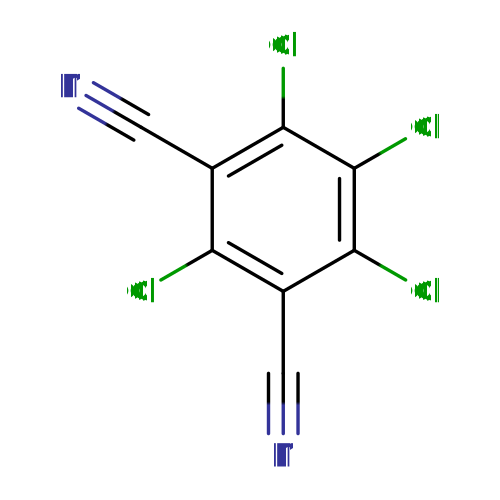
| Description | Chlorothalonil, also known as daconil or TPN, belongs to the class of organic compounds known as benzonitriles. These are organic compounds containing a benzene bearing a nitrile substituent. Chlorothalonil is possibly neutral. Chlorothalonil is formally rated as a possible carcinogen (by IARC 2B) and is also a potentially toxic compound. Cyanide is also known produce some of its toxic effects by binding to catalase, glutathione peroxidase, methemoglobin, hydroxocobalamin, phosphatase, tyrosinase, ascorbic acid oxidase, xanthine oxidase, succinic dehydrogenase, and Cu/Zn superoxide dismutase. It is used predominantly on peanuts, potatoes, and tomatoes. Cyanide metabolites are excreted in the urine. Antidotes to cyanide poisoning include hydroxocobalamin and sodium nitrite, which release the cyanide from the cytochrome system, and rhodanase, which is an enzyme occurring naturally in mammals that combines serum cyanide with thiosulfate, producing comparatively harmless thiocyanate. chlorothalonil is found in Curcuma longa. chlorothalonil was first documented in 2000 (PMID: 11016668). Chronic inhalation of cyanide causes breathing difficulties, chest pain, vomiting, blood changes, headaches, and enlargement of the thyroid gland (PMID: 14575671) (PMID: 17482661) (PMID: 23116300) (PMID: 23866729). |
|---|
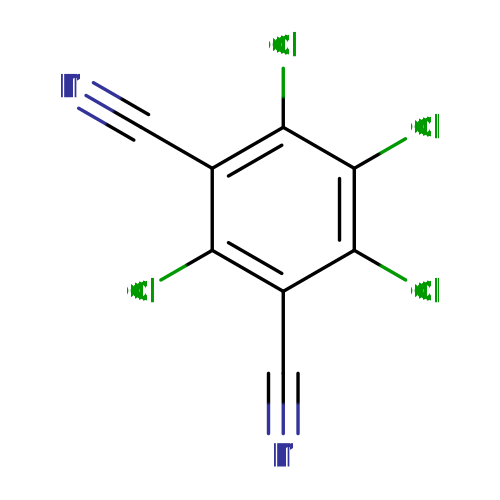
| Structure | ClC1=C(Cl)C(C#N)=C(Cl)C(C#N)=C1Cl InChI=1S/C8Cl4N2/c9-5-3(1-13)6(10)8(12)7(11)4(5)2-14 |
|---|
| Synonyms | | Value | Source |
|---|
| 1,3-Dicyanotetrachlorobenzene | ChEBI | | 2,4,5,6-Tetrachloro-3-cyanobenzonitrile | ChEBI | | Daconil | ChEBI | | m-TCPN | ChEBI | | m-Tetrachlorophthalonitrile | ChEBI | | Meta-TCPN | ChEBI | | Meta-tetrachlorophthalodinitrile | ChEBI | | Tetrachloroisophthalonitrile | ChEBI | | TPN | ChEBI | | Hydroxychlorothalonil | MeSH | | Bravo | MeSH |
|
|---|
| Chemical Formula | C8Cl4N2 |
|---|
| Average Mass | 265.9110 Da |
|---|
| Monoisotopic Mass | 263.88156 Da |
|---|
| IUPAC Name | tetrachlorobenzene-1,3-dicarbonitrile |
|---|
| Traditional Name | chlorothalonil |
|---|
| CAS Registry Number | Not Available |
|---|
| SMILES | ClC1=C(Cl)C(C#N)=C(Cl)C(C#N)=C1Cl |
|---|
| InChI Identifier | InChI=1S/C8Cl4N2/c9-5-3(1-13)6(10)8(12)7(11)4(5)2-14 |
|---|
| InChI Key | CRQQGFGUEAVUIL-UHFFFAOYSA-N |
|---|
| Experimental Spectra |
|---|
|
| | Spectrum Type | Description | Depositor Email | Depositor Organization | Depositor | Deposition Date | View |
|---|
| 1D NMR | 13C NMR Spectrum (1D, 25.16 MHz, DMSO-d6, experimental) | Wishart Lab | Wishart Lab | David Wishart | 2021-06-20 | View Spectrum |
| | Predicted Spectra |
|---|
|
| Not Available | | Chemical Shift Submissions |
|---|
|
| Not Available | | Species |
|---|
| Species of Origin | |
|---|
| Chemical Taxonomy |
|---|
| Description | Belongs to the class of organic compounds known as benzonitriles. These are organic compounds containing a benzene bearing a nitrile substituent. |
|---|
| Kingdom | Organic compounds |
|---|
| Super Class | Benzenoids |
|---|
| Class | Benzene and substituted derivatives |
|---|
| Sub Class | Benzonitriles |
|---|
| Direct Parent | Benzonitriles |
|---|
| Alternative Parents | |
|---|
| Substituents | - Benzonitrile
- Halobenzene
- Chlorobenzene
- Aryl halide
- Aryl chloride
- Nitrile
- Carbonitrile
- Organic nitrogen compound
- Organopnictogen compound
- Hydrocarbon derivative
- Organonitrogen compound
- Organochloride
- Organohalogen compound
- Aromatic homomonocyclic compound
|
|---|
| Molecular Framework | Aromatic homomonocyclic compounds |
|---|
| External Descriptors | |
|---|
| Physical Properties |
|---|
| State | Not Available |
|---|
| Experimental Properties | | Property | Value | Reference |
|---|
| Melting Point | Not Available | Not Available | | Boiling Point | Not Available | Not Available | | Water Solubility | Not Available | Not Available | | LogP | Not Available | Not Available |
|
|---|
| Predicted Properties | |
|---|
| General References | - Boman A, Montelius J, Rissanen RL, Liden C: Sensitizing potential of chlorothalonil in the guinea pig and the mouse. Contact Dermatitis. 2000 Nov;43(5):273-9. doi: 10.1034/j.1600-0536.2000.043005273.x. [PubMed:11016668 ]
- Sherrard RM, Murray-Gulde CL, Rodgers JH Jr, Shah YT: Comparative toxicity of chlorothalonil: Ceriodaphnia dubia and Pimephales promelas. Ecotoxicol Environ Saf. 2003 Nov;56(3):327-33. doi: 10.1016/s0147-6513(02)00073-8. [PubMed:14575671 ]
- Hernandez-Hernandez CN, Valle-Mora J, Santiesteban-Hernandez A, Bello-Mendoza R: Comparative ecological risks of pesticides used in plantation production of papaya: application of the SYNOPS indicator. Sci Total Environ. 2007 Aug 1;381(1-3):112-25. doi: 10.1016/j.scitotenv.2007.03.014. Epub 2007 May 7. [PubMed:17482661 ]
- Peruga A, Barreda M, Beltran J, Hernandez F: A robust GC-MS/MS method for the determination of chlorothalonil in fruits and vegetables. Food Addit Contam Part A Chem Anal Control Expo Risk Assess. 2013;30(2):298-307. doi: 10.1080/19440049.2012.738369. Epub 2012 Nov 1. [PubMed:23116300 ]
- Yu S, Wages MR, Cobb GP, Maul JD: Effects of chlorothalonil on development and growth of amphibian embryos and larvae. Environ Pollut. 2013 Oct;181:329-34. doi: 10.1016/j.envpol.2013.06.017. Epub 2013 Jul 16. [PubMed:23866729 ]
- LOTUS database [Link]
|
|---|