| Record Information |
|---|
| Version | 2.0 |
|---|
| Created at | 2022-09-05 09:05:43 UTC |
|---|
| Updated at | 2022-09-05 09:05:43 UTC |
|---|
| NP-MRD ID | NP0211012 |
|---|
| Secondary Accession Numbers | None |
|---|
| Natural Product Identification |
|---|
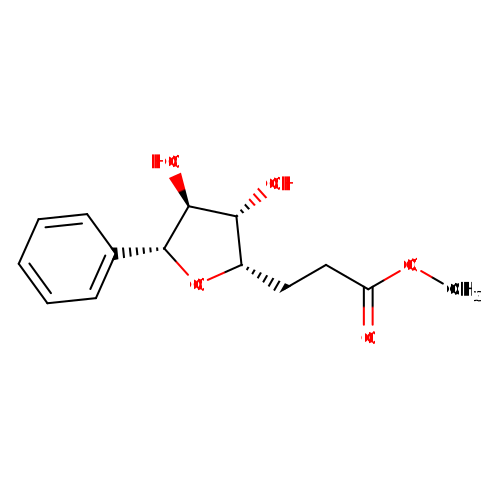
| Common Name | methyl 3-[(2s,3s,4s,5r)-3,4-dihydroxy-5-phenyloxolan-2-yl]propanoate |
|---|
| Description | (+)-Goniothalesdiol belongs to the class of organic compounds known as phenolic glycosides. These are organic compounds containing a phenolic structure attached to a glycosyl moiety. Some examples of phenolic structures include lignans, and flavonoids. Among the sugar units found in natural glycosides are D-glucose, L-Fructose, and L rhamnose. methyl 3-[(2s,3s,4s,5r)-3,4-dihydroxy-5-phenyloxolan-2-yl]propanoate is found in Goniothalamus borneensis. methyl 3-[(2s,3s,4s,5r)-3,4-dihydroxy-5-phenyloxolan-2-yl]propanoate was first documented in 2004 (PMID: 15058944). Based on a literature review a significant number of articles have been published on (+)-Goniothalesdiol (PMID: 16819228) (PMID: 25865074) (PMID: 21243696) (PMID: 20297827) (PMID: 16626158) (PMID: 16288545). |
|---|
| Structure | COC(=O)CC[C@@H]1O[C@@H]([C@@H](O)[C@@H]1O)C1=CC=CC=C1 InChI=1S/C14H18O5/c1-18-11(15)8-7-10-12(16)13(17)14(19-10)9-5-3-2-4-6-9/h2-6,10,12-14,16-17H,7-8H2,1H3/t10-,12+,13-,14+/m0/s1 |
|---|
| Synonyms | | Value | Source |
|---|
| Goniothalesdiol | MeSH |
|
|---|
| Chemical Formula | C14H18O5 |
|---|
| Average Mass | 266.2930 Da |
|---|
| Monoisotopic Mass | 266.11542 Da |
|---|
| IUPAC Name | methyl 3-[(2S,3S,4S,5R)-3,4-dihydroxy-5-phenyloxolan-2-yl]propanoate |
|---|
| Traditional Name | methyl 3-[(2S,3S,4S,5R)-3,4-dihydroxy-5-phenyloxolan-2-yl]propanoate |
|---|
| CAS Registry Number | Not Available |
|---|
| SMILES | COC(=O)CC[C@@H]1O[C@@H]([C@@H](O)[C@@H]1O)C1=CC=CC=C1 |
|---|
| InChI Identifier | InChI=1S/C14H18O5/c1-18-11(15)8-7-10-12(16)13(17)14(19-10)9-5-3-2-4-6-9/h2-6,10,12-14,16-17H,7-8H2,1H3/t10-,12+,13-,14+/m0/s1 |
|---|
| InChI Key | RUDVTXZKYPJLFH-AHLTXXRQSA-N |
|---|
| Experimental Spectra |
|---|
|
| Not Available | | Predicted Spectra |
|---|
|
| | Spectrum Type | Description | Depositor ID | Depositor Organization | Depositor | Deposition Date | View |
|---|
| 1D NMR | 13C NMR Spectrum (1D, 25 MHz, H2O, predicted) | Wishart Lab | Wishart Lab | David Wishart | 2021-06-20 | View Spectrum | | 1D NMR | 1H NMR Spectrum (1D, 100 MHz, H2O, predicted) | Wishart Lab | Wishart Lab | David Wishart | 2021-06-20 | View Spectrum | | 1D NMR | 13C NMR Spectrum (1D, 252 MHz, H2O, predicted) | Wishart Lab | Wishart Lab | David Wishart | 2021-06-20 | View Spectrum | | 1D NMR | 1H NMR Spectrum (1D, 1000 MHz, H2O, predicted) | Wishart Lab | Wishart Lab | David Wishart | 2021-06-20 | View Spectrum | | 1D NMR | 13C NMR Spectrum (1D, 50 MHz, H2O, predicted) | Wishart Lab | Wishart Lab | David Wishart | 2021-06-20 | View Spectrum | | 1D NMR | 1H NMR Spectrum (1D, 200 MHz, H2O, predicted) | Wishart Lab | Wishart Lab | David Wishart | 2021-06-20 | View Spectrum | | 1D NMR | 13C NMR Spectrum (1D, 75 MHz, H2O, predicted) | Wishart Lab | Wishart Lab | David Wishart | 2021-06-20 | View Spectrum | | 1D NMR | 1H NMR Spectrum (1D, 300 MHz, H2O, predicted) | Wishart Lab | Wishart Lab | David Wishart | 2021-06-20 | View Spectrum | | 1D NMR | 13C NMR Spectrum (1D, 101 MHz, H2O, predicted) | Wishart Lab | Wishart Lab | David Wishart | 2021-06-20 | View Spectrum | | 1D NMR | 1H NMR Spectrum (1D, 400 MHz, H2O, predicted) | Wishart Lab | Wishart Lab | David Wishart | 2021-06-20 | View Spectrum | | 1D NMR | 13C NMR Spectrum (1D, 126 MHz, H2O, predicted) | Wishart Lab | Wishart Lab | David Wishart | 2021-06-20 | View Spectrum | | 1D NMR | 1H NMR Spectrum (1D, 500 MHz, H2O, predicted) | Wishart Lab | Wishart Lab | David Wishart | 2021-06-20 | View Spectrum | | 1D NMR | 13C NMR Spectrum (1D, 151 MHz, H2O, predicted) | Wishart Lab | Wishart Lab | David Wishart | 2021-06-20 | View Spectrum | | 1D NMR | 1H NMR Spectrum (1D, 600 MHz, H2O, predicted) | Wishart Lab | Wishart Lab | David Wishart | 2021-06-20 | View Spectrum | | 1D NMR | 13C NMR Spectrum (1D, 176 MHz, H2O, predicted) | Wishart Lab | Wishart Lab | David Wishart | 2021-06-20 | View Spectrum | | 1D NMR | 1H NMR Spectrum (1D, 700 MHz, H2O, predicted) | Wishart Lab | Wishart Lab | David Wishart | 2021-06-20 | View Spectrum | | 1D NMR | 13C NMR Spectrum (1D, 201 MHz, H2O, predicted) | Wishart Lab | Wishart Lab | David Wishart | 2021-06-20 | View Spectrum | | 1D NMR | 1H NMR Spectrum (1D, 800 MHz, H2O, predicted) | Wishart Lab | Wishart Lab | David Wishart | 2021-06-20 | View Spectrum | | 1D NMR | 13C NMR Spectrum (1D, 226 MHz, H2O, predicted) | Wishart Lab | Wishart Lab | David Wishart | 2021-06-20 | View Spectrum | | 1D NMR | 1H NMR Spectrum (1D, 900 MHz, H2O, predicted) | Wishart Lab | Wishart Lab | David Wishart | 2021-06-20 | View Spectrum |
| | Chemical Shift Submissions |
|---|
|
| Not Available | | Species |
|---|
| Species of Origin | |
|---|
| Chemical Taxonomy |
|---|
| Description | Belongs to the class of organic compounds known as phenolic glycosides. These are organic compounds containing a phenolic structure attached to a glycosyl moiety. Some examples of phenolic structures include lignans, and flavonoids. Among the sugar units found in natural glycosides are D-glucose, L-Fructose, and L rhamnose. |
|---|
| Kingdom | Organic compounds |
|---|
| Super Class | Organic oxygen compounds |
|---|
| Class | Organooxygen compounds |
|---|
| Sub Class | Carbohydrates and carbohydrate conjugates |
|---|
| Direct Parent | Phenolic glycosides |
|---|
| Alternative Parents | |
|---|
| Substituents | - Phenolic glycoside
- C-glycosyl compound
- Pentose monosaccharide
- Fatty acid ester
- Monocyclic benzene moiety
- Fatty acyl
- Benzenoid
- Monosaccharide
- Methyl ester
- Oxolane
- 1,2-diol
- Carboxylic acid ester
- Secondary alcohol
- Oxacycle
- Carboxylic acid derivative
- Organoheterocyclic compound
- Dialkyl ether
- Ether
- Monocarboxylic acid or derivatives
- Alcohol
- Hydrocarbon derivative
- Organic oxide
- Carbonyl group
- Aromatic heteromonocyclic compound
|
|---|
| Molecular Framework | Aromatic heteromonocyclic compounds |
|---|
| External Descriptors | Not Available |
|---|
| Physical Properties |
|---|
| State | Not Available |
|---|
| Experimental Properties | | Property | Value | Reference |
|---|
| Melting Point | Not Available | Not Available | | Boiling Point | Not Available | Not Available | | Water Solubility | Not Available | Not Available | | LogP | Not Available | Not Available |
|
|---|
| Predicted Properties | |
|---|
| General References | - Lan YH, Chang FR, Yang YL, Wu YC: New constituents from stems of Goniothalamus amuyon. Chem Pharm Bull (Tokyo). 2006 Jul;54(7):1040-3. doi: 10.1248/cpb.54.1040. [PubMed:16819228 ]
- Suchaichit N, Kanokmedhakul K, Panthama N, Poopasit K, Moosophon P, Kanokmedhakul S: A 2H-tetrahydropyran derivative and bioactive constituents from the bark of Goniothalamus elegants Ast. Fitoterapia. 2015 Jun;103:206-12. doi: 10.1016/j.fitote.2015.04.005. Epub 2015 Apr 10. [PubMed:25865074 ]
- Hernandez-Torres G, Carreno MC, Urbano A, Colobert F: The effect of sulfoxides on the stereoselective construction of tetrahydrofurans: total synthesis of (+)-goniothalesdiol. Chemistry. 2011 Jan 24;17(4):1283-93. doi: 10.1002/chem.201002637. Epub 2010 Dec 10. [PubMed:21243696 ]
- Kang B, Chang S, Decker S, Britton R: Regioselective and stereoselective cyclizations of chloropolyols in water: rapid synthesis of hydroxytetrahydrofurans. Org Lett. 2010 Apr 16;12(8):1716-9. doi: 10.1021/ol100260z. [PubMed:20297827 ]
- Prasad KR, Gholap SL: Stereoselective synthesis of (+)-goniothalesdiol. J Org Chem. 2006 Apr 28;71(9):3643-5. doi: 10.1021/jo060159f. [PubMed:16626158 ]
- Carreno MC, Hernandez-Torres G, Urbano A, Colobert F: Total stereoselective synthesis of (+)-goniothalesdiol. Org Lett. 2005 Nov 24;7(24):5517-20. doi: 10.1021/ol0523603. [PubMed:16288545 ]
- Murga J, Ruiz P, Falomir E, Carda M, Peris G, Marco JA: Stereoselective anti aldol reactions of erythrulose derivatives. Functionalized chiral d3 and d4 synthons. J Org Chem. 2004 Mar 19;69(6):1987-92. doi: 10.1021/jo0356356. [PubMed:15058944 ]
- LOTUS database [Link]
|
|---|