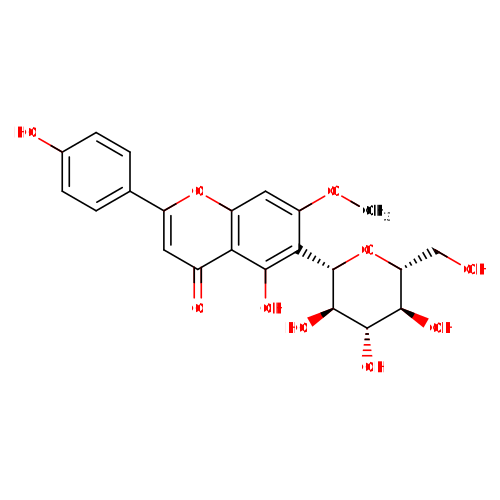
| Record Information |
|---|
| Version | 2.0 |
|---|
| Created at | 2022-09-05 08:49:25 UTC |
|---|
| Updated at | 2022-09-05 08:49:25 UTC |
|---|
| NP-MRD ID | NP0210830 |
|---|
| Secondary Accession Numbers | None |
|---|
| Natural Product Identification |
|---|
| Common Name | 5-hydroxy-2-(4-hydroxyphenyl)-7-methoxy-6-[(2s,3r,4r,5s,6r)-3,4,5-trihydroxy-6-(hydroxymethyl)oxan-2-yl]chromen-4-one |
|---|
| Description | Swertisin, also known as flavocommelitin, belongs to the class of organic compounds known as flavonoid c-glycosides. Flavonoid C-glycosides are compounds containing a carbohydrate moiety which is C-glycosidically linked to the 2-phenylchromen-4-one flavonoid backbone. Thus, swertisin is considered to be a flavonoid. Swertisin is a secondary metabolite. Secondary metabolites are metabolically or physiologically non-essential metabolites that may serve a role as defense or signalling molecules. In some cases they are simply molecules that arise from the incomplete metabolism of other secondary metabolites. 5-hydroxy-2-(4-hydroxyphenyl)-7-methoxy-6-[(2s,3r,4r,5s,6r)-3,4,5-trihydroxy-6-(hydroxymethyl)oxan-2-yl]chromen-4-one is found in Aleurites moluccanus, Alliaria petiolata, Aquilegia oxysepala, Carex fraseriana, Echinodorus grandiflorus, Gaillardia aristata, Gaillardia pulchella, Galipea trifoliata, Gentiana algida, Gentiana brachyphylla, Gentianella austriaca, Gnetum gnemon, Iris germanica, Iris gracilipes, Justicia pectoralis, Justicia ramosa, Knautia montana, Lophatherum gracile, Machaerium isadelphum, Passiflora biflora, Passiflora incarnata, Saccharum officinarum, Swertia japonica, Swertia mussotii, Swertia paniculata, Swertia tetrapetala, Syzygium cumini, Triticum aestivum, Wilbrandia ebracteata and Ziziphus jujuba. 5-hydroxy-2-(4-hydroxyphenyl)-7-methoxy-6-[(2s,3r,4r,5s,6r)-3,4,5-trihydroxy-6-(hydroxymethyl)oxan-2-yl]chromen-4-one was first documented in 2021 (PMID: 34634740). Based on a literature review a small amount of articles have been published on swertisin (PMID: 35855584) (PMID: 35843397) (PMID: 35655066) (PMID: 35528477). |
|---|
| Structure | COC1=C([C@@H]2O[C@H](CO)[C@@H](O)[C@H](O)[C@H]2O)C(O)=C2C(=O)C=C(OC2=C1)C1=CC=C(O)C=C1 InChI=1S/C22H22O10/c1-30-13-7-14-16(11(25)6-12(31-14)9-2-4-10(24)5-3-9)19(27)17(13)22-21(29)20(28)18(26)15(8-23)32-22/h2-7,15,18,20-24,26-29H,8H2,1H3/t15-,18-,20+,21-,22+/m1/s1 |
|---|
| Synonyms | | Value | Source |
|---|
| 5,4'-Dihydroxy-7-methoxy-6-C-beta-D-glucopyranosyl flavonoside | ChEBI | | 6-beta-D-Glucopyranosyl-4',5-dihydroxy-7-methoxyflavone | ChEBI | | 6-beta-D-Glucopyranosyl-5-hydroxy-2-(4-hydroxyphenyl)-7-methoxy-4H-1-benzopyran-4-one | ChEBI | | 6-C-Glucopyranosyl-7-O-methylapigenin | ChEBI | | 7-O-Methyl-6-C-beta-D-glucopyranosylapigenin | ChEBI | | 7-O-Methylapigenin 6-C-beta-D-glucopyranoside | ChEBI | | Flavocommelitin | ChEBI | | 5,4'-Dihydroxy-7-methoxy-6-C-b-D-glucopyranosyl flavonoside | Generator | | 5,4'-Dihydroxy-7-methoxy-6-C-β-D-glucopyranosyl flavonoside | Generator | | 6-b-D-Glucopyranosyl-4',5-dihydroxy-7-methoxyflavone | Generator | | 6-Β-D-glucopyranosyl-4',5-dihydroxy-7-methoxyflavone | Generator | | 6-b-D-Glucopyranosyl-5-hydroxy-2-(4-hydroxyphenyl)-7-methoxy-4H-1-benzopyran-4-one | Generator | | 6-Β-D-glucopyranosyl-5-hydroxy-2-(4-hydroxyphenyl)-7-methoxy-4H-1-benzopyran-4-one | Generator | | 7-O-Methyl-6-C-b-D-glucopyranosylapigenin | Generator | | 7-O-Methyl-6-C-β-D-glucopyranosylapigenin | Generator | | 7-O-Methylapigenin 6-C-b-D-glucopyranoside | Generator | | 7-O-Methylapigenin 6-C-β-D-glucopyranoside | Generator |
|
|---|
| Chemical Formula | C22H22O10 |
|---|
| Average Mass | 446.4080 Da |
|---|
| Monoisotopic Mass | 446.12130 Da |
|---|
| IUPAC Name | 5-hydroxy-2-(4-hydroxyphenyl)-7-methoxy-6-[(2S,3R,4R,5S,6R)-3,4,5-trihydroxy-6-(hydroxymethyl)oxan-2-yl]-4H-chromen-4-one |
|---|
| Traditional Name | 5-hydroxy-2-(4-hydroxyphenyl)-7-methoxy-6-[(2S,3R,4R,5S,6R)-3,4,5-trihydroxy-6-(hydroxymethyl)oxan-2-yl]chromen-4-one |
|---|
| CAS Registry Number | Not Available |
|---|
| SMILES | COC1=C([C@@H]2O[C@H](CO)[C@@H](O)[C@H](O)[C@H]2O)C(O)=C2C(=O)C=C(OC2=C1)C1=CC=C(O)C=C1 |
|---|
| InChI Identifier | InChI=1S/C22H22O10/c1-30-13-7-14-16(11(25)6-12(31-14)9-2-4-10(24)5-3-9)19(27)17(13)22-21(29)20(28)18(26)15(8-23)32-22/h2-7,15,18,20-24,26-29H,8H2,1H3/t15-,18-,20+,21-,22+/m1/s1 |
|---|
| InChI Key | ABRULANJVVJLFI-DGHBBABESA-N |
|---|
| Experimental Spectra |
|---|
|
| Not Available | | Predicted Spectra |
|---|
|
| | Spectrum Type | Description | Depositor ID | Depositor Organization | Depositor | Deposition Date | View |
|---|
| 1D NMR | 13C NMR Spectrum (1D, 25 MHz, H2O, predicted) | Wishart Lab | Wishart Lab | David Wishart | 2021-06-20 | View Spectrum | | 1D NMR | 1H NMR Spectrum (1D, 100 MHz, H2O, predicted) | Wishart Lab | Wishart Lab | David Wishart | 2021-06-20 | View Spectrum | | 1D NMR | 13C NMR Spectrum (1D, 252 MHz, H2O, predicted) | Wishart Lab | Wishart Lab | David Wishart | 2021-06-20 | View Spectrum | | 1D NMR | 1H NMR Spectrum (1D, 1000 MHz, H2O, predicted) | Wishart Lab | Wishart Lab | David Wishart | 2021-06-20 | View Spectrum | | 1D NMR | 13C NMR Spectrum (1D, 50 MHz, H2O, predicted) | Wishart Lab | Wishart Lab | David Wishart | 2021-06-20 | View Spectrum | | 1D NMR | 1H NMR Spectrum (1D, 200 MHz, H2O, predicted) | Wishart Lab | Wishart Lab | David Wishart | 2021-06-20 | View Spectrum | | 1D NMR | 13C NMR Spectrum (1D, 75 MHz, H2O, predicted) | Wishart Lab | Wishart Lab | David Wishart | 2021-06-20 | View Spectrum | | 1D NMR | 1H NMR Spectrum (1D, 300 MHz, H2O, predicted) | Wishart Lab | Wishart Lab | David Wishart | 2021-06-20 | View Spectrum | | 1D NMR | 13C NMR Spectrum (1D, 101 MHz, H2O, predicted) | Wishart Lab | Wishart Lab | David Wishart | 2021-06-20 | View Spectrum | | 1D NMR | 1H NMR Spectrum (1D, 400 MHz, H2O, predicted) | Wishart Lab | Wishart Lab | David Wishart | 2021-06-20 | View Spectrum | | 1D NMR | 13C NMR Spectrum (1D, 126 MHz, H2O, predicted) | Wishart Lab | Wishart Lab | David Wishart | 2021-06-20 | View Spectrum | | 1D NMR | 1H NMR Spectrum (1D, 500 MHz, H2O, predicted) | Wishart Lab | Wishart Lab | David Wishart | 2021-06-20 | View Spectrum | | 1D NMR | 13C NMR Spectrum (1D, 151 MHz, H2O, predicted) | Wishart Lab | Wishart Lab | David Wishart | 2021-06-20 | View Spectrum | | 1D NMR | 1H NMR Spectrum (1D, 600 MHz, H2O, predicted) | Wishart Lab | Wishart Lab | David Wishart | 2021-06-20 | View Spectrum | | 1D NMR | 13C NMR Spectrum (1D, 176 MHz, H2O, predicted) | Wishart Lab | Wishart Lab | David Wishart | 2021-06-20 | View Spectrum | | 1D NMR | 1H NMR Spectrum (1D, 700 MHz, H2O, predicted) | Wishart Lab | Wishart Lab | David Wishart | 2021-06-20 | View Spectrum | | 1D NMR | 13C NMR Spectrum (1D, 201 MHz, H2O, predicted) | Wishart Lab | Wishart Lab | David Wishart | 2021-06-20 | View Spectrum | | 1D NMR | 1H NMR Spectrum (1D, 800 MHz, H2O, predicted) | Wishart Lab | Wishart Lab | David Wishart | 2021-06-20 | View Spectrum | | 1D NMR | 13C NMR Spectrum (1D, 226 MHz, H2O, predicted) | Wishart Lab | Wishart Lab | David Wishart | 2021-06-20 | View Spectrum | | 1D NMR | 1H NMR Spectrum (1D, 900 MHz, H2O, predicted) | Wishart Lab | Wishart Lab | David Wishart | 2021-06-20 | View Spectrum |
| | Chemical Shift Submissions |
|---|
|
| Not Available | | Species |
|---|
| Species of Origin | |
|---|
| Chemical Taxonomy |
|---|
| Description | Belongs to the class of organic compounds known as flavonoid c-glycosides. Flavonoid C-glycosides are compounds containing a carbohydrate moiety which is C-glycosidically linked to the 2-phenylchromen-4-one flavonoid backbone. |
|---|
| Kingdom | Organic compounds |
|---|
| Super Class | Phenylpropanoids and polyketides |
|---|
| Class | Flavonoids |
|---|
| Sub Class | Flavonoid glycosides |
|---|
| Direct Parent | Flavonoid C-glycosides |
|---|
| Alternative Parents | |
|---|
| Substituents | - Flavonoid c-glycoside
- 7-methoxyflavonoid-skeleton
- Hydroxyflavonoid
- 4'-hydroxyflavonoid
- 5-hydroxyflavonoid
- Flavone
- Phenolic glycoside
- Hexose monosaccharide
- Glycosyl compound
- Chromone
- C-glycosyl compound
- 1-benzopyran
- Benzopyran
- Anisole
- Alkyl aryl ether
- Pyranone
- 1-hydroxy-4-unsubstituted benzenoid
- Phenol
- 1-hydroxy-2-unsubstituted benzenoid
- Monocyclic benzene moiety
- Benzenoid
- Pyran
- Oxane
- Monosaccharide
- Vinylogous acid
- Heteroaromatic compound
- Secondary alcohol
- Ether
- Dialkyl ether
- Organoheterocyclic compound
- Oxacycle
- Polyol
- Hydrocarbon derivative
- Organic oxide
- Organic oxygen compound
- Primary alcohol
- Alcohol
- Organooxygen compound
- Aromatic heteropolycyclic compound
|
|---|
| Molecular Framework | Aromatic heteropolycyclic compounds |
|---|
| External Descriptors | Not Available |
|---|
| Physical Properties |
|---|
| State | Not Available |
|---|
| Experimental Properties | | Property | Value | Reference |
|---|
| Melting Point | Not Available | Not Available | | Boiling Point | Not Available | Not Available | | Water Solubility | Not Available | Not Available | | LogP | Not Available | Not Available |
|
|---|
| Predicted Properties | |
|---|
| General References | - Hu Y, Liu L, Wang Z, Jiang CP, Zhu Z, Li H, Zeng Q, Xue Y, Wu Y, Wang Y, Yi Y, Zhu H, Shen C, Liu Q: Network pharmacology, molecular docking and in vivo and in vitro experiments to explore the molecular mechanism of licorice green tea beverage to scavenge oxygen free radicals. J Food Biochem. 2022 Oct;46(10):e14315. doi: 10.1111/jfbc.14315. Epub 2022 Jul 19. [PubMed:35855584 ]
- Sadeghi M, Miroliaei M, Ghanadian M: Inhibitory effect of flavonoid glycosides on digestive enzymes: In silico, in vitro, and in vivo studies. Int J Biol Macromol. 2022 Sep 30;217:714-730. doi: 10.1016/j.ijbiomac.2022.07.086. Epub 2022 Jul 14. [PubMed:35843397 ]
- Liu H, Zhang X, Liu Y, Xin N, Deng Y, Li Y: Semen Ziziphi Spinosae attenuates blood-brain barrier dysfunction induced by lipopolysaccharide by targeting the FAK-DOCK180-Rac1-WAVE2-Arp3 signaling pathway. NPJ Sci Food. 2022 Jun 2;6(1):27. doi: 10.1038/s41538-022-00142-6. [PubMed:35655066 ]
- Fernandes DC, Martins BP, Silva GPD, Fonseca END, Santos SVM, Velozo LSM, Gayer CRM, Sabino KCC, Coelho MGP: Echinodorus macrophyllus fraction with a high level of flavonoid inhibits peripheral and central mechanisms of nociception. J Tradit Complement Med. 2021 Jul 15;12(2):123-130. doi: 10.1016/j.jtcme.2021.07.001. eCollection 2022 Mar. [PubMed:35528477 ]
- Zhu Y, Wang W, Liu Z, Jiang S, Tao Y, Jiang L, Mei L: Comprehensive screening and separation of cyclooxygenase-2 inhibitors from Pterocephalus hookeri by affinity solid-phase extraction coupled with preparative high-performance liquid chromatography. J Chromatogr B Analyt Technol Biomed Life Sci. 2021 Oct 15;1183:122981. doi: 10.1016/j.jchromb.2021.122981. Epub 2021 Oct 6. [PubMed:34634740 ]
- LOTUS database [Link]
|
|---|