| Record Information |
|---|
| Version | 2.0 |
|---|
| Created at | 2022-09-05 07:38:02 UTC |
|---|
| Updated at | 2022-09-05 07:38:02 UTC |
|---|
| NP-MRD ID | NP0209997 |
|---|
| Secondary Accession Numbers | None |
|---|
| Natural Product Identification |
|---|
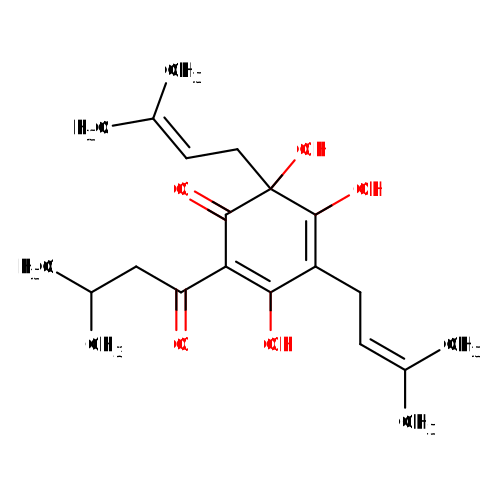
| Common Name | 3,5,6-trihydroxy-4,6-bis(3-methylbut-2-en-1-yl)-2-(3-methylbutanoyl)cyclohexa-2,4-dien-1-one |
|---|
| Description | Humulone, also known as alpha bitter acid, belongs to the class of organic compounds known as acyloins. These are organic compounds containing an alpha hydroxy ketone. Acyloins are formally derived from reductive coupling of carboxylic acyl groups. Humulone is an extremely weak basic (essentially neutral) compound (based on its pKa). This conversion yields the benzenoid 3-methyl-1-(2,4,6-trihydroxyphenyl)butan-1-one. Two side-chains are prenyl groups and one is an isovaleryl group. Antimicrobial properties of humulone are antiviral and antibacterial. These “alpha acids” survive the boiling process, although numerous oxidized derivatives are produced. During the brewing process, humulone degrades to cis- and trans-isohumulone. In terms of structure, humulone is a phloroglucinol derivative with three isoprenoid side-chains. Humulone (α-lupulic acid), a vinylogous type of organic acid, is a bitter-tasting chemical compound found in the resin of mature hops (Humulus lupulus). As determined by INADEQUATE 2D NMR, the biosynthesis of humulone in Humulus lupulus starts with an isovaleryl-CoA unit and 3 malonyl-CoA units catalyzed by phlorovalerophenone synthase. This step is followed by prenylation with 1-bromo-3-methyl-2-butene to give humulone. 3,5,6-trihydroxy-4,6-bis(3-methylbut-2-en-1-yl)-2-(3-methylbutanoyl)cyclohexa-2,4-dien-1-one is found in Humulus lupulus. Humulone can be synthesized by the acylation of 1,2,3,5-benzenetetrol with isovaleryl chloride to give 2,3,4,6-tetrahydroxyisovalerophenone. |
|---|
| Structure | CC(C)CC(=O)C1=C(O)C(CC=C(C)C)=C(O)C(O)(CC=C(C)C)C1=O InChI=1S/C21H30O5/c1-12(2)7-8-15-18(23)17(16(22)11-14(5)6)20(25)21(26,19(15)24)10-9-13(3)4/h7,9,14,23-24,26H,8,10-11H2,1-6H3 |
|---|
| Synonyms | | Value | Source |
|---|
| 3,5,6-Trihydroxy-4-isovaleryl-2,6-bis(3-methyl-2-butenyl)-2,4-cyclohexadiene-1-one | MeSH | | alpha Bitter acid | MeSH | | Humulon | MeSH | | Humulone | MeSH |
|
|---|
| Chemical Formula | C21H30O5 |
|---|
| Average Mass | 362.4660 Da |
|---|
| Monoisotopic Mass | 362.20932 Da |
|---|
| IUPAC Name | 3,5,6-trihydroxy-4,6-bis(3-methylbut-2-en-1-yl)-2-(3-methylbutanoyl)cyclohexa-2,4-dien-1-one |
|---|
| Traditional Name | 3,5,6-trihydroxy-4,6-bis(3-methylbut-2-en-1-yl)-2-(3-methylbutanoyl)cyclohexa-2,4-dien-1-one |
|---|
| CAS Registry Number | Not Available |
|---|
| SMILES | CC(C)CC(=O)C1=C(O)C(CC=C(C)C)=C(O)C(O)(CC=C(C)C)C1=O |
|---|
| InChI Identifier | InChI=1S/C21H30O5/c1-12(2)7-8-15-18(23)17(16(22)11-14(5)6)20(25)21(26,19(15)24)10-9-13(3)4/h7,9,14,23-24,26H,8,10-11H2,1-6H3 |
|---|
| InChI Key | VMSLCPKYRPDHLN-UHFFFAOYSA-N |
|---|
| Experimental Spectra |
|---|
|
| Not Available | | Predicted Spectra |
|---|
|
| | Spectrum Type | Description | Depositor ID | Depositor Organization | Depositor | Deposition Date | View |
|---|
| 1D NMR | 13C NMR Spectrum (1D, 25 MHz, H2O, predicted) | Wishart Lab | Wishart Lab | David Wishart | 2021-06-20 | View Spectrum | | 1D NMR | 1H NMR Spectrum (1D, 100 MHz, H2O, predicted) | Wishart Lab | Wishart Lab | David Wishart | 2021-06-20 | View Spectrum | | 1D NMR | 13C NMR Spectrum (1D, 252 MHz, H2O, predicted) | Wishart Lab | Wishart Lab | David Wishart | 2021-06-20 | View Spectrum | | 1D NMR | 1H NMR Spectrum (1D, 1000 MHz, H2O, predicted) | Wishart Lab | Wishart Lab | David Wishart | 2021-06-20 | View Spectrum | | 1D NMR | 13C NMR Spectrum (1D, 50 MHz, H2O, predicted) | Wishart Lab | Wishart Lab | David Wishart | 2021-06-20 | View Spectrum | | 1D NMR | 1H NMR Spectrum (1D, 200 MHz, H2O, predicted) | Wishart Lab | Wishart Lab | David Wishart | 2021-06-20 | View Spectrum | | 1D NMR | 13C NMR Spectrum (1D, 75 MHz, H2O, predicted) | Wishart Lab | Wishart Lab | David Wishart | 2021-06-20 | View Spectrum | | 1D NMR | 1H NMR Spectrum (1D, 300 MHz, H2O, predicted) | Wishart Lab | Wishart Lab | David Wishart | 2021-06-20 | View Spectrum | | 1D NMR | 13C NMR Spectrum (1D, 101 MHz, H2O, predicted) | Wishart Lab | Wishart Lab | David Wishart | 2021-06-20 | View Spectrum | | 1D NMR | 1H NMR Spectrum (1D, 400 MHz, H2O, predicted) | Wishart Lab | Wishart Lab | David Wishart | 2021-06-20 | View Spectrum | | 1D NMR | 13C NMR Spectrum (1D, 126 MHz, H2O, predicted) | Wishart Lab | Wishart Lab | David Wishart | 2021-06-20 | View Spectrum | | 1D NMR | 1H NMR Spectrum (1D, 500 MHz, H2O, predicted) | Wishart Lab | Wishart Lab | David Wishart | 2021-06-20 | View Spectrum | | 1D NMR | 13C NMR Spectrum (1D, 151 MHz, H2O, predicted) | Wishart Lab | Wishart Lab | David Wishart | 2021-06-20 | View Spectrum | | 1D NMR | 1H NMR Spectrum (1D, 600 MHz, H2O, predicted) | Wishart Lab | Wishart Lab | David Wishart | 2021-06-20 | View Spectrum | | 1D NMR | 13C NMR Spectrum (1D, 176 MHz, H2O, predicted) | Wishart Lab | Wishart Lab | David Wishart | 2021-06-20 | View Spectrum | | 1D NMR | 1H NMR Spectrum (1D, 700 MHz, H2O, predicted) | Wishart Lab | Wishart Lab | David Wishart | 2021-06-20 | View Spectrum | | 1D NMR | 13C NMR Spectrum (1D, 201 MHz, H2O, predicted) | Wishart Lab | Wishart Lab | David Wishart | 2021-06-20 | View Spectrum | | 1D NMR | 1H NMR Spectrum (1D, 800 MHz, H2O, predicted) | Wishart Lab | Wishart Lab | David Wishart | 2021-06-20 | View Spectrum | | 1D NMR | 13C NMR Spectrum (1D, 226 MHz, H2O, predicted) | Wishart Lab | Wishart Lab | David Wishart | 2021-06-20 | View Spectrum | | 1D NMR | 1H NMR Spectrum (1D, 900 MHz, H2O, predicted) | Wishart Lab | Wishart Lab | David Wishart | 2021-06-20 | View Spectrum |
| | Chemical Shift Submissions |
|---|
|
| Not Available | | Species |
|---|
| Species of Origin | |
|---|
| Chemical Taxonomy |
|---|
| Description | Belongs to the class of organic compounds known as acyloins. These are organic compounds containing an alpha hydroxy ketone. Acyloins are formally derived from reductive coupling of carboxylic acyl groups. |
|---|
| Kingdom | Organic compounds |
|---|
| Super Class | Organic oxygen compounds |
|---|
| Class | Organooxygen compounds |
|---|
| Sub Class | Carbonyl compounds |
|---|
| Direct Parent | Acyloins |
|---|
| Alternative Parents | |
|---|
| Substituents | - Acyloin
- Vinylogous acid
- Tertiary alcohol
- Cyclic ketone
- Ketone
- Polyol
- Enol
- Organic oxide
- Hydrocarbon derivative
- Alcohol
- Aliphatic homomonocyclic compound
|
|---|
| Molecular Framework | Aliphatic homomonocyclic compounds |
|---|
| External Descriptors | Not Available |
|---|
| Physical Properties |
|---|
| State | Not Available |
|---|
| Experimental Properties | | Property | Value | Reference |
|---|
| Melting Point | Not Available | Not Available | | Boiling Point | Not Available | Not Available | | Water Solubility | Not Available | Not Available | | LogP | Not Available | Not Available |
|
|---|
| Predicted Properties | |
|---|