| Record Information |
|---|
| Version | 2.0 |
|---|
| Created at | 2022-09-04 23:56:32 UTC |
|---|
| Updated at | 2022-09-04 23:56:32 UTC |
|---|
| NP-MRD ID | NP0204297 |
|---|
| Secondary Accession Numbers | None |
|---|
| Natural Product Identification |
|---|
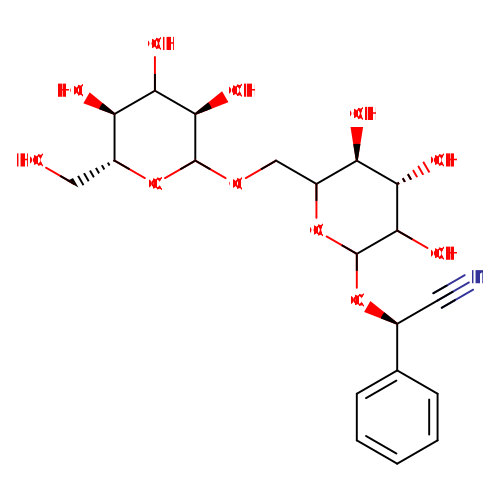
| Common Name | (2r)-2-phenyl-2-{[(4s,5s)-3,4,5-trihydroxy-6-({[(3r,5s,6r)-3,4,5-trihydroxy-6-(hydroxymethyl)oxan-2-yl]oxy}methyl)oxan-2-yl]oxy}acetonitrile |
|---|
| Description | Amygdalin, also known as laetrile or vitamin B17, belongs to the class of organic compounds known as cyanogenic glycosides. These are glycosides in which the aglycone moiety contains a cyanide group. (2r)-2-phenyl-2-{[(4s,5s)-3,4,5-trihydroxy-6-({[(3r,5s,6r)-3,4,5-trihydroxy-6-(hydroxymethyl)oxan-2-yl]oxy}methyl)oxan-2-yl]oxy}acetonitrile is found in Gerbera jamesonii, Oxyanthus pyriformis, Passiflora edulis, Prunus armeniaca, Prunus cerasus, Prunus persica, Prunus salicina and Prunus spinosa. (2r)-2-phenyl-2-{[(4s,5s)-3,4,5-trihydroxy-6-({[(3r,5s,6r)-3,4,5-trihydroxy-6-(hydroxymethyl)oxan-2-yl]oxy}methyl)oxan-2-yl]oxy}acetonitrile was first documented in 2022 (PMID: 36047933). Based on a literature review a significant number of articles have been published on amygdalin (PMID: 36044826) (PMID: 36014482) (PMID: 35987015) (PMID: 35977575) (PMID: 35975846) (PMID: 35958222). |
|---|
| Structure | OC[C@H]1OC(OCC2OC(O[C@@H](C#N)C3=CC=CC=C3)C(O)[C@@H](O)[C@@H]2O)[C@H](O)C(O)[C@@H]1O InChI=1S/C20H27NO11/c21-6-10(9-4-2-1-3-5-9)30-20-18(28)16(26)14(24)12(32-20)8-29-19-17(27)15(25)13(23)11(7-22)31-19/h1-5,10-20,22-28H,7-8H2/t10-,11+,12?,13+,14+,15?,16-,17+,18?,19?,20?/m0/s1 |
|---|
| Synonyms | | Value | Source |
|---|
| Mandelonitrile-beta-gentiobioside | MeSH | | Neoamygdalin | MeSH | | Amygdaloside | MeSH | | Laetrile | MeSH | | Mandelonitrile beta gentiobioside | MeSH | | Vitamin b17 | MeSH |
|
|---|
| Chemical Formula | C20H27NO11 |
|---|
| Average Mass | 457.4320 Da |
|---|
| Monoisotopic Mass | 457.15841 Da |
|---|
| IUPAC Name | (2R)-2-phenyl-2-{[(4S,5S)-3,4,5-trihydroxy-6-({[(3R,5S,6R)-3,4,5-trihydroxy-6-(hydroxymethyl)oxan-2-yl]oxy}methyl)oxan-2-yl]oxy}acetonitrile |
|---|
| Traditional Name | (2R)-2-phenyl-2-{[(4S,5S)-3,4,5-trihydroxy-6-({[(3R,5S,6R)-3,4,5-trihydroxy-6-(hydroxymethyl)oxan-2-yl]oxy}methyl)oxan-2-yl]oxy}acetonitrile |
|---|
| CAS Registry Number | Not Available |
|---|
| SMILES | OC[C@H]1OC(OCC2OC(O[C@@H](C#N)C3=CC=CC=C3)C(O)[C@@H](O)[C@@H]2O)[C@H](O)C(O)[C@@H]1O |
|---|
| InChI Identifier | InChI=1S/C20H27NO11/c21-6-10(9-4-2-1-3-5-9)30-20-18(28)16(26)14(24)12(32-20)8-29-19-17(27)15(25)13(23)11(7-22)31-19/h1-5,10-20,22-28H,7-8H2/t10-,11+,12?,13+,14+,15?,16-,17+,18?,19?,20?/m0/s1 |
|---|
| InChI Key | XUCIJNAGGSZNQT-MUXXRXLQSA-N |
|---|
| Experimental Spectra |
|---|
|
| Not Available | | Predicted Spectra |
|---|
|
| | Spectrum Type | Description | Depositor ID | Depositor Organization | Depositor | Deposition Date | View |
|---|
| 1D NMR | 13C NMR Spectrum (1D, 25 MHz, H2O, predicted) | Wishart Lab | Wishart Lab | David Wishart | 2021-06-20 | View Spectrum | | 1D NMR | 1H NMR Spectrum (1D, 100 MHz, H2O, predicted) | Wishart Lab | Wishart Lab | David Wishart | 2021-06-20 | View Spectrum | | 1D NMR | 13C NMR Spectrum (1D, 252 MHz, H2O, predicted) | Wishart Lab | Wishart Lab | David Wishart | 2021-06-20 | View Spectrum | | 1D NMR | 1H NMR Spectrum (1D, 1000 MHz, H2O, predicted) | Wishart Lab | Wishart Lab | David Wishart | 2021-06-20 | View Spectrum | | 1D NMR | 13C NMR Spectrum (1D, 50 MHz, H2O, predicted) | Wishart Lab | Wishart Lab | David Wishart | 2021-06-20 | View Spectrum | | 1D NMR | 1H NMR Spectrum (1D, 200 MHz, H2O, predicted) | Wishart Lab | Wishart Lab | David Wishart | 2021-06-20 | View Spectrum | | 1D NMR | 13C NMR Spectrum (1D, 75 MHz, H2O, predicted) | Wishart Lab | Wishart Lab | David Wishart | 2021-06-20 | View Spectrum | | 1D NMR | 1H NMR Spectrum (1D, 300 MHz, H2O, predicted) | Wishart Lab | Wishart Lab | David Wishart | 2021-06-20 | View Spectrum | | 1D NMR | 13C NMR Spectrum (1D, 101 MHz, H2O, predicted) | Wishart Lab | Wishart Lab | David Wishart | 2021-06-20 | View Spectrum | | 1D NMR | 1H NMR Spectrum (1D, 400 MHz, H2O, predicted) | Wishart Lab | Wishart Lab | David Wishart | 2021-06-20 | View Spectrum | | 1D NMR | 13C NMR Spectrum (1D, 126 MHz, H2O, predicted) | Wishart Lab | Wishart Lab | David Wishart | 2021-06-20 | View Spectrum | | 1D NMR | 1H NMR Spectrum (1D, 500 MHz, H2O, predicted) | Wishart Lab | Wishart Lab | David Wishart | 2021-06-20 | View Spectrum | | 1D NMR | 13C NMR Spectrum (1D, 151 MHz, H2O, predicted) | Wishart Lab | Wishart Lab | David Wishart | 2021-06-20 | View Spectrum | | 1D NMR | 1H NMR Spectrum (1D, 600 MHz, H2O, predicted) | Wishart Lab | Wishart Lab | David Wishart | 2021-06-20 | View Spectrum | | 1D NMR | 13C NMR Spectrum (1D, 176 MHz, H2O, predicted) | Wishart Lab | Wishart Lab | David Wishart | 2021-06-20 | View Spectrum | | 1D NMR | 1H NMR Spectrum (1D, 700 MHz, H2O, predicted) | Wishart Lab | Wishart Lab | David Wishart | 2021-06-20 | View Spectrum | | 1D NMR | 13C NMR Spectrum (1D, 201 MHz, H2O, predicted) | Wishart Lab | Wishart Lab | David Wishart | 2021-06-20 | View Spectrum | | 1D NMR | 1H NMR Spectrum (1D, 800 MHz, H2O, predicted) | Wishart Lab | Wishart Lab | David Wishart | 2021-06-20 | View Spectrum | | 1D NMR | 13C NMR Spectrum (1D, 226 MHz, H2O, predicted) | Wishart Lab | Wishart Lab | David Wishart | 2021-06-20 | View Spectrum | | 1D NMR | 1H NMR Spectrum (1D, 900 MHz, H2O, predicted) | Wishart Lab | Wishart Lab | David Wishart | 2021-06-20 | View Spectrum |
| | Chemical Shift Submissions |
|---|
|
| Not Available | | Species |
|---|
| Species of Origin | |
|---|
| Chemical Taxonomy |
|---|
| Description | Belongs to the class of organic compounds known as cyanogenic glycosides. These are glycosides in which the aglycone moiety contains a cyanide group. |
|---|
| Kingdom | Organic compounds |
|---|
| Super Class | Organic oxygen compounds |
|---|
| Class | Organooxygen compounds |
|---|
| Sub Class | Carbohydrates and carbohydrate conjugates |
|---|
| Direct Parent | Cyanogenic glycosides |
|---|
| Alternative Parents | |
|---|
| Substituents | - Cyanogenic glycoside
- O-glycosyl compound
- Disaccharide
- Benzenoid
- Oxane
- Monocyclic benzene moiety
- Secondary alcohol
- Oxacycle
- Organoheterocyclic compound
- Polyol
- Nitrile
- Carbonitrile
- Acetal
- Organic nitrogen compound
- Organopnictogen compound
- Hydrocarbon derivative
- Primary alcohol
- Organonitrogen compound
- Alcohol
- Aromatic heteromonocyclic compound
|
|---|
| Molecular Framework | Aromatic heteromonocyclic compounds |
|---|
| External Descriptors | Not Available |
|---|
| Physical Properties |
|---|
| State | Not Available |
|---|
| Experimental Properties | | Property | Value | Reference |
|---|
| Melting Point | Not Available | Not Available | | Boiling Point | Not Available | Not Available | | Water Solubility | Not Available | Not Available | | LogP | Not Available | Not Available |
|
|---|
| Predicted Properties | |
|---|
| General References | - Yang Y, Zhu J, Yao CL, Guo DA, He N, Mei QX, Feng GJ, Chen QH, Yang GY: Determination of six core components from Mahuang Xuanfei Zhike syrup in rat plasma and tissues by UPLC-MS/MS: Application to a pharmacokinetics and tissue distribution study. Biomed Chromatogr. 2022 Dec;36(12):e5496. doi: 10.1002/bmc.5496. Epub 2022 Sep 21. [PubMed:36047933 ]
- Permal R, Chia T, Arena G, Fleming C, Chen J, Chen T, Chang WL, Seale B, Hamid N, Kam R: Converting avocado seeds into a ready to eat snack and analysing for persin and amygdalin. Food Chem. 2023 Jan 15;399:134011. doi: 10.1016/j.foodchem.2022.134011. Epub 2022 Aug 25. [PubMed:36044826 ]
- Zhou Y, Zhang J, Chen W, Li X, Fu K, Sun W, Liang Y, Xu M, Zhang J, Fan G, Yin H, Wang Z: Identification of Hair Growth Promoting Components in the Kernels of Prunus mira Koehne and Their Mechanism of Action. Molecules. 2022 Aug 17;27(16):5242. doi: 10.3390/molecules27165242. [PubMed:36014482 ]
- Fu X, Sun Z, Long Q, Tan W, Ding H, Liu X, Wu L, Wang Y, Zhang W: Glycosides from Buyang Huanwu Decoction inhibit atherosclerotic inflammation via JAK/STAT signaling pathway. Phytomedicine. 2022 Oct;105:154385. doi: 10.1016/j.phymed.2022.154385. Epub 2022 Aug 8. [PubMed:35987015 ]
- Ramalingam S, Bahuguna A, Al-Ansari MM, Shanmugam G, Al-Humaid L, Lee JS, Kim M: Whole-genome analysis guided molecular mechanism of cyanogenic glucoside degradation by yeast isolated from Prunus mume fruit syrup. Chemosphere. 2022 Nov;307(Pt 4):136061. doi: 10.1016/j.chemosphere.2022.136061. Epub 2022 Aug 14. [PubMed:35977575 ]
- Abdel-Rafei MK, Askar MA, Azab KS, El-Sayyad GS, El Kodous MA, El Fatih NM, Tawill GE, Thabet NM: FA-HA-Amygdalin@Fe(2)O(3) and/or gamma-Rays Affecting SIRT1 Regulation of YAP/TAZ-p53 Signaling and Modulates Tumorigenicity of MDA-MB231 or MCF-7 Cancer Cells. Curr Cancer Drug Targets. 2023;23(2):118-144. doi: 10.2174/1568009622666220816123508. [PubMed:35975846 ]
- Iqbal Z, Javad S, Naz S, Shah AA, Shah AN, Paray BA, Gulnaz A, Abdelsalam NR: Elicitation of the in vitro Cultures of Selected Varieties of Vigna radiata L. With Zinc Oxide and Copper Oxide Nanoparticles for Enhanced Phytochemicals Production. Front Plant Sci. 2022 Jul 26;13:908532. doi: 10.3389/fpls.2022.908532. eCollection 2022. [PubMed:35958222 ]
- Todorova A, Todorova T: Apricot kernels' extract and amygdalin alter bleomycin-induced Ty1 retrotransposition, mitotic gene conversion in the trp-5 locus and reverse point mutations in ilv1-92 allele in Saccharomyces cerevisiae. Arch Microbiol. 2022 Aug 6;204(9):542. doi: 10.1007/s00203-022-03155-7. [PubMed:35932430 ]
- Huang X, Xu J, Gao F, Zhang H, Guo L: Rapid quantitative typing spectra model for distinguishing sweet and bitter apricot kernels. Food Sci Biotechnol. 2022 Jun 23;31(9):1123-1131. doi: 10.1007/s10068-022-01095-y. eCollection 2022 Aug. [PubMed:35919360 ]
- Kitic D, Miladinovic B, Randjelovic M, Szopa A, Sharifi-Rad J, Calina D, Seidel V: Anticancer Potential and Other Pharmacological Properties of Prunus armeniaca L.: An Updated Overview. Plants (Basel). 2022 Jul 20;11(14):1885. doi: 10.3390/plants11141885. [PubMed:35890519 ]
- LOTUS database [Link]
|
|---|