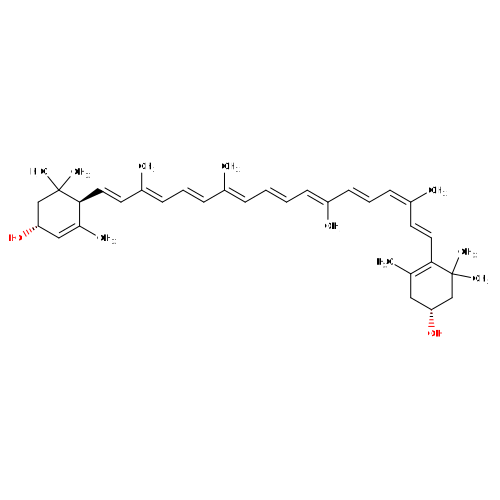
| Record Information |
|---|
| Version | 2.0 |
|---|
| Created at | 2022-09-04 22:42:56 UTC |
|---|
| Updated at | 2022-09-04 22:42:56 UTC |
|---|
| NP-MRD ID | NP0203293 |
|---|
| Secondary Accession Numbers | None |
|---|
| Natural Product Identification |
|---|
| Common Name | (1r,4r)-4-[(1e,3e,5e,7e,9e,11e,13e,15z,17e)-18-[(4r)-4-hydroxy-2,6,6-trimethylcyclohex-1-en-1-yl]-3,7,12,16-tetramethyloctadeca-1,3,5,7,9,11,13,15,17-nonaen-1-yl]-3,5,5-trimethylcyclohex-2-en-1-ol |
|---|
| Description | (3R,3'R,6'R,9-cis)-beta,epsilon-Carotene-3,3'-diol, also known as neolutein b or (9Z,3R,3'r,6'r)-β,ε-carotene-3,3'-diol, belongs to the class of organic compounds known as xanthophylls. These are carotenoids containing an oxygenated carotene backbone. Carotenes are characterized by the presence of two end-groups (mostly cyclohexene rings, but also cyclopentene rings or acyclic groups) linked by a long branched alkyl chain. Carotenes belonging form a subgroup of the carotenoids family. Xanthophylls arise by oxygenation of the carotene backbone. Animals are unable to synthesise carotenoids de novo, and rely upon the diet as a source of these compounds (3R,3'R,6'R,9-cis)-beta,epsilon-Carotene-3,3'-diol is an extremely weak basic (essentially neutral) compound (based on its pKa). Since carotenoids are among the micronutrients found in cancer preventive foods, detailed qualitative and quantitative determination of these compounds, particularly in fruits and vegetables and in human plasma, have recently become increasingly important (PMID: 1416048 , 15003396 ). Over recent years there has been considerable interest in dietary carotenoids with respect to their potential in alleviating age-related diseases in humans. Carotenoids are isoprenoid molecules that are widespread in nature and are typically seen as pigments in fruits, flowers, birds and crustacea. This attention has been mirrored by significant advances in cloning most of the carotenoid genes and in the genetic manipulation of crop plants with the intention of increasing levels in the diet. (1r,4r)-4-[(1e,3e,5e,7e,9e,11e,13e,15z,17e)-18-[(4r)-4-hydroxy-2,6,6-trimethylcyclohex-1-en-1-yl]-3,7,12,16-tetramethyloctadeca-1,3,5,7,9,11,13,15,17-nonaen-1-yl]-3,5,5-trimethylcyclohex-2-en-1-ol is found in Chrysanthemum morifolium and Isatis tinctoria. Studies have shown an inverse relationship between the consumption of certain fruits and vegetables and the risk of epithelial cancer. |
|---|
| Structure | C\C(\C=C\C=C(/C)\C=C\[C@H]1C(C)=C[C@H](O)CC1(C)C)=C/C=C/C=C(\C)/C=C/C=C(/C)\C=C\C1=C(C)C[C@@H](O)CC1(C)C InChI=1S/C40H56O2/c1-29(17-13-19-31(3)21-23-37-33(5)25-35(41)27-39(37,7)8)15-11-12-16-30(2)18-14-20-32(4)22-24-38-34(6)26-36(42)28-40(38,9)10/h11-25,35-37,41-42H,26-28H2,1-10H3/b12-11+,17-13+,18-14+,23-21+,24-22+,29-15+,30-16+,31-19+,32-20-/t35-,36+,37-/m0/s1 |
|---|
| Synonyms | | Value | Source |
|---|
| (3R,3'r,6'r,9-cis)-b,epsilon-Carotene-3,3'-diol | Generator | | (3R,3'r,6'r,9-cis)-Β,epsilon-carotene-3,3'-diol | Generator | | (9Z,3R,3'r,6'r)-Β,ε-carotene-3,3'-diol | HMDB | | (9Z,3R,3'r,6'r)-beta,epsilon-carotene-3,3'-diol | HMDB | | (9Z,3R,3'r,6'r)-Lutein | HMDB | | (3R,3'r,6'r,9-cis)-Β,ε-carotene-3,3'-diol | HMDB | | (3R,3'r,6'r,9-cis)-Carotene-3,3'-diol | HMDB | | (9Z)-Lutein | HMDB | | 9-cis-Lutein | HMDB | | Neolutein b | HMDB | | Neolutein b'' | HMDB | | (3R,3’R,6’r,9-cis)-β,ε-carotene-3,3’-diol | HMDB | | Neolutein b’’ | HMDB | | (3R,3'R,6'R,9-cis)-beta,epsilon-Carotene-3,3'-diol | HMDB |
|
|---|
| Chemical Formula | C40H56O2 |
|---|
| Average Mass | 568.8860 Da |
|---|
| Monoisotopic Mass | 568.42803 Da |
|---|
| IUPAC Name | (1R,4R)-4-[(1E,3E,5E,7E,9E,11E,13E,15Z,17E)-18-[(4R)-4-hydroxy-2,6,6-trimethylcyclohex-1-en-1-yl]-3,7,12,16-tetramethyloctadeca-1,3,5,7,9,11,13,15,17-nonaen-1-yl]-3,5,5-trimethylcyclohex-2-en-1-ol |
|---|
| Traditional Name | (1R,4R)-4-[(1E,3E,5E,7E,9E,11E,13E,15Z,17E)-18-[(4R)-4-hydroxy-2,6,6-trimethylcyclohex-1-en-1-yl]-3,7,12,16-tetramethyloctadeca-1,3,5,7,9,11,13,15,17-nonaen-1-yl]-3,5,5-trimethylcyclohex-2-en-1-ol |
|---|
| CAS Registry Number | Not Available |
|---|
| SMILES | C\C(\C=C\C=C(/C)\C=C\[C@H]1C(C)=C[C@H](O)CC1(C)C)=C/C=C/C=C(\C)/C=C/C=C(/C)\C=C\C1=C(C)C[C@@H](O)CC1(C)C |
|---|
| InChI Identifier | InChI=1S/C40H56O2/c1-29(17-13-19-31(3)21-23-37-33(5)25-35(41)27-39(37,7)8)15-11-12-16-30(2)18-14-20-32(4)22-24-38-34(6)26-36(42)28-40(38,9)10/h11-25,35-37,41-42H,26-28H2,1-10H3/b12-11+,17-13+,18-14+,23-21+,24-22+,29-15+,30-16+,31-19+,32-20-/t35-,36+,37-/m0/s1 |
|---|
| InChI Key | KBPHJBAIARWVSC-HPIWMWCCSA-N |
|---|
| Experimental Spectra |
|---|
|
| Not Available | | Predicted Spectra |
|---|
|
| | Spectrum Type | Description | Depositor ID | Depositor Organization | Depositor | Deposition Date | View |
|---|
| 1D NMR | 13C NMR Spectrum (1D, 25 MHz, H2O, predicted) | Wishart Lab | Wishart Lab | David Wishart | 2021-06-20 | View Spectrum | | 1D NMR | 1H NMR Spectrum (1D, 100 MHz, H2O, predicted) | Wishart Lab | Wishart Lab | David Wishart | 2021-06-20 | View Spectrum | | 1D NMR | 13C NMR Spectrum (1D, 252 MHz, H2O, predicted) | Wishart Lab | Wishart Lab | David Wishart | 2021-06-20 | View Spectrum | | 1D NMR | 1H NMR Spectrum (1D, 1000 MHz, H2O, predicted) | Wishart Lab | Wishart Lab | David Wishart | 2021-06-20 | View Spectrum | | 1D NMR | 13C NMR Spectrum (1D, 50 MHz, H2O, predicted) | Wishart Lab | Wishart Lab | David Wishart | 2021-06-20 | View Spectrum | | 1D NMR | 1H NMR Spectrum (1D, 200 MHz, H2O, predicted) | Wishart Lab | Wishart Lab | David Wishart | 2021-06-20 | View Spectrum | | 1D NMR | 13C NMR Spectrum (1D, 75 MHz, H2O, predicted) | Wishart Lab | Wishart Lab | David Wishart | 2021-06-20 | View Spectrum | | 1D NMR | 1H NMR Spectrum (1D, 300 MHz, H2O, predicted) | Wishart Lab | Wishart Lab | David Wishart | 2021-06-20 | View Spectrum | | 1D NMR | 13C NMR Spectrum (1D, 101 MHz, H2O, predicted) | Wishart Lab | Wishart Lab | David Wishart | 2021-06-20 | View Spectrum | | 1D NMR | 1H NMR Spectrum (1D, 400 MHz, H2O, predicted) | Wishart Lab | Wishart Lab | David Wishart | 2021-06-20 | View Spectrum | | 1D NMR | 13C NMR Spectrum (1D, 126 MHz, H2O, predicted) | Wishart Lab | Wishart Lab | David Wishart | 2021-06-20 | View Spectrum | | 1D NMR | 1H NMR Spectrum (1D, 500 MHz, H2O, predicted) | Wishart Lab | Wishart Lab | David Wishart | 2021-06-20 | View Spectrum | | 1D NMR | 13C NMR Spectrum (1D, 151 MHz, H2O, predicted) | Wishart Lab | Wishart Lab | David Wishart | 2021-06-20 | View Spectrum | | 1D NMR | 1H NMR Spectrum (1D, 600 MHz, H2O, predicted) | Wishart Lab | Wishart Lab | David Wishart | 2021-06-20 | View Spectrum | | 1D NMR | 13C NMR Spectrum (1D, 176 MHz, H2O, predicted) | Wishart Lab | Wishart Lab | David Wishart | 2021-06-20 | View Spectrum | | 1D NMR | 1H NMR Spectrum (1D, 700 MHz, H2O, predicted) | Wishart Lab | Wishart Lab | David Wishart | 2021-06-20 | View Spectrum | | 1D NMR | 13C NMR Spectrum (1D, 201 MHz, H2O, predicted) | Wishart Lab | Wishart Lab | David Wishart | 2021-06-20 | View Spectrum | | 1D NMR | 1H NMR Spectrum (1D, 800 MHz, H2O, predicted) | Wishart Lab | Wishart Lab | David Wishart | 2021-06-20 | View Spectrum | | 1D NMR | 13C NMR Spectrum (1D, 226 MHz, H2O, predicted) | Wishart Lab | Wishart Lab | David Wishart | 2021-06-20 | View Spectrum | | 1D NMR | 1H NMR Spectrum (1D, 900 MHz, H2O, predicted) | Wishart Lab | Wishart Lab | David Wishart | 2021-06-20 | View Spectrum |
| | Chemical Shift Submissions |
|---|
|
| Not Available | | Species |
|---|
| Species of Origin | |
|---|
| Chemical Taxonomy |
|---|
| Description | Belongs to the class of organic compounds known as xanthophylls. These are carotenoids containing an oxygenated carotene backbone. Carotenes are characterized by the presence of two end-groups (mostly cyclohexene rings, but also cyclopentene rings or acyclic groups) linked by a long branched alkyl chain. Carotenes belonging form a subgroup of the carotenoids family. Xanthophylls arise by oxygenation of the carotene backbone. |
|---|
| Kingdom | Organic compounds |
|---|
| Super Class | Lipids and lipid-like molecules |
|---|
| Class | Prenol lipids |
|---|
| Sub Class | Tetraterpenoids |
|---|
| Direct Parent | Xanthophylls |
|---|
| Alternative Parents | |
|---|
| Substituents | - Xanthophyll
- Secondary alcohol
- Organic oxygen compound
- Hydrocarbon derivative
- Organooxygen compound
- Alcohol
- Aliphatic homomonocyclic compound
|
|---|
| Molecular Framework | Aliphatic homomonocyclic compounds |
|---|
| External Descriptors | Not Available |
|---|
| Physical Properties |
|---|
| State | Not Available |
|---|
| Experimental Properties | | Property | Value | Reference |
|---|
| Melting Point | Not Available | Not Available | | Boiling Point | Not Available | Not Available | | Water Solubility | Not Available | Not Available | | LogP | Not Available | Not Available |
|
|---|
| Predicted Properties | |
|---|