| Record Information |
|---|
| Version | 2.0 |
|---|
| Created at | 2022-09-04 20:47:35 UTC |
|---|
| Updated at | 2022-09-04 20:47:35 UTC |
|---|
| NP-MRD ID | NP0201697 |
|---|
| Secondary Accession Numbers | None |
|---|
| Natural Product Identification |
|---|
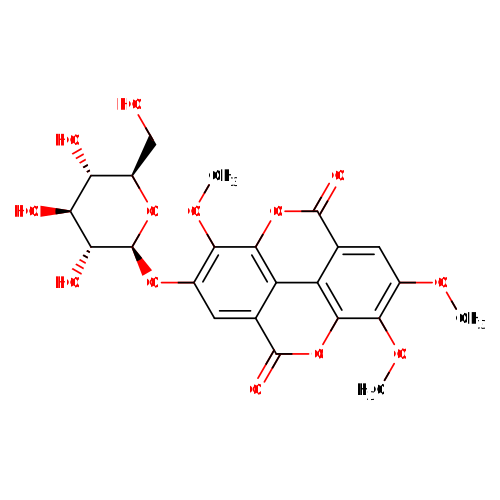
| Common Name | 6,7,14-trimethoxy-13-{[(2s,3r,4s,5s,6r)-3,4,5-trihydroxy-6-(hydroxymethyl)oxan-2-yl]oxy}-2,9-dioxatetracyclo[6.6.2.0⁴,¹⁶.0¹¹,¹⁵]hexadeca-1(15),4(16),5,7,11,13-hexaene-3,10-dione |
|---|
| Description | TMEG belongs to the class of organic compounds known as hydrolyzable tannins. These are tannins with a structure characterized by either of the following models. In model 1, the structure contains galloyl units (in some cases, shikimic acid units) that are linked to diverse polyol carbohydrate-, catechin-, or triterpenoid units. In model 2, contains at least two galloyl units C-C coupled to each other, and do not contain a glycosidically linked catechin unit. 6,7,14-trimethoxy-13-{[(2s,3r,4s,5s,6r)-3,4,5-trihydroxy-6-(hydroxymethyl)oxan-2-yl]oxy}-2,9-dioxatetracyclo[6.6.2.0⁴,¹⁶.0¹¹,¹⁵]hexadeca-1(15),4(16),5,7,11,13-hexaene-3,10-dione is found in Aphananthe aspera, Camptotheca acuminata, Cleidion brevipetiolatum, Dipentodon sinicus, Euphorbia sessiliflora, Nyssa sylvatica, Phyllagathis rotundifolia and Psidium guajava. 6,7,14-trimethoxy-13-{[(2s,3r,4s,5s,6r)-3,4,5-trihydroxy-6-(hydroxymethyl)oxan-2-yl]oxy}-2,9-dioxatetracyclo[6.6.2.0⁴,¹⁶.0¹¹,¹⁵]hexadeca-1(15),4(16),5,7,11,13-hexaene-3,10-dione was first documented in 2018 (PMID: 29473409). Based on a literature review a small amount of articles have been published on TMEG (PMID: 35860136) (PMID: 32861995) (PMID: 31379766) (PMID: 30691532). |
|---|
| Structure | COC1=C(OC)C2=C3C(=C1)C(=O)OC1=C(OC)C(O[C@@H]4O[C@H](CO)[C@@H](O)[C@H](O)[C@H]4O)=CC(C(=O)O2)=C31 InChI=1S/C23H22O13/c1-30-9-4-7-12-13-8(22(29)35-19(12)17(9)31-2)5-10(18(32-3)20(13)36-21(7)28)33-23-16(27)15(26)14(25)11(6-24)34-23/h4-5,11,14-16,23-27H,6H2,1-3H3/t11-,14-,15+,16-,23-/m1/s1 |
|---|
| Synonyms | Not Available |
|---|
| Chemical Formula | C23H22O13 |
|---|
| Average Mass | 506.4160 Da |
|---|
| Monoisotopic Mass | 506.10604 Da |
|---|
| IUPAC Name | 7,13,14-trimethoxy-6-{[(2S,3R,4S,5S,6R)-3,4,5-trihydroxy-6-(hydroxymethyl)oxan-2-yl]oxy}-2,9-dioxatetracyclo[6.6.2.0^{4,16}.0^{11,15}]hexadeca-1(15),4(16),5,7,11,13-hexaene-3,10-dione |
|---|
| Traditional Name | 7,13,14-trimethoxy-6-{[(2S,3R,4S,5S,6R)-3,4,5-trihydroxy-6-(hydroxymethyl)oxan-2-yl]oxy}-2,9-dioxatetracyclo[6.6.2.0^{4,16}.0^{11,15}]hexadeca-1(15),4(16),5,7,11,13-hexaene-3,10-dione |
|---|
| CAS Registry Number | Not Available |
|---|
| SMILES | COC1=C(OC)C2=C3C(=C1)C(=O)OC1=C(OC)C(O[C@@H]4O[C@H](CO)[C@@H](O)[C@H](O)[C@H]4O)=CC(C(=O)O2)=C31 |
|---|
| InChI Identifier | InChI=1S/C23H22O13/c1-30-9-4-7-12-13-8(22(29)35-19(12)17(9)31-2)5-10(18(32-3)20(13)36-21(7)28)33-23-16(27)15(26)14(25)11(6-24)34-23/h4-5,11,14-16,23-27H,6H2,1-3H3/t11-,14-,15+,16-,23-/m1/s1 |
|---|
| InChI Key | RKFCDGOVCBYSEW-AUUKWEANSA-N |
|---|
| Experimental Spectra |
|---|
|
| Not Available | | Predicted Spectra |
|---|
|
| | Spectrum Type | Description | Depositor ID | Depositor Organization | Depositor | Deposition Date | View |
|---|
| 1D NMR | 13C NMR Spectrum (1D, 25 MHz, H2O, predicted) | Wishart Lab | Wishart Lab | David Wishart | 2021-06-20 | View Spectrum | | 1D NMR | 1H NMR Spectrum (1D, 100 MHz, H2O, predicted) | Wishart Lab | Wishart Lab | David Wishart | 2021-06-20 | View Spectrum | | 1D NMR | 13C NMR Spectrum (1D, 252 MHz, H2O, predicted) | Wishart Lab | Wishart Lab | David Wishart | 2021-06-20 | View Spectrum | | 1D NMR | 1H NMR Spectrum (1D, 1000 MHz, H2O, predicted) | Wishart Lab | Wishart Lab | David Wishart | 2021-06-20 | View Spectrum | | 1D NMR | 13C NMR Spectrum (1D, 50 MHz, H2O, predicted) | Wishart Lab | Wishart Lab | David Wishart | 2021-06-20 | View Spectrum | | 1D NMR | 1H NMR Spectrum (1D, 200 MHz, H2O, predicted) | Wishart Lab | Wishart Lab | David Wishart | 2021-06-20 | View Spectrum | | 1D NMR | 13C NMR Spectrum (1D, 75 MHz, H2O, predicted) | Wishart Lab | Wishart Lab | David Wishart | 2021-06-20 | View Spectrum | | 1D NMR | 1H NMR Spectrum (1D, 300 MHz, H2O, predicted) | Wishart Lab | Wishart Lab | David Wishart | 2021-06-20 | View Spectrum | | 1D NMR | 13C NMR Spectrum (1D, 101 MHz, H2O, predicted) | Wishart Lab | Wishart Lab | David Wishart | 2021-06-20 | View Spectrum | | 1D NMR | 1H NMR Spectrum (1D, 400 MHz, H2O, predicted) | Wishart Lab | Wishart Lab | David Wishart | 2021-06-20 | View Spectrum | | 1D NMR | 13C NMR Spectrum (1D, 126 MHz, H2O, predicted) | Wishart Lab | Wishart Lab | David Wishart | 2021-06-20 | View Spectrum | | 1D NMR | 1H NMR Spectrum (1D, 500 MHz, H2O, predicted) | Wishart Lab | Wishart Lab | David Wishart | 2021-06-20 | View Spectrum | | 1D NMR | 13C NMR Spectrum (1D, 151 MHz, H2O, predicted) | Wishart Lab | Wishart Lab | David Wishart | 2021-06-20 | View Spectrum | | 1D NMR | 1H NMR Spectrum (1D, 600 MHz, H2O, predicted) | Wishart Lab | Wishart Lab | David Wishart | 2021-06-20 | View Spectrum | | 1D NMR | 13C NMR Spectrum (1D, 176 MHz, H2O, predicted) | Wishart Lab | Wishart Lab | David Wishart | 2021-06-20 | View Spectrum | | 1D NMR | 1H NMR Spectrum (1D, 700 MHz, H2O, predicted) | Wishart Lab | Wishart Lab | David Wishart | 2021-06-20 | View Spectrum | | 1D NMR | 13C NMR Spectrum (1D, 201 MHz, H2O, predicted) | Wishart Lab | Wishart Lab | David Wishart | 2021-06-20 | View Spectrum | | 1D NMR | 1H NMR Spectrum (1D, 800 MHz, H2O, predicted) | Wishart Lab | Wishart Lab | David Wishart | 2021-06-20 | View Spectrum | | 1D NMR | 13C NMR Spectrum (1D, 226 MHz, H2O, predicted) | Wishart Lab | Wishart Lab | David Wishart | 2021-06-20 | View Spectrum | | 1D NMR | 1H NMR Spectrum (1D, 900 MHz, H2O, predicted) | Wishart Lab | Wishart Lab | David Wishart | 2021-06-20 | View Spectrum |
| | Chemical Shift Submissions |
|---|
|
| Not Available | | Species |
|---|
| Species of Origin | |
|---|
| Chemical Taxonomy |
|---|
| Description | Belongs to the class of organic compounds known as hydrolyzable tannins. These are tannins with a structure characterized by either of the following models. In model 1, the structure contains galloyl units (in some cases, shikimic acid units) that are linked to diverse polyol carbohydrate-, catechin-, or triterpenoid units. In model 2, contains at least two galloyl units C-C coupled to each other, and do not contain a glycosidically linked catechin unit. |
|---|
| Kingdom | Organic compounds |
|---|
| Super Class | Phenylpropanoids and polyketides |
|---|
| Class | Tannins |
|---|
| Sub Class | Hydrolyzable tannins |
|---|
| Direct Parent | Hydrolyzable tannins |
|---|
| Alternative Parents | |
|---|
| Substituents | - Hydrolyzable tannin
- Ellagic_acid
- Phenolic glycoside
- Hexose monosaccharide
- Isocoumarin
- Coumarin
- O-glycosyl compound
- Glycosyl compound
- Benzopyran
- 2-benzopyran
- 1-benzopyran
- Anisole
- Alkyl aryl ether
- Pyranone
- Monosaccharide
- Benzenoid
- Oxane
- Pyran
- Heteroaromatic compound
- Secondary alcohol
- Lactone
- Acetal
- Oxacycle
- Organoheterocyclic compound
- Ether
- Polyol
- Alcohol
- Hydrocarbon derivative
- Organic oxygen compound
- Organic oxide
- Primary alcohol
- Organooxygen compound
- Aromatic heteropolycyclic compound
|
|---|
| Molecular Framework | Aromatic heteropolycyclic compounds |
|---|
| External Descriptors | Not Available |
|---|
| Physical Properties |
|---|
| State | Not Available |
|---|
| Experimental Properties | | Property | Value | Reference |
|---|
| Melting Point | Not Available | Not Available | | Boiling Point | Not Available | Not Available | | Water Solubility | Not Available | Not Available | | LogP | Not Available | Not Available |
|
|---|
| Predicted Properties | |
|---|
| General References | - Kbirou A, Jandou I, Sayah M, Benhadda H, Moataz A, Dakir M, Debbagh A, Aboutaieb R: Forensic aspects of trauma to the male external genitalia (TMEG), analysis of a series of 84 cases. Ann Med Surg (Lond). 2022 Jun 6;79:103916. doi: 10.1016/j.amsu.2022.103916. eCollection 2022 Jul. [PubMed:35860136 ]
- Ramirez GA, McKay LJ, Fields MW, Buckley A, Mortera C, Hensen C, Ravelo AC, Teske AP: The Guaymas Basin Subseafloor Sedimentary Archaeome Reflects Complex Environmental Histories. iScience. 2020 Aug 15;23(9):101459. doi: 10.1016/j.isci.2020.101459. eCollection 2020 Sep 25. [PubMed:32861995 ]
- Gavrilov SN, Korzhenkov AA, Kublanov IV, Bargiela R, Zamana LV, Popova AA, Toshchakov SV, Golyshin PN, Golyshina OV: Microbial Communities of Polymetallic Deposits' Acidic Ecosystems of Continental Climatic Zone With High Temperature Contrasts. Front Microbiol. 2019 Jul 17;10:1573. doi: 10.3389/fmicb.2019.01573. eCollection 2019. [PubMed:31379766 ]
- Korzhenkov AA, Toshchakov SV, Bargiela R, Gibbard H, Ferrer M, Teplyuk AV, Jones DL, Kublanov IV, Golyshin PN, Golyshina OV: Archaea dominate the microbial community in an ecosystem with low-to-moderate temperature and extreme acidity. Microbiome. 2019 Jan 28;7(1):11. doi: 10.1186/s40168-019-0623-8. [PubMed:30691532 ]
- Chun J, Kishore RA, Kumar P, Kang MG, Kang HB, Sanghadasa M, Priya S: Self-Powered Temperature-Mapping Sensors Based on Thermo-Magneto-Electric Generator. ACS Appl Mater Interfaces. 2018 Apr 4;10(13):10796-10803. doi: 10.1021/acsami.7b17686. Epub 2018 Mar 26. [PubMed:29473409 ]
- LOTUS database [Link]
|
|---|