| Record Information |
|---|
| Version | 2.0 |
|---|
| Created at | 2022-09-04 16:57:35 UTC |
|---|
| Updated at | 2022-09-04 16:57:36 UTC |
|---|
| NP-MRD ID | NP0198495 |
|---|
| Secondary Accession Numbers | None |
|---|
| Natural Product Identification |
|---|
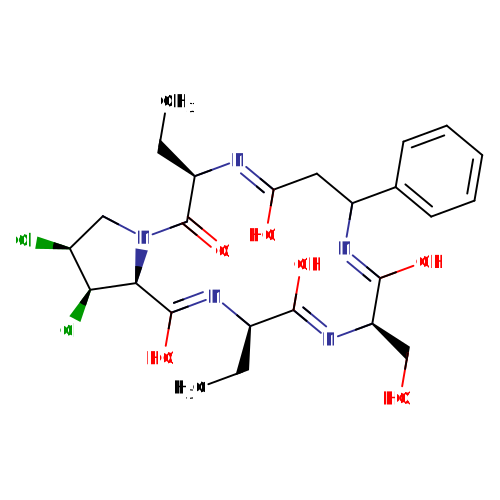
| Common Name | (3r,6r,13r,17s,18r,18as)-17,18-dichloro-3,13-diethyl-1,4,7,11-tetrahydroxy-6-(hydroxymethyl)-9-phenyl-3h,6h,9h,10h,13h,16h,17h,18h,18ah-pyrrolo[1,2-d]1,4,7,10,13-pentaazacyclohexadecan-14-one |
|---|
| Description | Astin C belongs to the class of organic compounds known as hybrid peptides. Hybrid peptides are compounds containing at least two different types of amino acids (alpha, beta, gamma, delta) linked to each other through a peptide bond. (3r,6r,13r,17s,18r,18as)-17,18-dichloro-3,13-diethyl-1,4,7,11-tetrahydroxy-6-(hydroxymethyl)-9-phenyl-3h,6h,9h,10h,13h,16h,17h,18h,18ah-pyrrolo[1,2-d]1,4,7,10,13-pentaazacyclohexadecan-14-one is found in Aster tataricus. (3r,6r,13r,17s,18r,18as)-17,18-dichloro-3,13-diethyl-1,4,7,11-tetrahydroxy-6-(hydroxymethyl)-9-phenyl-3h,6h,9h,10h,13h,16h,17h,18h,18ah-pyrrolo[1,2-d]1,4,7,10,13-pentaazacyclohexadecan-14-one was first documented in 2018 (PMID: 30566866). Based on a literature review a small amount of articles have been published on Astin C (PMID: 34615362) (PMID: 32512189) (PMID: 31811021) (PMID: 31161690). |
|---|
| Structure | CC[C@H]1N=C(O)[C@H]2[C@@H](Cl)[C@@H](Cl)CN2C(=O)[C@@H](CC)N=C(O)CC(N=C(O)[C@@H](CO)N=C1O)C1=CC=CC=C1 InChI=1S/C25H33Cl2N5O6/c1-3-15-22(35)31-18(12-33)23(36)30-17(13-8-6-5-7-9-13)10-19(34)28-16(4-2)25(38)32-11-14(26)20(27)21(32)24(37)29-15/h5-9,14-18,20-21,33H,3-4,10-12H2,1-2H3,(H,28,34)(H,29,37)(H,30,36)(H,31,35)/t14-,15+,16+,17?,18+,20-,21+/m0/s1 |
|---|
| Synonyms | Not Available |
|---|
| Chemical Formula | C25H33Cl2N5O6 |
|---|
| Average Mass | 570.4700 Da |
|---|
| Monoisotopic Mass | 569.18079 Da |
|---|
| IUPAC Name | (3R,6R,13R,17S,18R,18aS)-17,18-dichloro-3,13-diethyl-1,4,7,11-tetrahydroxy-6-(hydroxymethyl)-9-phenyl-3H,6H,9H,10H,13H,14H,16H,17H,18H,18aH-pyrrolo[1,2-d]1,4,7,10,13-pentaazacyclohexadecan-14-one |
|---|
| Traditional Name | (3R,6R,13R,17S,18R,18aS)-17,18-dichloro-3,13-diethyl-1,4,7,11-tetrahydroxy-6-(hydroxymethyl)-9-phenyl-3H,6H,9H,10H,13H,16H,17H,18H,18aH-pyrrolo[1,2-d]1,4,7,10,13-pentaazacyclohexadecan-14-one |
|---|
| CAS Registry Number | Not Available |
|---|
| SMILES | CC[C@H]1N=C(O)[C@H]2[C@@H](Cl)[C@@H](Cl)CN2C(=O)[C@@H](CC)N=C(O)CC(N=C(O)[C@@H](CO)N=C1O)C1=CC=CC=C1 |
|---|
| InChI Identifier | InChI=1S/C25H33Cl2N5O6/c1-3-15-22(35)31-18(12-33)23(36)30-17(13-8-6-5-7-9-13)10-19(34)28-16(4-2)25(38)32-11-14(26)20(27)21(32)24(37)29-15/h5-9,14-18,20-21,33H,3-4,10-12H2,1-2H3,(H,28,34)(H,29,37)(H,30,36)(H,31,35)/t14-,15+,16+,17?,18+,20-,21+/m0/s1 |
|---|
| InChI Key | YWGAKIGNXGAAQR-ZQWDDLIFSA-N |
|---|
| Experimental Spectra |
|---|
|
| Not Available | | Predicted Spectra |
|---|
|
| | Spectrum Type | Description | Depositor ID | Depositor Organization | Depositor | Deposition Date | View |
|---|
| 1D NMR | 13C NMR Spectrum (1D, 25 MHz, H2O, predicted) | Wishart Lab | Wishart Lab | David Wishart | 2021-06-20 | View Spectrum | | 1D NMR | 1H NMR Spectrum (1D, 100 MHz, H2O, predicted) | Wishart Lab | Wishart Lab | David Wishart | 2021-06-20 | View Spectrum | | 1D NMR | 13C NMR Spectrum (1D, 252 MHz, H2O, predicted) | Wishart Lab | Wishart Lab | David Wishart | 2021-06-20 | View Spectrum | | 1D NMR | 1H NMR Spectrum (1D, 1000 MHz, H2O, predicted) | Wishart Lab | Wishart Lab | David Wishart | 2021-06-20 | View Spectrum | | 1D NMR | 13C NMR Spectrum (1D, 50 MHz, H2O, predicted) | Wishart Lab | Wishart Lab | David Wishart | 2021-06-20 | View Spectrum | | 1D NMR | 1H NMR Spectrum (1D, 200 MHz, H2O, predicted) | Wishart Lab | Wishart Lab | David Wishart | 2021-06-20 | View Spectrum | | 1D NMR | 13C NMR Spectrum (1D, 75 MHz, H2O, predicted) | Wishart Lab | Wishart Lab | David Wishart | 2021-06-20 | View Spectrum | | 1D NMR | 1H NMR Spectrum (1D, 300 MHz, H2O, predicted) | Wishart Lab | Wishart Lab | David Wishart | 2021-06-20 | View Spectrum | | 1D NMR | 13C NMR Spectrum (1D, 101 MHz, H2O, predicted) | Wishart Lab | Wishart Lab | David Wishart | 2021-06-20 | View Spectrum | | 1D NMR | 1H NMR Spectrum (1D, 400 MHz, H2O, predicted) | Wishart Lab | Wishart Lab | David Wishart | 2021-06-20 | View Spectrum | | 1D NMR | 13C NMR Spectrum (1D, 126 MHz, H2O, predicted) | Wishart Lab | Wishart Lab | David Wishart | 2021-06-20 | View Spectrum | | 1D NMR | 1H NMR Spectrum (1D, 500 MHz, H2O, predicted) | Wishart Lab | Wishart Lab | David Wishart | 2021-06-20 | View Spectrum | | 1D NMR | 13C NMR Spectrum (1D, 151 MHz, H2O, predicted) | Wishart Lab | Wishart Lab | David Wishart | 2021-06-20 | View Spectrum | | 1D NMR | 1H NMR Spectrum (1D, 600 MHz, H2O, predicted) | Wishart Lab | Wishart Lab | David Wishart | 2021-06-20 | View Spectrum | | 1D NMR | 13C NMR Spectrum (1D, 176 MHz, H2O, predicted) | Wishart Lab | Wishart Lab | David Wishart | 2021-06-20 | View Spectrum | | 1D NMR | 1H NMR Spectrum (1D, 700 MHz, H2O, predicted) | Wishart Lab | Wishart Lab | David Wishart | 2021-06-20 | View Spectrum | | 1D NMR | 13C NMR Spectrum (1D, 201 MHz, H2O, predicted) | Wishart Lab | Wishart Lab | David Wishart | 2021-06-20 | View Spectrum | | 1D NMR | 1H NMR Spectrum (1D, 800 MHz, H2O, predicted) | Wishart Lab | Wishart Lab | David Wishart | 2021-06-20 | View Spectrum | | 1D NMR | 13C NMR Spectrum (1D, 226 MHz, H2O, predicted) | Wishart Lab | Wishart Lab | David Wishart | 2021-06-20 | View Spectrum | | 1D NMR | 1H NMR Spectrum (1D, 900 MHz, H2O, predicted) | Wishart Lab | Wishart Lab | David Wishart | 2021-06-20 | View Spectrum |
| | Chemical Shift Submissions |
|---|
|
| Not Available | | Species |
|---|
| Species of Origin | |
|---|
| Chemical Taxonomy |
|---|
| Description | Belongs to the class of organic compounds known as hybrid peptides. Hybrid peptides are compounds containing at least two different types of amino acids (alpha, beta, gamma, delta) linked to each other through a peptide bond. |
|---|
| Kingdom | Organic compounds |
|---|
| Super Class | Organic acids and derivatives |
|---|
| Class | Peptidomimetics |
|---|
| Sub Class | Hybrid peptides |
|---|
| Direct Parent | Hybrid peptides |
|---|
| Alternative Parents | |
|---|
| Substituents | - Cyclic hybrid peptide
- Alpha-amino acid or derivatives
- Nitrogen mustard
- Benzenoid
- Monocyclic benzene moiety
- Cyclic carboximidic acid
- Tertiary carboxylic acid amide
- Pyrrolidine
- Lactam
- Carboxamide group
- Azacycle
- Organoheterocyclic compound
- Organic 1,3-dipolar compound
- Propargyl-type 1,3-dipolar organic compound
- Polyol
- Carboxylic acid derivative
- Organic nitrogen compound
- Organic oxygen compound
- Organopnictogen compound
- Organic oxide
- Hydrocarbon derivative
- Primary alcohol
- Organooxygen compound
- Organonitrogen compound
- Organochloride
- Organohalogen compound
- Carbonyl group
- Alkyl halide
- Alkyl chloride
- Alcohol
- Aromatic heteropolycyclic compound
|
|---|
| Molecular Framework | Aromatic heteropolycyclic compounds |
|---|
| External Descriptors | Not Available |
|---|
| Physical Properties |
|---|
| State | Not Available |
|---|
| Experimental Properties | | Property | Value | Reference |
|---|
| Melting Point | Not Available | Not Available | | Boiling Point | Not Available | Not Available | | Water Solubility | Not Available | Not Available | | LogP | Not Available | Not Available |
|
|---|
| Predicted Properties | |
|---|
| General References | - Jahn L, Storm-Johannsen L, Seidler D, Noack J, Gao W, Schafhauser T, Wohlleben W, van Berkel WJH, Jacques P, Kar T, Piechulla B, Ludwig-Muller J: The Endophytic Fungus Cyanodermella asteris Influences Growth of the Nonnatural Host Plant Arabidopsis thaliana. Mol Plant Microbe Interact. 2022 Jan;35(1):49-63. doi: 10.1094/MPMI-03-21-0072-R. Epub 2021 Dec 17. [PubMed:34615362 ]
- Gong Y, Li G, Tao J, Wu NN, Kandadi MR, Bi Y, Wang S, Pei Z, Ren J: Double knockout of Akt2 and AMPK accentuates high fat diet-induced cardiac anomalies through a cGAS-STING-mediated mechanism. Biochim Biophys Acta Mol Basis Dis. 2020 Oct 1;1866(10):165855. doi: 10.1016/j.bbadis.2020.165855. Epub 2020 Jun 5. [PubMed:32512189 ]
- Schafhauser T, Jahn L, Kirchner N, Kulik A, Flor L, Lang A, Caradec T, Fewer DP, Sivonen K, van Berkel WJH, Jacques P, Weber T, Gross H, van Pee KH, Wohlleben W, Ludwig-Muller J: Antitumor astins originate from the fungal endophyte Cyanodermella asteris living within the medicinal plant Aster tataricus. Proc Natl Acad Sci U S A. 2019 Dec 26;116(52):26909-26917. doi: 10.1073/pnas.1910527116. Epub 2019 Dec 6. [PubMed:31811021 ]
- Vassaux A, Tarayre C, Arguelles-Arias A, Compere P, Delvigne F, Fickers P, Jahn L, Lang A, Leclere V, Ludwig-Muller J, Ongena M, Schafhauser T, Telek S, Theatre A, van Berkel WJH, Vandenbol M, van Pee KH, Willems L, Wohlleben W, Jacques P: Astin C Production by the Endophytic Fungus Cyanodermella asteris in Planktonic and Immobilized Culture Conditions. Biotechnol J. 2019 Aug;14(8):e1800624. doi: 10.1002/biot.201800624. Epub 2019 Jul 5. [PubMed:31161690 ]
- Li S, Hong Z, Wang Z, Li F, Mei J, Huang L, Lou X, Zhao S, Song L, Chen W, Wang Q, Liu H, Cai Y, Yu H, Xu H, Zeng G, Wang Q, Zhu J, Liu X, Tan N, Wang C: The Cyclopeptide Astin C Specifically Inhibits the Innate Immune CDN Sensor STING. Cell Rep. 2018 Dec 18;25(12):3405-3421.e7. doi: 10.1016/j.celrep.2018.11.097. [PubMed:30566866 ]
- LOTUS database [Link]
|
|---|