| Record Information |
|---|
| Version | 2.0 |
|---|
| Created at | 2022-09-04 15:54:06 UTC |
|---|
| Updated at | 2022-09-04 15:54:06 UTC |
|---|
| NP-MRD ID | NP0197605 |
|---|
| Secondary Accession Numbers | None |
|---|
| Natural Product Identification |
|---|
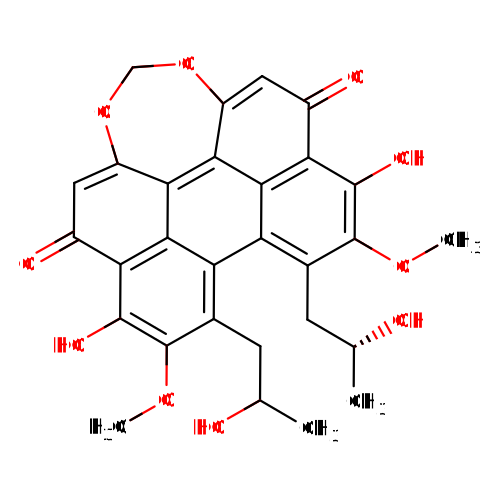
| Common Name | 7,19-dihydroxy-5-(2-hydroxypropyl)-21-[(2r)-2-hydroxypropyl]-6,20-dimethoxy-12,14-dioxahexacyclo[13.8.0.0²,¹¹.0³,⁸.0⁴,²².0¹⁸,²³]tricosa-1,3(8),4,6,10,15,18(23),19,21-nonaene-9,17-dione |
|---|
| Description | CERCOSPORIN belongs to the class of organic compounds known as perylenequinones. These are heterocyclic compounds characterized by two 8-hydroxy-1,4-dihydronaphthalen-1-one moieties joined together one or two CC-bonds. 7,19-dihydroxy-5-(2-hydroxypropyl)-21-[(2r)-2-hydroxypropyl]-6,20-dimethoxy-12,14-dioxahexacyclo[13.8.0.0²,¹¹.0³,⁸.0⁴,²².0¹⁸,²³]tricosa-1,3(8),4,6,10,15,18(23),19,21-nonaene-9,17-dione is found in Cercospora beticola. 7,19-dihydroxy-5-(2-hydroxypropyl)-21-[(2r)-2-hydroxypropyl]-6,20-dimethoxy-12,14-dioxahexacyclo[13.8.0.0²,¹¹.0³,⁸.0⁴,²².0¹⁸,²³]tricosa-1,3(8),4,6,10,15,18(23),19,21-nonaene-9,17-dione was first documented in 2021 (PMID: 34616379). Based on a literature review a small amount of articles have been published on CERCOSPORIN (PMID: 35259559) (PMID: 34647457) (PMID: 34323722) (PMID: 33992112). |
|---|
| Structure | COC1=C(CC(C)O)C2=C3C(C(=O)C=C4OCOC5=CC(=O)C6=C(O)C(OC)=C(C[C@@H](C)O)C2=C6C5=C34)=C1O InChI=1S/C29H26O10/c1-10(30)5-12-18-19-13(6-11(2)31)29(37-4)27(35)21-15(33)8-17-23(25(19)21)22-16(38-9-39-17)7-14(32)20(24(18)22)26(34)28(12)36-3/h7-8,10-11,30-31,34-35H,5-6,9H2,1-4H3/t10-,11?/m1/s1 |
|---|
| Synonyms | Not Available |
|---|
| Chemical Formula | C29H26O10 |
|---|
| Average Mass | 534.5170 Da |
|---|
| Monoisotopic Mass | 534.15260 Da |
|---|
| IUPAC Name | 7,19-dihydroxy-5-(2-hydroxypropyl)-21-[(2R)-2-hydroxypropyl]-6,20-dimethoxy-12,14-dioxahexacyclo[13.8.0.0^{2,11}.0^{3,8}.0^{4,22}.0^{18,23}]tricosa-1,3,5,7,10,15,18,20,22-nonaene-9,17-dione |
|---|
| Traditional Name | 7,19-dihydroxy-5-(2-hydroxypropyl)-21-[(2R)-2-hydroxypropyl]-6,20-dimethoxy-12,14-dioxahexacyclo[13.8.0.0^{2,11}.0^{3,8}.0^{4,22}.0^{18,23}]tricosa-1,3,5,7,10,15,18,20,22-nonaene-9,17-dione |
|---|
| CAS Registry Number | Not Available |
|---|
| SMILES | COC1=C(CC(C)O)C2=C3C(C(=O)C=C4OCOC5=CC(=O)C6=C(O)C(OC)=C(C[C@@H](C)O)C2=C6C5=C34)=C1O |
|---|
| InChI Identifier | InChI=1S/C29H26O10/c1-10(30)5-12-18-19-13(6-11(2)31)29(37-4)27(35)21-15(33)8-17-23(25(19)21)22-16(38-9-39-17)7-14(32)20(24(18)22)26(34)28(12)36-3/h7-8,10-11,30-31,34-35H,5-6,9H2,1-4H3/t10-,11?/m1/s1 |
|---|
| InChI Key | MXLWQNCWIIZUQT-NFJWQWPMSA-N |
|---|
| Experimental Spectra |
|---|
|
| Not Available | | Predicted Spectra |
|---|
|
| | Spectrum Type | Description | Depositor ID | Depositor Organization | Depositor | Deposition Date | View |
|---|
| 1D NMR | 13C NMR Spectrum (1D, 25 MHz, H2O, predicted) | Wishart Lab | Wishart Lab | David Wishart | 2021-06-20 | View Spectrum | | 1D NMR | 1H NMR Spectrum (1D, 100 MHz, H2O, predicted) | Wishart Lab | Wishart Lab | David Wishart | 2021-06-20 | View Spectrum | | 1D NMR | 13C NMR Spectrum (1D, 252 MHz, H2O, predicted) | Wishart Lab | Wishart Lab | David Wishart | 2021-06-20 | View Spectrum | | 1D NMR | 1H NMR Spectrum (1D, 1000 MHz, H2O, predicted) | Wishart Lab | Wishart Lab | David Wishart | 2021-06-20 | View Spectrum | | 1D NMR | 13C NMR Spectrum (1D, 50 MHz, H2O, predicted) | Wishart Lab | Wishart Lab | David Wishart | 2021-06-20 | View Spectrum | | 1D NMR | 1H NMR Spectrum (1D, 200 MHz, H2O, predicted) | Wishart Lab | Wishart Lab | David Wishart | 2021-06-20 | View Spectrum | | 1D NMR | 13C NMR Spectrum (1D, 75 MHz, H2O, predicted) | Wishart Lab | Wishart Lab | David Wishart | 2021-06-20 | View Spectrum | | 1D NMR | 1H NMR Spectrum (1D, 300 MHz, H2O, predicted) | Wishart Lab | Wishart Lab | David Wishart | 2021-06-20 | View Spectrum | | 1D NMR | 13C NMR Spectrum (1D, 101 MHz, H2O, predicted) | Wishart Lab | Wishart Lab | David Wishart | 2021-06-20 | View Spectrum | | 1D NMR | 1H NMR Spectrum (1D, 400 MHz, H2O, predicted) | Wishart Lab | Wishart Lab | David Wishart | 2021-06-20 | View Spectrum | | 1D NMR | 13C NMR Spectrum (1D, 126 MHz, H2O, predicted) | Wishart Lab | Wishart Lab | David Wishart | 2021-06-20 | View Spectrum | | 1D NMR | 1H NMR Spectrum (1D, 500 MHz, H2O, predicted) | Wishart Lab | Wishart Lab | David Wishart | 2021-06-20 | View Spectrum | | 1D NMR | 13C NMR Spectrum (1D, 151 MHz, H2O, predicted) | Wishart Lab | Wishart Lab | David Wishart | 2021-06-20 | View Spectrum | | 1D NMR | 1H NMR Spectrum (1D, 600 MHz, H2O, predicted) | Wishart Lab | Wishart Lab | David Wishart | 2021-06-20 | View Spectrum | | 1D NMR | 13C NMR Spectrum (1D, 176 MHz, H2O, predicted) | Wishart Lab | Wishart Lab | David Wishart | 2021-06-20 | View Spectrum | | 1D NMR | 1H NMR Spectrum (1D, 700 MHz, H2O, predicted) | Wishart Lab | Wishart Lab | David Wishart | 2021-06-20 | View Spectrum | | 1D NMR | 13C NMR Spectrum (1D, 201 MHz, H2O, predicted) | Wishart Lab | Wishart Lab | David Wishart | 2021-06-20 | View Spectrum | | 1D NMR | 1H NMR Spectrum (1D, 800 MHz, H2O, predicted) | Wishart Lab | Wishart Lab | David Wishart | 2021-06-20 | View Spectrum | | 1D NMR | 13C NMR Spectrum (1D, 226 MHz, H2O, predicted) | Wishart Lab | Wishart Lab | David Wishart | 2021-06-20 | View Spectrum | | 1D NMR | 1H NMR Spectrum (1D, 900 MHz, H2O, predicted) | Wishart Lab | Wishart Lab | David Wishart | 2021-06-20 | View Spectrum |
| | Chemical Shift Submissions |
|---|
|
| Not Available | | Species |
|---|
| Species of Origin | |
|---|
| Chemical Taxonomy |
|---|
| Description | Belongs to the class of organic compounds known as perylenequinones. These are heterocyclic compounds characterized by two 8-hydroxy-1,4-dihydronaphthalen-1-one moieties joined together one or two CC-bonds. |
|---|
| Kingdom | Organic compounds |
|---|
| Super Class | Benzenoids |
|---|
| Class | Perylenequinones |
|---|
| Sub Class | Not Available |
|---|
| Direct Parent | Perylenequinones |
|---|
| Alternative Parents | |
|---|
| Substituents | - Perylenequinone
- Phenanthrol
- Anthracene
- Phenanthrene
- 2-naphthol
- 1-naphthol
- Anisole
- Alkyl aryl ether
- Vinylogous ester
- Vinylogous acid
- Secondary alcohol
- Acetal
- Organoheterocyclic compound
- Oxacycle
- Ether
- Organooxygen compound
- Hydrocarbon derivative
- Organic oxide
- Organic oxygen compound
- Alcohol
- Aromatic heteropolycyclic compound
|
|---|
| Molecular Framework | Aromatic heteropolycyclic compounds |
|---|
| External Descriptors | Not Available |
|---|
| Physical Properties |
|---|
| State | Not Available |
|---|
| Experimental Properties | | Property | Value | Reference |
|---|
| Melting Point | Not Available | Not Available | | Boiling Point | Not Available | Not Available | | Water Solubility | Not Available | Not Available | | LogP | Not Available | Not Available |
|
|---|
| Predicted Properties | |
|---|
| General References | - Huang K, Tang J, Zou Y, Sun X, Lan J, Wang W, Xu P, Wu X, Ma R, Wang Q, Wang Z, Liu J: Whole Genome Sequence of Alternaria alternata, the Causal Agent of Black Spot of Kiwifruit. Front Microbiol. 2021 Sep 20;12:713462. doi: 10.3389/fmicb.2021.713462. eCollection 2021. [PubMed:34616379 ]
- Liu M, Zhang Y, Yuan Z, Lu L, Liu X, Zhu X, Wang L, Liu C, Rao Y: Cercosporin-bioinspired photoinactivation of harmful cyanobacteria under natural sunlight via bifunctional mechanisms. Water Res. 2022 May 15;215:118242. doi: 10.1016/j.watres.2022.118242. Epub 2022 Mar 2. [PubMed:35259559 ]
- Zhang Y, Xia M, Li M, Ping Q, Yuan Z, Liu X, Yin H, Huang S, Rao Y: Energy-Transfer-Mediated Photocatalysis by a Bioinspired Organic Perylenephotosensitizer HiBRCP. J Org Chem. 2021 Nov 5;86(21):15284-15297. doi: 10.1021/acs.joc.1c01876. Epub 2021 Oct 14. [PubMed:34647457 ]
- Wu Y, Lu L, Zhang Y, Yuan Z, Yang L, Wang L, Rao Y: A bioinspired cercosporin/polymethylmethacrylate photocatalyst with high efficiency for decontamination of pharmaceuticals and pathogens. J Hazard Mater. 2021 Oct 5;419:126555. doi: 10.1016/j.jhazmat.2021.126555. Epub 2021 Jul 1. [PubMed:34323722 ]
- Zhou T, Yu S, Hu Y, Zhang Y, Song Y, Chu J, Liu C, Rao Y: Enhanced cercosporin production by co-culturing Cercospora sp. JNU001 with leaf-spot-disease-related endophytic bacteria. Microb Cell Fact. 2021 May 15;20(1):100. doi: 10.1186/s12934-021-01587-2. [PubMed:33992112 ]
- LOTUS database [Link]
|
|---|