| Record Information |
|---|
| Version | 2.0 |
|---|
| Created at | 2022-09-04 15:28:00 UTC |
|---|
| Updated at | 2022-09-04 15:28:00 UTC |
|---|
| NP-MRD ID | NP0197243 |
|---|
| Secondary Accession Numbers | None |
|---|
| Natural Product Identification |
|---|
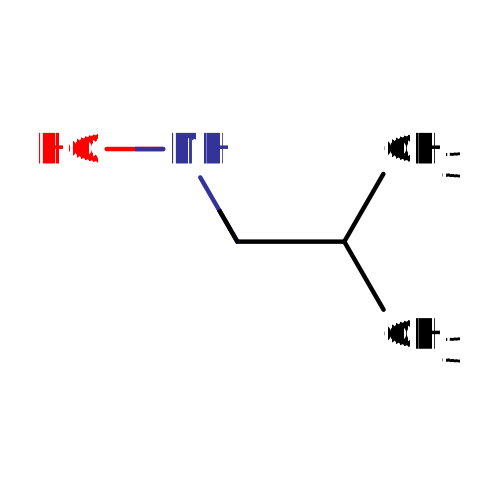
| Common Name | n-hydroxy-2-methylpropanamine |
|---|
| Description | N-hydroxy-2-methylpropanamine, also known as isobutylhydroxylamine or N-(2-methylpropyl)-hydroxylamine, belongs to the class of organic compounds known as n-organohydroxylamines. These are organic compounds comprising the hydroxylamine functional group, with the general structure R1ON(R2)R3 (R1,R3=H, organyl; R2 = organyl). N-hydroxy-2-methylpropanamine is a secondary metabolite. Secondary metabolites are metabolically or physiologically non-essential metabolites that may serve a role as defense or signalling molecules. In some cases they are simply molecules that arise from the incomplete metabolism of other secondary metabolites. n-hydroxy-2-methylpropanamine is found in Streptomyces viridifaciens. n-hydroxy-2-methylpropanamine was first documented in 1997 (PMID: 8990292). Based on a literature review a small amount of articles have been published on N-hydroxy-2-methylpropanamine (PMID: 12688722) (PMID: 18451033) (PMID: 9056232) (PMID: 9287340). |
|---|
| Structure | InChI=1S/C4H11NO/c1-4(2)3-5-6/h4-6H,3H2,1-2H3 |
|---|
| Synonyms | | Value | Source |
|---|
| Isobutylhydroxylamine | ChEBI | | N-(2-Methylpropyl)-hydroxylamine | ChEBI | | N-(2-Methylpropyl)hydroxylamine | ChEBI | | N-(Isobutyl)hydroxylamine | ChEBI | | N-Hydroxyisobutylamine | ChEBI | | N-Isobutylhydroxylamine | ChEBI |
|
|---|
| Chemical Formula | C4H11NO |
|---|
| Average Mass | 89.1380 Da |
|---|
| Monoisotopic Mass | 89.08406 Da |
|---|
| IUPAC Name | N-(2-methylpropyl)hydroxylamine |
|---|
| Traditional Name | N-(2-methylpropyl)hydroxylamine |
|---|
| CAS Registry Number | Not Available |
|---|
| SMILES | CC(C)CNO |
|---|
| InChI Identifier | InChI=1S/C4H11NO/c1-4(2)3-5-6/h4-6H,3H2,1-2H3 |
|---|
| InChI Key | NDCGVLJXFQKXOF-UHFFFAOYSA-N |
|---|
| Experimental Spectra |
|---|
|
| Not Available | | Predicted Spectra |
|---|
|
| | Spectrum Type | Description | Depositor ID | Depositor Organization | Depositor | Deposition Date | View |
|---|
| 1D NMR | 13C NMR Spectrum (1D, 25 MHz, H2O, predicted) | Wishart Lab | Wishart Lab | David Wishart | 2021-06-20 | View Spectrum | | 1D NMR | 1H NMR Spectrum (1D, 100 MHz, H2O, predicted) | Wishart Lab | Wishart Lab | David Wishart | 2021-06-20 | View Spectrum | | 1D NMR | 13C NMR Spectrum (1D, 252 MHz, H2O, predicted) | Wishart Lab | Wishart Lab | David Wishart | 2021-06-20 | View Spectrum | | 1D NMR | 1H NMR Spectrum (1D, 1000 MHz, H2O, predicted) | Wishart Lab | Wishart Lab | David Wishart | 2021-06-20 | View Spectrum | | 1D NMR | 13C NMR Spectrum (1D, 50 MHz, H2O, predicted) | Wishart Lab | Wishart Lab | David Wishart | 2021-06-20 | View Spectrum | | 1D NMR | 1H NMR Spectrum (1D, 200 MHz, H2O, predicted) | Wishart Lab | Wishart Lab | David Wishart | 2021-06-20 | View Spectrum | | 1D NMR | 13C NMR Spectrum (1D, 75 MHz, H2O, predicted) | Wishart Lab | Wishart Lab | David Wishart | 2021-06-20 | View Spectrum | | 1D NMR | 1H NMR Spectrum (1D, 300 MHz, H2O, predicted) | Wishart Lab | Wishart Lab | David Wishart | 2021-06-20 | View Spectrum | | 1D NMR | 13C NMR Spectrum (1D, 101 MHz, H2O, predicted) | Wishart Lab | Wishart Lab | David Wishart | 2021-06-20 | View Spectrum | | 1D NMR | 1H NMR Spectrum (1D, 400 MHz, H2O, predicted) | Wishart Lab | Wishart Lab | David Wishart | 2021-06-20 | View Spectrum | | 1D NMR | 13C NMR Spectrum (1D, 126 MHz, H2O, predicted) | Wishart Lab | Wishart Lab | David Wishart | 2021-06-20 | View Spectrum | | 1D NMR | 1H NMR Spectrum (1D, 500 MHz, H2O, predicted) | Wishart Lab | Wishart Lab | David Wishart | 2021-06-20 | View Spectrum | | 1D NMR | 13C NMR Spectrum (1D, 151 MHz, H2O, predicted) | Wishart Lab | Wishart Lab | David Wishart | 2021-06-20 | View Spectrum | | 1D NMR | 1H NMR Spectrum (1D, 600 MHz, H2O, predicted) | Wishart Lab | Wishart Lab | David Wishart | 2021-06-20 | View Spectrum | | 1D NMR | 13C NMR Spectrum (1D, 176 MHz, H2O, predicted) | Wishart Lab | Wishart Lab | David Wishart | 2021-06-20 | View Spectrum | | 1D NMR | 1H NMR Spectrum (1D, 700 MHz, H2O, predicted) | Wishart Lab | Wishart Lab | David Wishart | 2021-06-20 | View Spectrum | | 1D NMR | 13C NMR Spectrum (1D, 201 MHz, H2O, predicted) | Wishart Lab | Wishart Lab | David Wishart | 2021-06-20 | View Spectrum | | 1D NMR | 1H NMR Spectrum (1D, 800 MHz, H2O, predicted) | Wishart Lab | Wishart Lab | David Wishart | 2021-06-20 | View Spectrum | | 1D NMR | 13C NMR Spectrum (1D, 226 MHz, H2O, predicted) | Wishart Lab | Wishart Lab | David Wishart | 2021-06-20 | View Spectrum | | 1D NMR | 1H NMR Spectrum (1D, 900 MHz, H2O, predicted) | Wishart Lab | Wishart Lab | David Wishart | 2021-06-20 | View Spectrum |
| | Chemical Shift Submissions |
|---|
|
| Not Available | | Species |
|---|
| Species of Origin | |
|---|
| Chemical Taxonomy |
|---|
| Description | Belongs to the class of organic compounds known as n-organohydroxylamines. These are organic compounds comprising the hydroxylamine functional group, with the general structure R1ON(R2)R3 (R1,R3=H, organyl; R2 = organyl). |
|---|
| Kingdom | Organic compounds |
|---|
| Super Class | Organic nitrogen compounds |
|---|
| Class | Organonitrogen compounds |
|---|
| Sub Class | N-organohydroxylamines |
|---|
| Direct Parent | N-organohydroxylamines |
|---|
| Alternative Parents | |
|---|
| Substituents | - N-organohydroxylamine
- Organic oxygen compound
- Organopnictogen compound
- Hydrocarbon derivative
- Aliphatic acyclic compound
|
|---|
| Molecular Framework | Aliphatic acyclic compounds |
|---|
| External Descriptors | Not Available |
|---|
| Physical Properties |
|---|
| State | Not Available |
|---|
| Experimental Properties | | Property | Value | Reference |
|---|
| Melting Point | Not Available | Not Available | | Boiling Point | Not Available | Not Available | | Water Solubility | Not Available | Not Available | | LogP | Not Available | Not Available |
|
|---|
| Predicted Properties | |
|---|
| General References | - Tao T, Alemany LB, Parry RJ: Valanimycin biosynthesis: investigations of the mechanism of isobutylhydroxylamine incorporation. Org Lett. 2003 Apr 17;5(8):1213-5. doi: 10.1021/ol0340989. [PubMed:12688722 ]
- Garg RP, Qian XL, Alemany LB, Moran S, Parry RJ: Investigations of valanimycin biosynthesis: elucidation of the role of seryl-tRNA. Proc Natl Acad Sci U S A. 2008 May 6;105(18):6543-7. doi: 10.1073/pnas.0708957105. Epub 2008 May 1. [PubMed:18451033 ]
- Parry RJ, Li W, Cooper HN: Cloning, analysis, and overexpression of the gene encoding isobutylamine N-hydroxylase from the valanimycin producer, Streptomyces viridifaciens. J Bacteriol. 1997 Jan;179(2):409-16. doi: 10.1128/jb.179.2.409-416.1997. [PubMed:8990292 ]
- Parry RJ, Li W: Purification and characterization of isobutylamine N-hydroxylase from the valanimycin producer Streptomyces viridifaciens MG456-hF10. Arch Biochem Biophys. 1997 Mar 1;339(1):47-54. doi: 10.1006/abbi.1996.9857. [PubMed:9056232 ]
- Parry RJ, Li W: An NADPH:FAD oxidoreductase from the valanimycin producer, Streptomyces viridifaciens. Cloning, analysis, and overexpression. J Biol Chem. 1997 Sep 12;272(37):23303-11. doi: 10.1074/jbc.272.37.23303. [PubMed:9287340 ]
- LOTUS database [Link]
|
|---|