| Record Information |
|---|
| Version | 2.0 |
|---|
| Created at | 2022-09-04 14:48:16 UTC |
|---|
| Updated at | 2022-09-04 14:48:16 UTC |
|---|
| NP-MRD ID | NP0196676 |
|---|
| Secondary Accession Numbers | None |
|---|
| Natural Product Identification |
|---|
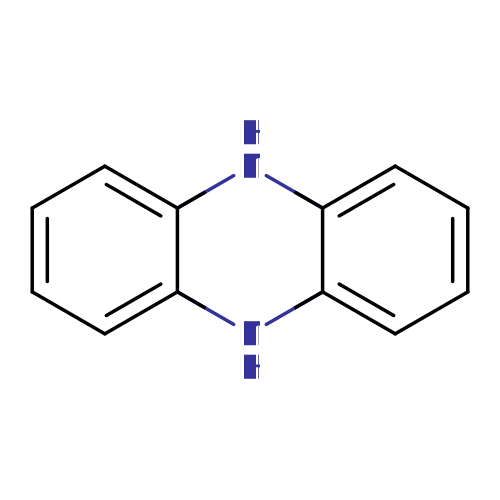
| Common Name | 5,10-dihydrophenazine |
|---|
| Description | 5,10-Dihydrophenazine belongs to the class of organic compounds known as phenazines and derivatives. These are polycyclic aromatic compounds containing a phenazine moiety, which is a linear tricyclic system that consists of a two benzene rings joined by a pyrazine ring. 5,10-Dihydrophenazine is a secondary metabolite. Secondary metabolites are metabolically or physiologically non-essential metabolites that may serve a role as defense or signalling molecules. In some cases they are simply molecules that arise from the incomplete metabolism of other secondary metabolites. 5,10-dihydrophenazine was first documented in 2020 (PMID: 34267405). Based on a literature review a significant number of articles have been published on 5,10-dihydrophenazine (PMID: 35608074) (PMID: 35543697) (PMID: 35259298) (PMID: 35197286) (PMID: 34652071) (PMID: 34432942). |
|---|
| Structure | N1C2=CC=CC=C2NC2=CC=CC=C12 InChI=1S/C12H10N2/c1-2-6-10-9(5-1)13-11-7-3-4-8-12(11)14-10/h1-8,13-14H |
|---|
| Synonyms | Not Available |
|---|
| Chemical Formula | C12H10N2 |
|---|
| Average Mass | 182.2260 Da |
|---|
| Monoisotopic Mass | 182.08440 Da |
|---|
| IUPAC Name | 5,10-dihydrophenazine |
|---|
| Traditional Name | 5,10-dihydrophenazine |
|---|
| CAS Registry Number | Not Available |
|---|
| SMILES | N1C2=CC=CC=C2NC2=CC=CC=C12 |
|---|
| InChI Identifier | InChI=1S/C12H10N2/c1-2-6-10-9(5-1)13-11-7-3-4-8-12(11)14-10/h1-8,13-14H |
|---|
| InChI Key | IVURTNNWJAPOML-UHFFFAOYSA-N |
|---|
| Experimental Spectra |
|---|
|
| Not Available | | Predicted Spectra |
|---|
|
| | Spectrum Type | Description | Depositor ID | Depositor Organization | Depositor | Deposition Date | View |
|---|
| 1D NMR | 13C NMR Spectrum (1D, 25 MHz, H2O, predicted) | Wishart Lab | Wishart Lab | David Wishart | 2021-06-20 | View Spectrum | | 1D NMR | 1H NMR Spectrum (1D, 100 MHz, H2O, predicted) | Wishart Lab | Wishart Lab | David Wishart | 2021-06-20 | View Spectrum | | 1D NMR | 13C NMR Spectrum (1D, 252 MHz, H2O, predicted) | Wishart Lab | Wishart Lab | David Wishart | 2021-06-20 | View Spectrum | | 1D NMR | 1H NMR Spectrum (1D, 1000 MHz, H2O, predicted) | Wishart Lab | Wishart Lab | David Wishart | 2021-06-20 | View Spectrum | | 1D NMR | 13C NMR Spectrum (1D, 50 MHz, H2O, predicted) | Wishart Lab | Wishart Lab | David Wishart | 2021-06-20 | View Spectrum | | 1D NMR | 1H NMR Spectrum (1D, 200 MHz, H2O, predicted) | Wishart Lab | Wishart Lab | David Wishart | 2021-06-20 | View Spectrum | | 1D NMR | 13C NMR Spectrum (1D, 75 MHz, H2O, predicted) | Wishart Lab | Wishart Lab | David Wishart | 2021-06-20 | View Spectrum | | 1D NMR | 1H NMR Spectrum (1D, 300 MHz, H2O, predicted) | Wishart Lab | Wishart Lab | David Wishart | 2021-06-20 | View Spectrum | | 1D NMR | 13C NMR Spectrum (1D, 101 MHz, H2O, predicted) | Wishart Lab | Wishart Lab | David Wishart | 2021-06-20 | View Spectrum | | 1D NMR | 1H NMR Spectrum (1D, 400 MHz, H2O, predicted) | Wishart Lab | Wishart Lab | David Wishart | 2021-06-20 | View Spectrum | | 1D NMR | 13C NMR Spectrum (1D, 126 MHz, H2O, predicted) | Wishart Lab | Wishart Lab | David Wishart | 2021-06-20 | View Spectrum | | 1D NMR | 1H NMR Spectrum (1D, 500 MHz, H2O, predicted) | Wishart Lab | Wishart Lab | David Wishart | 2021-06-20 | View Spectrum | | 1D NMR | 13C NMR Spectrum (1D, 151 MHz, H2O, predicted) | Wishart Lab | Wishart Lab | David Wishart | 2021-06-20 | View Spectrum | | 1D NMR | 1H NMR Spectrum (1D, 600 MHz, H2O, predicted) | Wishart Lab | Wishart Lab | David Wishart | 2021-06-20 | View Spectrum | | 1D NMR | 13C NMR Spectrum (1D, 176 MHz, H2O, predicted) | Wishart Lab | Wishart Lab | David Wishart | 2021-06-20 | View Spectrum | | 1D NMR | 1H NMR Spectrum (1D, 700 MHz, H2O, predicted) | Wishart Lab | Wishart Lab | David Wishart | 2021-06-20 | View Spectrum | | 1D NMR | 13C NMR Spectrum (1D, 201 MHz, H2O, predicted) | Wishart Lab | Wishart Lab | David Wishart | 2021-06-20 | View Spectrum | | 1D NMR | 1H NMR Spectrum (1D, 800 MHz, H2O, predicted) | Wishart Lab | Wishart Lab | David Wishart | 2021-06-20 | View Spectrum | | 1D NMR | 13C NMR Spectrum (1D, 226 MHz, H2O, predicted) | Wishart Lab | Wishart Lab | David Wishart | 2021-06-20 | View Spectrum | | 1D NMR | 1H NMR Spectrum (1D, 900 MHz, H2O, predicted) | Wishart Lab | Wishart Lab | David Wishart | 2021-06-20 | View Spectrum |
| | Chemical Shift Submissions |
|---|
|
| Not Available | | Species |
|---|
| Species of Origin | Not Available |
|---|
| Chemical Taxonomy |
|---|
| Description | Belongs to the class of organic compounds known as phenazines and derivatives. These are polycyclic aromatic compounds containing a phenazine moiety, which is a linear tricyclic system that consists of a two benzene rings joined by a pyrazine ring. |
|---|
| Kingdom | Organic compounds |
|---|
| Super Class | Organoheterocyclic compounds |
|---|
| Class | Diazanaphthalenes |
|---|
| Sub Class | Benzodiazines |
|---|
| Direct Parent | Phenazines and derivatives |
|---|
| Alternative Parents | |
|---|
| Substituents | - Phenazine
- Benzenoid
- Azacycle
- Secondary amine
- Organic nitrogen compound
- Organopnictogen compound
- Hydrocarbon derivative
- Organonitrogen compound
- Amine
- Aromatic heteropolycyclic compound
|
|---|
| Molecular Framework | Aromatic heteropolycyclic compounds |
|---|
| External Descriptors | Not Available |
|---|
| Physical Properties |
|---|
| State | Not Available |
|---|
| Experimental Properties | | Property | Value | Reference |
|---|
| Melting Point | Not Available | Not Available | | Boiling Point | Not Available | Not Available | | Water Solubility | Not Available | Not Available | | LogP | Not Available | Not Available |
|
|---|
| Predicted Properties | |
|---|
| General References | - McCarthy B, Sartor S, Cole J, Damrauer N, Miyake GM: Solvent Effects and Side Reactions in Organocatalyzed Atom Transfer Radical Polymerization for Enabling the Controlled Polymerization of Acrylates Catalyzed by Diaryl Dihydrophenazines. Macromolecules. 2020 Nov 10;53(21):9208-9219. doi: 10.1021/acs.macromol.0c02245. Epub 2020 Oct 21. [PubMed:34267405 ]
- Li H, Liu C, Wang X, Wang J, Li P, Xie G, Jiang Y, Chen R, Tao Y: Achieving Balanced Electrical Performance of Host Material through Dual N-P horizontal lineO Resonance Linkage for Efficient Electroluminescence. ACS Appl Mater Interfaces. 2022 Jun 8;14(22):25834-25841. doi: 10.1021/acsami.2c02745. Epub 2022 May 24. [PubMed:35608074 ]
- Rall JM, Schorpp M, Keilwerth M, Maylander M, Friedmann C, Daub M, Richert S, Meyer K, Krossing I: Synthesis and Characterization of Stable Iron Pentacarbonyl Radical Cation Salts. Angew Chem Int Ed Engl. 2022 Aug 8;61(32):e202204080. doi: 10.1002/anie.202204080. Epub 2022 Jun 7. [PubMed:35543697 ]
- Jin X, Li S, Guo L, Hua J, Qu DH, Su J, Zhang Z, Tian H: Interplay of Steric Effects and Aromaticity Reversals to Expand the Structural/Electronic Responses of Dihydrophenazines. J Am Chem Soc. 2022 Mar 23;144(11):4883-4896. doi: 10.1021/jacs.1c12610. Epub 2022 Mar 8. [PubMed:35259298 ]
- Park H, Kwon G, Lee H, Lee K, Park SY, Kwon JE, Kang K, Kim SJ: In operando visualization of redox flow battery in membrane-free microfluidic platform. Proc Natl Acad Sci U S A. 2022 Mar 1;119(9):e2114947119. doi: 10.1073/pnas.2114947119. [PubMed:35197286 ]
- Jiang WL, Huang B, Wu MX, Zhu YK, Zhao XL, Shi X, Yang HB: Post-Synthetic Modification of Metal-Organic Frameworks Bearing Phenazine Radical Cations for aza-Diels-Alder Reactions. Chem Asian J. 2021 Dec 1;16(23):3985-3992. doi: 10.1002/asia.202100883. Epub 2021 Oct 26. [PubMed:34652071 ]
- Plater MJ, Harrison WTA: A Potential Iterative Approach to 1,4-Dihydro-N-Heteroacene Arrays. ChemistryOpen. 2022 Mar;11(3):e202100150. doi: 10.1002/open.202100150. Epub 2021 Aug 25. [PubMed:34432942 ]
- Bhattacherjee A, Sneha M, Lewis-Borrell L, Amoruso G, Oliver TAA, Tyler J, Clark IP, Orr-Ewing AJ: Singlet and Triplet Contributions to the Excited-State Activities of Dihydrophenazine, Phenoxazine, and Phenothiazine Organocatalysts Used in Atom Transfer Radical Polymerization. J Am Chem Soc. 2021 Mar 10;143(9):3613-3627. doi: 10.1021/jacs.1c00279. Epub 2021 Feb 25. [PubMed:33629835 ]
- van Vliet KM, van Leeuwen NS, Brouwer AM, de Bruin B: Visible-light-induced addition of carboxymethanide to styrene from monochloroacetic acid. Beilstein J Org Chem. 2020 Mar 16;16:398-408. doi: 10.3762/bjoc.16.38. eCollection 2020. [PubMed:32273903 ]
- Schorpp M, Heizmann T, Schmucker M, Rein S, Weber S, Krossing I: Synthesis and Application of a Perfluorinated Ammoniumyl Radical Cation as a Very Strong Deelectronator. Angew Chem Int Ed Engl. 2020 Jun 8;59(24):9453-9459. doi: 10.1002/anie.202002768. Epub 2020 Apr 24. [PubMed:32187797 ]
- LOTUS database [Link]
|
|---|