| Record Information |
|---|
| Version | 2.0 |
|---|
| Created at | 2022-09-04 10:57:28 UTC |
|---|
| Updated at | 2022-09-04 10:57:28 UTC |
|---|
| NP-MRD ID | NP0193501 |
|---|
| Secondary Accession Numbers | None |
|---|
| Natural Product Identification |
|---|
| Common Name | 1-[3,4-dihydroxy-5-(hydroxymethyl)oxolan-2-yl]-4-hydroxypyrimidin-2-one |
|---|
| Description | Uridine belongs to the class of organic compounds known as pyrimidine nucleosides. Pyrimidine nucleosides are compounds comprising a pyrimidine base attached to a ribosyl or deoxyribosyl moiety. It is one of the five standard nucleosides which make up nucleic acids, the others being adenosine, thymidine, cytidine and guanosine. However, thymidine is more commonly written as 'dT' ('d' represents 'deoxy') as it contains a 2'-deoxyribofuranose moiety rather than the ribofuranose ring found in uridine. Uridine is an extremely weak basic (essentially neutral) compound (based on its pKa). In humans, uridine is involved in the metabolic disorder called the g(m2)-gangliosidosis: Variant b, tay-sachs disease pathway. Therefore, galactose is converted to glucose and metabolized in the common glucose pathway. Outside of the human body, Uridine is found, on average, in the highest concentration within milk (cow). Uridine has also been detected, but not quantified in, several different foods, such as chinese chives, biscuits, yellow wax beans, swamp cabbages, and root vegetables. This could make uridine a potential biomarker for the consumption of these foods. Uridine plays a role in the glycolysis pathway of galactose. This process is continued to allow the proper glycolysis of galactose. Some foods that contain uridine in the form of RNA are listed below. There is no catabolic process to metabolize galactose. Uridine is regarded as a non-essential nutrient, as it is produced by the human body as needed and supplementation is not generally recommended, though it has been explored for specific applications. The orotidylate is produced from orotate, which is combined with 5-phosphoribosyl-1-pyrophosphate (PRPP) to form orotidylate by pyrimidine phosphoribosyltransferase. 1-[3,4-dihydroxy-5-(hydroxymethyl)oxolan-2-yl]-4-hydroxypyrimidin-2-one is found in Alangium kurzii, Annona cherimola, Atractylodes lancea, Chrysanthemum zawadskii, Cistanche tubulosa, Dimocarpus longan, Eunicella cavolini, Garcinia dulcis, Gastrodia elata, Glehnia littoralis, Isatis tinctoria, Isodictya erinacea, Lepidium meyenii, Lepisorus contortus, Lindackeria dentata, Maytenus hookeri, Peucedanum japonicum, Prunus dulcis, Salsola collina, Sauropus androgynus, Spiraea formosana and Ulva pertusa. The end result is UDP-galactose and glucose-1-phosphate. |
|---|
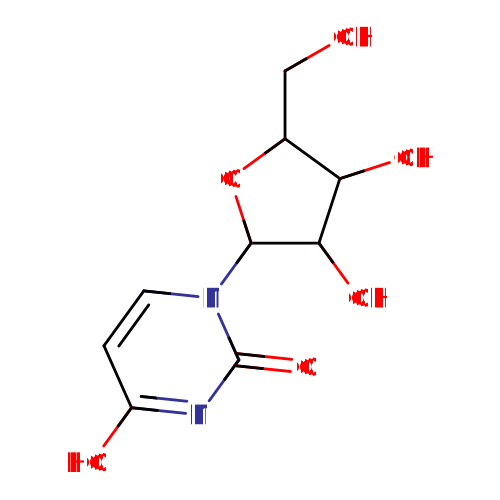
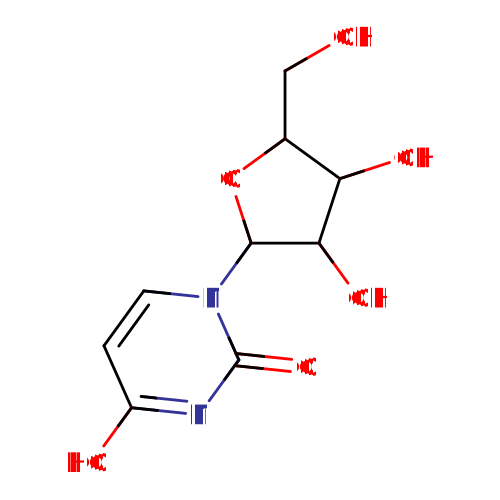
| Structure | OCC1OC(C(O)C1O)N1C=CC(O)=NC1=O InChI=1S/C9H12N2O6/c12-3-4-6(14)7(15)8(17-4)11-2-1-5(13)10-9(11)16/h1-2,4,6-8,12,14-15H,3H2,(H,10,13,16) |
|---|
| Synonyms | | Value | Source |
|---|
| Ara-u | MeSH | | Arabinofuranoside, uracil | MeSH | | Arabinosyluracil | MeSH | | Sponguridine | MeSH | | Uracil arabinofuranoside | MeSH | | 1 beta D Arabinofuranosyl uracil | MeSH | | Arabinofuranosyluracil | MeSH | | Arauridine | MeSH | | 1-beta-D-Arabinofuranosyl uracil | MeSH | | Ara u | MeSH | | Arabinoside, uracil | MeSH | | Uracil arabinoside | MeSH | | Uracil, 1-beta-D-arabinofuranosyl | MeSH |
|
|---|
| Chemical Formula | C9H12N2O6 |
|---|
| Average Mass | 244.2014 Da |
|---|
| Monoisotopic Mass | 244.06954 Da |
|---|
| IUPAC Name | 1-[3,4-dihydroxy-5-(hydroxymethyl)oxolan-2-yl]-4-hydroxy-1,2-dihydropyrimidin-2-one |
|---|
| Traditional Name | 1-[3,4-dihydroxy-5-(hydroxymethyl)oxolan-2-yl]-4-hydroxypyrimidin-2-one |
|---|
| CAS Registry Number | Not Available |
|---|
| SMILES | OCC1OC(C(O)C1O)N1C=CC(O)=NC1=O |
|---|
| InChI Identifier | InChI=1S/C9H12N2O6/c12-3-4-6(14)7(15)8(17-4)11-2-1-5(13)10-9(11)16/h1-2,4,6-8,12,14-15H,3H2,(H,10,13,16) |
|---|
| InChI Key | DRTQHJPVMGBUCF-UHFFFAOYSA-N |
|---|
| Experimental Spectra |
|---|
|
| | Spectrum Type | Description | Depositor Email | Depositor Organization | Depositor | Deposition Date | View |
|---|
| 1D NMR | 1H NMR Spectrum (1D, 400 MHz, D2O, experimental) | Wishart Lab | Wishart Lab | David Wishart | 2021-06-20 | View Spectrum | | 1D NMR | 13C NMR Spectrum (1D, 25.16 MHz, D2O, experimental) | Wishart Lab | Wishart Lab | David Wishart | 2021-06-20 | View Spectrum |
| | Predicted Spectra |
|---|
|
| Not Available | | Chemical Shift Submissions |
|---|
|
| Not Available | | Species |
|---|
| Species of Origin | |
|---|
| Chemical Taxonomy |
|---|
| Description | Belongs to the class of organic compounds known as pyrimidine nucleosides. Pyrimidine nucleosides are compounds comprising a pyrimidine base attached to a ribosyl or deoxyribosyl moiety. |
|---|
| Kingdom | Organic compounds |
|---|
| Super Class | Nucleosides, nucleotides, and analogues |
|---|
| Class | Pyrimidine nucleosides |
|---|
| Sub Class | Not Available |
|---|
| Direct Parent | Pyrimidine nucleosides |
|---|
| Alternative Parents | |
|---|
| Substituents | - Pyrimidine nucleoside
- Glycosyl compound
- N-glycosyl compound
- Pentose monosaccharide
- Pyrimidone
- Hydropyrimidine
- Monosaccharide
- Pyrimidine
- Vinylogous amide
- Tetrahydrofuran
- Heteroaromatic compound
- Urea
- Secondary alcohol
- Lactam
- Organoheterocyclic compound
- Oxacycle
- Azacycle
- Hydrocarbon derivative
- Organopnictogen compound
- Organooxygen compound
- Organonitrogen compound
- Primary alcohol
- Alcohol
- Organic oxygen compound
- Organic oxide
- Organic nitrogen compound
- Aromatic heteromonocyclic compound
|
|---|
| Molecular Framework | Aromatic heteromonocyclic compounds |
|---|
| External Descriptors | - a pyrimidine ribonucleoside (URIDINE )
|
|---|
| Physical Properties |
|---|
| State | Not Available |
|---|
| Experimental Properties | | Property | Value | Reference |
|---|
| Melting Point | Not Available | Not Available | | Boiling Point | Not Available | Not Available | | Water Solubility | Not Available | Not Available | | LogP | Not Available | Not Available |
|
|---|
| Predicted Properties | |
|---|