| Record Information |
|---|
| Version | 2.0 |
|---|
| Created at | 2022-09-04 08:42:39 UTC |
|---|
| Updated at | 2022-09-04 08:42:39 UTC |
|---|
| NP-MRD ID | NP0191674 |
|---|
| Secondary Accession Numbers | None |
|---|
| Natural Product Identification |
|---|
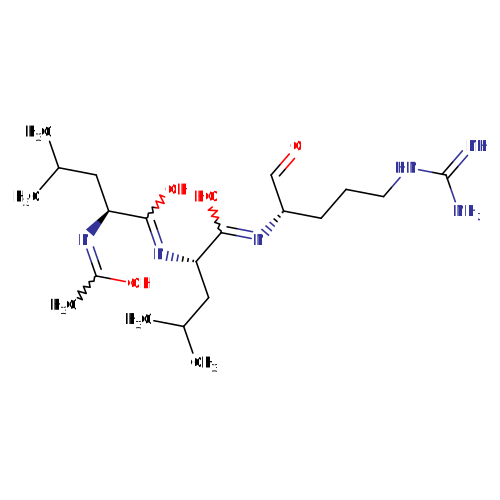
| Common Name | (2s)-n-[(1s)-1-{[(2s)-5-carbamimidamido-1-oxopentan-2-yl]-c-hydroxycarbonimidoyl}-3-methylbutyl]-2-[(1-hydroxyethylidene)amino]-4-methylpentanimidic acid |
|---|
| Description | Leupeptin, also known as ac-leu-leu-arg-H or ac-LLR-H, belongs to the class of organic compounds known as peptides. Peptides are compounds containing an amide derived from two or more amino carboxylic acid molecules (the same or different) by formation of a covalent bond from the carbonyl carbon of one to the nitrogen atom of another. Leupeptin is a secondary metabolite. Secondary metabolites are metabolically or physiologically non-essential metabolites that may serve a role as defense or signalling molecules. In some cases they are simply molecules that arise from the incomplete metabolism of other secondary metabolites. (2s)-n-[(1s)-1-{[(2s)-5-carbamimidamido-1-oxopentan-2-yl]-c-hydroxycarbonimidoyl}-3-methylbutyl]-2-[(1-hydroxyethylidene)amino]-4-methylpentanimidic acid is found in Apis cerana, Streptomyces lavendulae, Streptomyces roseus and Trypanosoma brucei. (2s)-n-[(1s)-1-{[(2s)-5-carbamimidamido-1-oxopentan-2-yl]-c-hydroxycarbonimidoyl}-3-methylbutyl]-2-[(1-hydroxyethylidene)amino]-4-methylpentanimidic acid was first documented in 2022 (PMID: 36058890). Based on a literature review a small amount of articles have been published on leupeptin (PMID: 36049162) (PMID: 36006781) (PMID: 35966002) (PMID: 35929479). |
|---|
| Structure | CC(C)C[C@H](N=C(C)O)C(O)=N[C@@H](CC(C)C)C(O)=N[C@@H](CCCNC(N)=N)C=O InChI=1S/C20H38N6O4/c1-12(2)9-16(24-14(5)28)19(30)26-17(10-13(3)4)18(29)25-15(11-27)7-6-8-23-20(21)22/h11-13,15-17H,6-10H2,1-5H3,(H,24,28)(H,25,29)(H,26,30)(H4,21,22,23)/t15-,16-,17-/m0/s1 |
|---|
| Synonyms | | Value | Source |
|---|
| Ac-L-leu-L-leu-L-arg-H | ChEBI | | Ac-leu-leu-arg-H | ChEBI | | Ac-leu-leu-argininal | ChEBI | | Ac-LLR-H | ChEBI | | Acetyl-L-leucyl-L-leucyl-L-argininal | ChEBI | | N-Acetyl-L-leucyl-L-leucyl-L-argininal | ChEBI | | N-Acetyl-leucylleucylargininal | ChEBI | | Leupeptin, (S)-isomer | MeSH | | Leupeptin, monoacetate, (S)-isomer | MeSH | | Acetyl-L-leucyl-L-leucyl-L-arginal | MeSH |
|
|---|
| Chemical Formula | C20H38N6O4 |
|---|
| Average Mass | 426.5620 Da |
|---|
| Monoisotopic Mass | 426.29545 Da |
|---|
| IUPAC Name | (2S)-N-[(1S)-1-{[(2S)-5-carbamimidamido-1-oxopentan-2-yl]-C-hydroxycarbonimidoyl}-3-methylbutyl]-2-[(1-hydroxyethylidene)amino]-4-methylpentanimidic acid |
|---|
| Traditional Name | leupeptin |
|---|
| CAS Registry Number | Not Available |
|---|
| SMILES | CC(C)C[C@H](N=C(C)O)C(O)=N[C@@H](CC(C)C)C(O)=N[C@@H](CCCNC(N)=N)C=O |
|---|
| InChI Identifier | InChI=1S/C20H38N6O4/c1-12(2)9-16(24-14(5)28)19(30)26-17(10-13(3)4)18(29)25-15(11-27)7-6-8-23-20(21)22/h11-13,15-17H,6-10H2,1-5H3,(H,24,28)(H,25,29)(H,26,30)(H4,21,22,23)/t15-,16-,17-/m0/s1 |
|---|
| InChI Key | GDBQQVLCIARPGH-ULQDDVLXSA-N |
|---|
| Experimental Spectra |
|---|
|
| Not Available | | Predicted Spectra |
|---|
|
| | Spectrum Type | Description | Depositor ID | Depositor Organization | Depositor | Deposition Date | View |
|---|
| 1D NMR | 13C NMR Spectrum (1D, 25 MHz, H2O, predicted) | Wishart Lab | Wishart Lab | David Wishart | 2021-06-20 | View Spectrum | | 1D NMR | 1H NMR Spectrum (1D, 100 MHz, H2O, predicted) | Wishart Lab | Wishart Lab | David Wishart | 2021-06-20 | View Spectrum | | 1D NMR | 13C NMR Spectrum (1D, 252 MHz, H2O, predicted) | Wishart Lab | Wishart Lab | David Wishart | 2021-06-20 | View Spectrum | | 1D NMR | 1H NMR Spectrum (1D, 1000 MHz, H2O, predicted) | Wishart Lab | Wishart Lab | David Wishart | 2021-06-20 | View Spectrum | | 1D NMR | 13C NMR Spectrum (1D, 50 MHz, H2O, predicted) | Wishart Lab | Wishart Lab | David Wishart | 2021-06-20 | View Spectrum | | 1D NMR | 1H NMR Spectrum (1D, 200 MHz, H2O, predicted) | Wishart Lab | Wishart Lab | David Wishart | 2021-06-20 | View Spectrum | | 1D NMR | 13C NMR Spectrum (1D, 75 MHz, H2O, predicted) | Wishart Lab | Wishart Lab | David Wishart | 2021-06-20 | View Spectrum | | 1D NMR | 1H NMR Spectrum (1D, 300 MHz, H2O, predicted) | Wishart Lab | Wishart Lab | David Wishart | 2021-06-20 | View Spectrum | | 1D NMR | 13C NMR Spectrum (1D, 101 MHz, H2O, predicted) | Wishart Lab | Wishart Lab | David Wishart | 2021-06-20 | View Spectrum | | 1D NMR | 1H NMR Spectrum (1D, 400 MHz, H2O, predicted) | Wishart Lab | Wishart Lab | David Wishart | 2021-06-20 | View Spectrum | | 1D NMR | 13C NMR Spectrum (1D, 126 MHz, H2O, predicted) | Wishart Lab | Wishart Lab | David Wishart | 2021-06-20 | View Spectrum | | 1D NMR | 1H NMR Spectrum (1D, 500 MHz, H2O, predicted) | Wishart Lab | Wishart Lab | David Wishart | 2021-06-20 | View Spectrum | | 1D NMR | 13C NMR Spectrum (1D, 151 MHz, H2O, predicted) | Wishart Lab | Wishart Lab | David Wishart | 2021-06-20 | View Spectrum | | 1D NMR | 1H NMR Spectrum (1D, 600 MHz, H2O, predicted) | Wishart Lab | Wishart Lab | David Wishart | 2021-06-20 | View Spectrum | | 1D NMR | 13C NMR Spectrum (1D, 176 MHz, H2O, predicted) | Wishart Lab | Wishart Lab | David Wishart | 2021-06-20 | View Spectrum | | 1D NMR | 1H NMR Spectrum (1D, 700 MHz, H2O, predicted) | Wishart Lab | Wishart Lab | David Wishart | 2021-06-20 | View Spectrum | | 1D NMR | 13C NMR Spectrum (1D, 201 MHz, H2O, predicted) | Wishart Lab | Wishart Lab | David Wishart | 2021-06-20 | View Spectrum | | 1D NMR | 1H NMR Spectrum (1D, 800 MHz, H2O, predicted) | Wishart Lab | Wishart Lab | David Wishart | 2021-06-20 | View Spectrum | | 1D NMR | 13C NMR Spectrum (1D, 226 MHz, H2O, predicted) | Wishart Lab | Wishart Lab | David Wishart | 2021-06-20 | View Spectrum | | 1D NMR | 1H NMR Spectrum (1D, 900 MHz, H2O, predicted) | Wishart Lab | Wishart Lab | David Wishart | 2021-06-20 | View Spectrum |
| | Chemical Shift Submissions |
|---|
|
| Not Available | | Species |
|---|
| Species of Origin | |
|---|
| Chemical Taxonomy |
|---|
| Description | Belongs to the class of organic compounds known as peptides. Peptides are compounds containing an amide derived from two or more amino carboxylic acid molecules (the same or different) by formation of a covalent bond from the carbonyl carbon of one to the nitrogen atom of another. |
|---|
| Kingdom | Organic compounds |
|---|
| Super Class | Organic acids and derivatives |
|---|
| Class | Carboxylic acids and derivatives |
|---|
| Sub Class | Amino acids, peptides, and analogues |
|---|
| Direct Parent | Peptides |
|---|
| Alternative Parents | |
|---|
| Substituents | - Alpha peptide
- Guanidine
- Carboximidic acid
- Carboximidic acid derivative
- Carboximidamide
- Propargyl-type 1,3-dipolar organic compound
- Organic 1,3-dipolar compound
- Carbonyl group
- Organic oxygen compound
- Organooxygen compound
- Organonitrogen compound
- Imine
- Organic nitrogen compound
- Aldehyde
- Hydrocarbon derivative
- Organic oxide
- Organopnictogen compound
- Aliphatic acyclic compound
|
|---|
| Molecular Framework | Aliphatic acyclic compounds |
|---|
| External Descriptors | Not Available |
|---|
| Physical Properties |
|---|
| State | Not Available |
|---|
| Experimental Properties | | Property | Value | Reference |
|---|
| Melting Point | Not Available | Not Available | | Boiling Point | Not Available | Not Available | | Water Solubility | Not Available | Not Available | | LogP | Not Available | Not Available |
|
|---|
| Predicted Properties | |
|---|
| General References | - Lu R, Chen J, Wang F, Wang L, Liu J, Lin Y: Lysosome Inhibition Reduces Basal and Nutrient-Induced Fat Accumulation in Caenorhabditis elegans. Mol Cells. 2022 Sep 30;45(9):649-659. doi: 10.14348/molcells.2022.0073. Epub 2022 Aug 29. [PubMed:36058890 ]
- Gurevich M, Iocolano K, Achonu JU, Badalamente MA, Hurst LC, Komatsu DE: Leupeptin accelerates recovery after sciatic transection and repair, but not crush injuries in rats. Neuroreport. 2022 Sep 7;33(13):590-596. doi: 10.1097/WNR.0000000000001821. Epub 2022 Aug 3. [PubMed:36049162 ]
- Li JZ, Dong LM, Zheng LL, Fu WL, Zhang JJ, Zhang L, Hu Q, Chen P, Gao ZF, Xia F: Molecular Visual Sensing, Boolean Logic Computing, and Data Security Using a Droplet-Based Superwetting Paradigm. ACS Appl Mater Interfaces. 2022 Sep 7;14(35):40447-40459. doi: 10.1021/acsami.2c11532. Epub 2022 Aug 25. [PubMed:36006781 ]
- Ma L, Han Z, Yin H, Tian J, Zhang J, Li N, Ding C, Zhang L: Characterization of Cathepsin B in Mediating Silica Nanoparticle-Induced Macrophage Pyroptosis via an NLRP3-Dependent Manner. J Inflamm Res. 2022 Aug 8;15:4537-4545. doi: 10.2147/JIR.S371536. eCollection 2022. [PubMed:35966002 ]
- McCoin CS, Franczak E, Washburn MP, Sardiu ME, Thyfault JP: Acute exercise dynamically modulates the hepatic mitochondrial proteome. Mol Omics. 2022 Oct 31;18(9):840-852. doi: 10.1039/d2mo00143h. [PubMed:35929479 ]
- LOTUS database [Link]
|
|---|