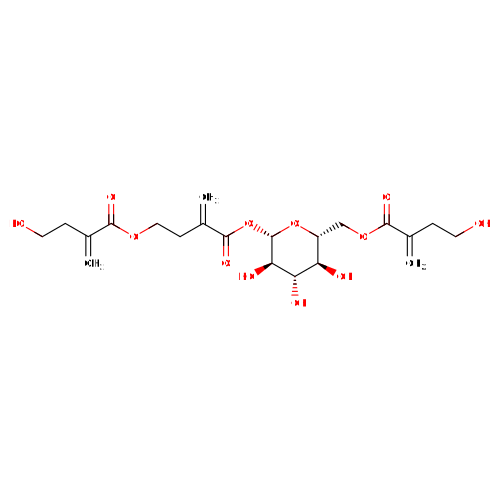
| Record Information |
|---|
| Version | 2.0 |
|---|
| Created at | 2022-09-04 08:28:30 UTC |
|---|
| Updated at | 2022-09-04 08:28:30 UTC |
|---|
| NP-MRD ID | NP0191488 |
|---|
| Secondary Accession Numbers | None |
|---|
| Natural Product Identification |
|---|
| Common Name | [(2r,3s,4s,5r,6s)-3,4,5-trihydroxy-6-({4-[(4-hydroxy-2-methylidenebutanoyl)oxy]-2-methylidenebutanoyl}oxy)oxan-2-yl]methyl 4-hydroxy-2-methylidenebutanoate |
|---|
| Description | [(2R,3S,4S,5R,6S)-3,4,5-trihydroxy-6-({4-[(4-hydroxy-2-methylidenebutanoyl)oxy]-2-methylidenebutanoyl}oxy)oxan-2-yl]methyl 4-hydroxy-2-methylidenebutanoate belongs to the class of organic compounds known as saccharolipids. Saccharolipids are compounds in which fatty acids are linked directly to a sugar backbone, forming structures that are compatible with membrane bilayers. In the saccharolipids, a sugar substitutes for the glycerol backbone that is present in glycerolipids and glycerophospholipids. The most familiar saccharolipids contain an acylated glucosamine. In contrast to others glycolipids, the fatty acid is not glycosidically linked to the sugar moiety. [(2r,3s,4s,5r,6s)-3,4,5-trihydroxy-6-({4-[(4-hydroxy-2-methylidenebutanoyl)oxy]-2-methylidenebutanoyl}oxy)oxan-2-yl]methyl 4-hydroxy-2-methylidenebutanoate is found in Alstroemeria revoluta. Based on a literature review very few articles have been published on [(2R,3S,4S,5R,6S)-3,4,5-trihydroxy-6-({4-[(4-hydroxy-2-methylidenebutanoyl)oxy]-2-methylidenebutanoyl}oxy)oxan-2-yl]methyl 4-hydroxy-2-methylidenebutanoate. |
|---|
| Structure | OCCC(=C)C(=O)OCCC(=C)C(=O)O[C@@H]1O[C@H](COC(=O)C(=C)CCO)[C@@H](O)[C@H](O)[C@H]1O InChI=1S/C21H30O12/c1-11(4-7-22)18(27)30-9-6-13(3)20(29)33-21-17(26)16(25)15(24)14(32-21)10-31-19(28)12(2)5-8-23/h14-17,21-26H,1-10H2/t14-,15-,16+,17-,21+/m1/s1 |
|---|
| Synonyms | | Value | Source |
|---|
| [(2R,3S,4S,5R,6S)-3,4,5-Trihydroxy-6-({4-[(4-hydroxy-2-methylidenebutanoyl)oxy]-2-methylidenebutanoyl}oxy)oxan-2-yl]methyl 4-hydroxy-2-methylidenebutanoic acid | Generator |
|
|---|
| Chemical Formula | C21H30O12 |
|---|
| Average Mass | 474.4590 Da |
|---|
| Monoisotopic Mass | 474.17373 Da |
|---|
| IUPAC Name | [(2R,3S,4S,5R,6S)-3,4,5-trihydroxy-6-({4-[(4-hydroxy-2-methylidenebutanoyl)oxy]-2-methylidenebutanoyl}oxy)oxan-2-yl]methyl 4-hydroxy-2-methylidenebutanoate |
|---|
| Traditional Name | [(2R,3S,4S,5R,6S)-3,4,5-trihydroxy-6-({4-[(4-hydroxy-2-methylidenebutanoyl)oxy]-2-methylidenebutanoyl}oxy)oxan-2-yl]methyl 4-hydroxy-2-methylidenebutanoate |
|---|
| CAS Registry Number | Not Available |
|---|
| SMILES | OCCC(=C)C(=O)OCCC(=C)C(=O)O[C@@H]1O[C@H](COC(=O)C(=C)CCO)[C@@H](O)[C@H](O)[C@H]1O |
|---|
| InChI Identifier | InChI=1S/C21H30O12/c1-11(4-7-22)18(27)30-9-6-13(3)20(29)33-21-17(26)16(25)15(24)14(32-21)10-31-19(28)12(2)5-8-23/h14-17,21-26H,1-10H2/t14-,15-,16+,17-,21+/m1/s1 |
|---|
| InChI Key | YPVGGTXGOCDLRH-IALVOCICSA-N |
|---|
| Experimental Spectra |
|---|
|
| Not Available | | Predicted Spectra |
|---|
|
| Not Available | | Chemical Shift Submissions |
|---|
|
| Not Available | | Species |
|---|
| Species of Origin | |
|---|
| Chemical Taxonomy |
|---|
| Description | Belongs to the class of organic compounds known as saccharolipids. Saccharolipids are compounds in which fatty acids are linked directly to a sugar backbone, forming structures that are compatible with membrane bilayers. In the saccharolipids, a sugar substitutes for the glycerol backbone that is present in glycerolipids and glycerophospholipids. The most familiar saccharolipids contain an acylated glucosamine. In contrast to others glycolipids, the fatty acid is not glycosidically linked to the sugar moiety. |
|---|
| Kingdom | Organic compounds |
|---|
| Super Class | Lipids and lipid-like molecules |
|---|
| Class | Saccharolipids |
|---|
| Sub Class | Not Available |
|---|
| Direct Parent | Saccharolipids |
|---|
| Alternative Parents | |
|---|
| Substituents | - Saccharolipid
- Tricarboxylic acid or derivatives
- Fatty acid ester
- Monosaccharide
- Oxane
- Fatty acyl
- Alpha,beta-unsaturated carboxylic ester
- Enoate ester
- Carboxylic acid ester
- Secondary alcohol
- Acetal
- Carboxylic acid derivative
- Oxacycle
- Polyol
- Organoheterocyclic compound
- Hydrocarbon derivative
- Organic oxide
- Organic oxygen compound
- Organooxygen compound
- Carbonyl group
- Primary alcohol
- Alcohol
- Aliphatic heteromonocyclic compound
|
|---|
| Molecular Framework | Aliphatic heteromonocyclic compounds |
|---|
| External Descriptors | Not Available |
|---|
| Physical Properties |
|---|
| State | Not Available |
|---|
| Experimental Properties | | Property | Value | Reference |
|---|
| Melting Point | Not Available | Not Available | | Boiling Point | Not Available | Not Available | | Water Solubility | Not Available | Not Available | | LogP | Not Available | Not Available |
|
|---|
| Predicted Properties | |
|---|