| Record Information |
|---|
| Version | 2.0 |
|---|
| Created at | 2022-09-04 08:17:38 UTC |
|---|
| Updated at | 2022-09-04 08:17:38 UTC |
|---|
| NP-MRD ID | NP0191360 |
|---|
| Secondary Accession Numbers | None |
|---|
| Natural Product Identification |
|---|
| Common Name | estrone 3-glucuronide |
|---|
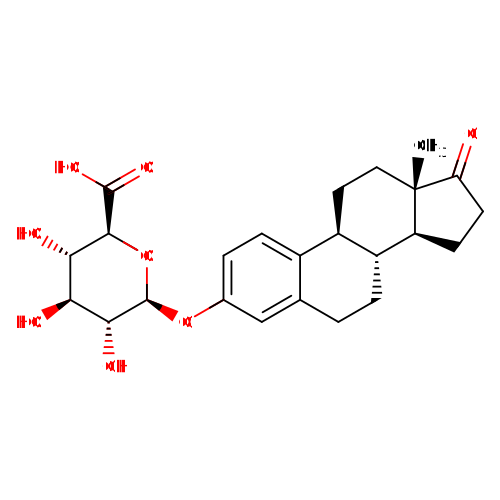
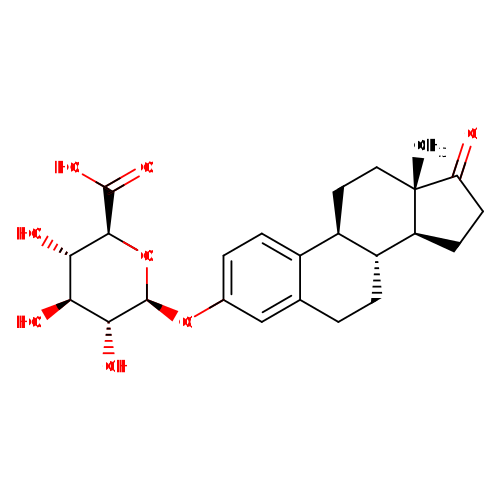
| Description | Estrone glucuronide belongs to the class of organic compounds known as steroid glucuronide conjugates. These are sterol lipids containing a glucuronide moiety linked to the steroid skeleton. Thus, estrone glucuronide is considered to be a steroid conjugate lipid molecule. Estrone glucuronide is a very hydrophobic molecule, practically insoluble (in water), and relatively neutral. Estrone glucuronide and uridine 5'-diphosphate can be biosynthesized from estrone and uridine diphosphate glucuronic acid through the action of the enzyme UDP-glucuronosyltransferase 1-1. In humans, estrone glucuronide is involved in estrone metabolism. estrone 3-glucuronide is found in Apis cerana, Homo sapiens and Mus musculus. estrone 3-glucuronide was first documented in 2010 (PMID: 20541211). The 3-beta-D-glucuronide of estrone. |
|---|
| Structure | [H][C@@]12CCC(=O)[C@@]1(C)CC[C@]1([H])C3=CC=C(O[C@@H]4O[C@@H]([C@@H](O)[C@H](O)[C@H]4O)C(O)=O)C=C3CC[C@@]21[H] InChI=1S/C24H30O8/c1-24-9-8-14-13-5-3-12(10-11(13)2-4-15(14)16(24)6-7-17(24)25)31-23-20(28)18(26)19(27)21(32-23)22(29)30/h3,5,10,14-16,18-21,23,26-28H,2,4,6-9H2,1H3,(H,29,30)/t14-,15-,16+,18+,19+,20-,21+,23-,24+/m1/s1 |
|---|
| Synonyms | | Value | Source |
|---|
| Estrone 3-glucosiduronic acid | ChEBI | | Estrone 3-glucuronide | ChEBI | | Estrone beta-D-glucuronide | ChEBI | | Estrone 3-glucosiduronate | Generator | | Estrone b-D-glucuronide | Generator | | Estrone β-D-glucuronide | Generator | | Estrone beta-delta-glucuronide | HMDB | | Estrone-3-glucosiduronic acid | HMDB | | Estrone-3-glucuronide | HMDB | | Estrone-3-glucosiduronate | HMDB |
|
|---|
| Chemical Formula | C24H30O8 |
|---|
| Average Mass | 446.4902 Da |
|---|
| Monoisotopic Mass | 446.19407 Da |
|---|
| IUPAC Name | (2S,3S,4S,5R,6S)-3,4,5-trihydroxy-6-{[(1S,10R,11S,15S)-15-methyl-14-oxotetracyclo[8.7.0.0²,⁷.0¹¹,¹⁵]heptadeca-2,4,6-trien-5-yl]oxy}oxane-2-carboxylic acid |
|---|
| Traditional Name | estrone-3-glucuronide |
|---|
| CAS Registry Number | Not Available |
|---|
| SMILES | [H][C@@]12CCC(=O)[C@@]1(C)CC[C@]1([H])C3=CC=C(O[C@@H]4O[C@@H]([C@@H](O)[C@H](O)[C@H]4O)C(O)=O)C=C3CC[C@@]21[H] |
|---|
| InChI Identifier | InChI=1S/C24H30O8/c1-24-9-8-14-13-5-3-12(10-11(13)2-4-15(14)16(24)6-7-17(24)25)31-23-20(28)18(26)19(27)21(32-23)22(29)30/h3,5,10,14-16,18-21,23,26-28H,2,4,6-9H2,1H3,(H,29,30)/t14-,15-,16+,18+,19+,20-,21+,23-,24+/m1/s1 |
|---|
| InChI Key | FJAZVHYPASAQKM-JBAURARKSA-N |
|---|
| Experimental Spectra |
|---|
|
| Not Available | | Predicted Spectra |
|---|
|
| | Spectrum Type | Description | Depositor ID | Depositor Organization | Depositor | Deposition Date | View |
|---|
| 1D NMR | 13C NMR Spectrum (1D, 25 MHz, H2O, predicted) | Wishart Lab | Wishart Lab | David Wishart | 2021-06-20 | View Spectrum | | 1D NMR | 1H NMR Spectrum (1D, 100 MHz, H2O, predicted) | Wishart Lab | Wishart Lab | David Wishart | 2021-06-20 | View Spectrum | | 1D NMR | 13C NMR Spectrum (1D, 252 MHz, H2O, predicted) | Wishart Lab | Wishart Lab | David Wishart | 2021-06-20 | View Spectrum | | 1D NMR | 1H NMR Spectrum (1D, 1000 MHz, H2O, predicted) | Wishart Lab | Wishart Lab | David Wishart | 2021-06-20 | View Spectrum | | 1D NMR | 13C NMR Spectrum (1D, 50 MHz, H2O, predicted) | Wishart Lab | Wishart Lab | David Wishart | 2021-06-20 | View Spectrum | | 1D NMR | 1H NMR Spectrum (1D, 200 MHz, H2O, predicted) | Wishart Lab | Wishart Lab | David Wishart | 2021-06-20 | View Spectrum | | 1D NMR | 13C NMR Spectrum (1D, 75 MHz, H2O, predicted) | Wishart Lab | Wishart Lab | David Wishart | 2021-06-20 | View Spectrum | | 1D NMR | 1H NMR Spectrum (1D, 300 MHz, H2O, predicted) | Wishart Lab | Wishart Lab | David Wishart | 2021-06-20 | View Spectrum | | 1D NMR | 13C NMR Spectrum (1D, 101 MHz, H2O, predicted) | Wishart Lab | Wishart Lab | David Wishart | 2021-06-20 | View Spectrum | | 1D NMR | 1H NMR Spectrum (1D, 400 MHz, H2O, predicted) | Wishart Lab | Wishart Lab | David Wishart | 2021-06-20 | View Spectrum | | 1D NMR | 13C NMR Spectrum (1D, 126 MHz, H2O, predicted) | Wishart Lab | Wishart Lab | David Wishart | 2021-06-20 | View Spectrum | | 1D NMR | 1H NMR Spectrum (1D, 500 MHz, H2O, predicted) | Wishart Lab | Wishart Lab | David Wishart | 2021-06-20 | View Spectrum | | 1D NMR | 13C NMR Spectrum (1D, 151 MHz, H2O, predicted) | Wishart Lab | Wishart Lab | David Wishart | 2021-06-20 | View Spectrum | | 1D NMR | 1H NMR Spectrum (1D, 600 MHz, H2O, predicted) | Wishart Lab | Wishart Lab | David Wishart | 2021-06-20 | View Spectrum | | 1D NMR | 13C NMR Spectrum (1D, 176 MHz, H2O, predicted) | Wishart Lab | Wishart Lab | David Wishart | 2021-06-20 | View Spectrum | | 1D NMR | 1H NMR Spectrum (1D, 700 MHz, H2O, predicted) | Wishart Lab | Wishart Lab | David Wishart | 2021-06-20 | View Spectrum | | 1D NMR | 13C NMR Spectrum (1D, 201 MHz, H2O, predicted) | Wishart Lab | Wishart Lab | David Wishart | 2021-06-20 | View Spectrum | | 1D NMR | 1H NMR Spectrum (1D, 800 MHz, H2O, predicted) | Wishart Lab | Wishart Lab | David Wishart | 2021-06-20 | View Spectrum | | 1D NMR | 13C NMR Spectrum (1D, 226 MHz, H2O, predicted) | Wishart Lab | Wishart Lab | David Wishart | 2021-06-20 | View Spectrum | | 1D NMR | 1H NMR Spectrum (1D, 900 MHz, H2O, predicted) | Wishart Lab | Wishart Lab | David Wishart | 2021-06-20 | View Spectrum |
| | Chemical Shift Submissions |
|---|
|
| Not Available | | Species |
|---|
| Species of Origin | |
|---|
| Chemical Taxonomy |
|---|
| Description | Belongs to the class of organic compounds known as steroid glucuronide conjugates. These are sterol lipids containing a glucuronide moiety linked to the steroid skeleton. |
|---|
| Kingdom | Organic compounds |
|---|
| Super Class | Lipids and lipid-like molecules |
|---|
| Class | Steroids and steroid derivatives |
|---|
| Sub Class | Steroidal glycosides |
|---|
| Direct Parent | Steroid glucuronide conjugates |
|---|
| Alternative Parents | |
|---|
| Substituents | - Steroid-glucuronide-skeleton
- Estrane-skeleton
- 17-oxosteroid
- Oxosteroid
- Fatty acyl glycoside
- Fatty acyl glycoside of mono- or disaccharide
- Phenolic glycoside
- 1-o-glucuronide
- O-glucuronide
- Phenanthrene
- Glucuronic acid or derivatives
- Alkyl glycoside
- Glycosyl compound
- O-glycosyl compound
- Tetralin
- Beta-hydroxy acid
- Pyran
- Fatty acyl
- Oxane
- Benzenoid
- Monosaccharide
- Hydroxy acid
- Ketone
- Secondary alcohol
- Oxacycle
- Organoheterocyclic compound
- Polyol
- Carboxylic acid derivative
- Carboxylic acid
- Acetal
- Monocarboxylic acid or derivatives
- Hydrocarbon derivative
- Organic oxygen compound
- Carbonyl group
- Alcohol
- Organic oxide
- Organooxygen compound
- Aromatic heteropolycyclic compound
|
|---|
| Molecular Framework | Aromatic heteropolycyclic compounds |
|---|
| External Descriptors | |
|---|
| Physical Properties |
|---|
| State | Not Available |
|---|
| Experimental Properties | | Property | Value | Reference |
|---|
| Melting Point | Not Available | Not Available | | Boiling Point | Not Available | Not Available | | Water Solubility | Not Available | Not Available | | LogP | Not Available | Not Available |
|
|---|
| Predicted Properties | |
|---|