| Record Information |
|---|
| Version | 2.0 |
|---|
| Created at | 2022-09-04 05:16:54 UTC |
|---|
| Updated at | 2022-09-04 05:16:54 UTC |
|---|
| NP-MRD ID | NP0188877 |
|---|
| Secondary Accession Numbers | None |
|---|
| Natural Product Identification |
|---|
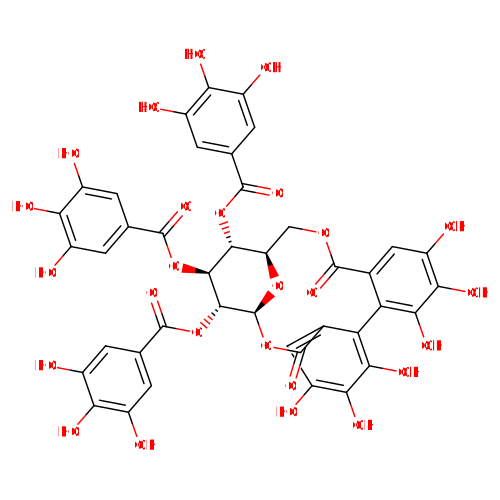
| Common Name | (1s,19r,20r,21s,22r)-6,7,8,11,12,13-hexahydroxy-3,16-dioxo-20,21-bis(3,4,5-trihydroxybenzoyloxy)-2,17,23-trioxatetracyclo[17.3.1.0⁴,⁹.0¹⁰,¹⁵]tricosa-4,6,8,10(15),11,13-hexaen-22-yl 3,4,5-trihydroxybenzoate |
|---|
| Description | Davidiin belongs to the class of organic compounds known as hydrolyzable tannins. These are tannins with a structure characterized by either of the following models. In model 1, the structure contains galloyl units (in some cases, shikimic acid units) that are linked to diverse polyol carbohydrate-, catechin-, or triterpenoid units. In model 2, contains at least two galloyl units C-C coupled to each other, and do not contain a glycosidically linked catechin unit. (1s,19r,20r,21s,22r)-6,7,8,11,12,13-hexahydroxy-3,16-dioxo-20,21-bis(3,4,5-trihydroxybenzoyloxy)-2,17,23-trioxatetracyclo[17.3.1.0⁴,⁹.0¹⁰,¹⁵]tricosa-4,6,8,10(15),11,13-hexaen-22-yl 3,4,5-trihydroxybenzoate is found in Acer tataricum. (1s,19r,20r,21s,22r)-6,7,8,11,12,13-hexahydroxy-3,16-dioxo-20,21-bis(3,4,5-trihydroxybenzoyloxy)-2,17,23-trioxatetracyclo[17.3.1.0⁴,⁹.0¹⁰,¹⁵]tricosa-4,6,8,10(15),11,13-hexaen-22-yl 3,4,5-trihydroxybenzoate was first documented in 2012 (PMID: 22865562). Based on a literature review a small amount of articles have been published on Davidiin (PMID: 28323035) (PMID: 28294988) (PMID: 24424345) (PMID: 23897557). |
|---|
| Structure | OC1=CC(=CC(O)=C1O)C(=O)O[C@@H]1[C@H]2COC(=O)C3=C(C(O)=C(O)C(O)=C3)C3=C(O)C(O)=C(O)C=C3C(=O)O[C@H](O2)[C@H](OC(=O)C2=CC(O)=C(O)C(O)=C2)[C@H]1OC(=O)C1=CC(O)=C(O)C(O)=C1 InChI=1S/C41H30O26/c42-15-1-10(2-16(43)26(15)50)36(57)64-33-23-9-62-39(60)13-7-21(48)29(53)31(55)24(13)25-14(8-22(49)30(54)32(25)56)40(61)67-41(63-23)35(66-38(59)12-5-19(46)28(52)20(47)6-12)34(33)65-37(58)11-3-17(44)27(51)18(45)4-11/h1-8,23,33-35,41-56H,9H2/t23-,33-,34+,35-,41+/m1/s1 |
|---|
| Synonyms | Not Available |
|---|
| Chemical Formula | C41H30O26 |
|---|
| Average Mass | 938.6650 Da |
|---|
| Monoisotopic Mass | 938.10253 Da |
|---|
| IUPAC Name | Not Available |
|---|
| Traditional Name | Not Available |
|---|
| CAS Registry Number | Not Available |
|---|
| SMILES | OC1=CC(=CC(O)=C1O)C(=O)O[C@@H]1[C@H]2COC(=O)C3=C(C(O)=C(O)C(O)=C3)C3=C(O)C(O)=C(O)C=C3C(=O)O[C@H](O2)[C@H](OC(=O)C2=CC(O)=C(O)C(O)=C2)[C@H]1OC(=O)C1=CC(O)=C(O)C(O)=C1 |
|---|
| InChI Identifier | InChI=1S/C41H30O26/c42-15-1-10(2-16(43)26(15)50)36(57)64-33-23-9-62-39(60)13-7-21(48)29(53)31(55)24(13)25-14(8-22(49)30(54)32(25)56)40(61)67-41(63-23)35(66-38(59)12-5-19(46)28(52)20(47)6-12)34(33)65-37(58)11-3-17(44)27(51)18(45)4-11/h1-8,23,33-35,41-56H,9H2/t23-,33-,34+,35-,41+/m1/s1 |
|---|
| InChI Key | WTXYHBLZUNEOJB-UUUCSUBKSA-N |
|---|
| Experimental Spectra |
|---|
|
| Not Available | | Predicted Spectra |
|---|
|
| | Spectrum Type | Description | Depositor ID | Depositor Organization | Depositor | Deposition Date | View |
|---|
| 1D NMR | 13C NMR Spectrum (1D, 25 MHz, H2O, predicted) | Wishart Lab | Wishart Lab | David Wishart | 2021-06-20 | View Spectrum | | 1D NMR | 1H NMR Spectrum (1D, 100 MHz, H2O, predicted) | Wishart Lab | Wishart Lab | David Wishart | 2021-06-20 | View Spectrum | | 1D NMR | 13C NMR Spectrum (1D, 252 MHz, H2O, predicted) | Wishart Lab | Wishart Lab | David Wishart | 2021-06-20 | View Spectrum | | 1D NMR | 1H NMR Spectrum (1D, 1000 MHz, H2O, predicted) | Wishart Lab | Wishart Lab | David Wishart | 2021-06-20 | View Spectrum | | 1D NMR | 13C NMR Spectrum (1D, 50 MHz, H2O, predicted) | Wishart Lab | Wishart Lab | David Wishart | 2021-06-20 | View Spectrum | | 1D NMR | 1H NMR Spectrum (1D, 200 MHz, H2O, predicted) | Wishart Lab | Wishart Lab | David Wishart | 2021-06-20 | View Spectrum | | 1D NMR | 13C NMR Spectrum (1D, 75 MHz, H2O, predicted) | Wishart Lab | Wishart Lab | David Wishart | 2021-06-20 | View Spectrum | | 1D NMR | 1H NMR Spectrum (1D, 300 MHz, H2O, predicted) | Wishart Lab | Wishart Lab | David Wishart | 2021-06-20 | View Spectrum | | 1D NMR | 13C NMR Spectrum (1D, 101 MHz, H2O, predicted) | Wishart Lab | Wishart Lab | David Wishart | 2021-06-20 | View Spectrum | | 1D NMR | 1H NMR Spectrum (1D, 400 MHz, H2O, predicted) | Wishart Lab | Wishart Lab | David Wishart | 2021-06-20 | View Spectrum | | 1D NMR | 13C NMR Spectrum (1D, 126 MHz, H2O, predicted) | Wishart Lab | Wishart Lab | David Wishart | 2021-06-20 | View Spectrum | | 1D NMR | 1H NMR Spectrum (1D, 500 MHz, H2O, predicted) | Wishart Lab | Wishart Lab | David Wishart | 2021-06-20 | View Spectrum | | 1D NMR | 13C NMR Spectrum (1D, 151 MHz, H2O, predicted) | Wishart Lab | Wishart Lab | David Wishart | 2021-06-20 | View Spectrum | | 1D NMR | 1H NMR Spectrum (1D, 600 MHz, H2O, predicted) | Wishart Lab | Wishart Lab | David Wishart | 2021-06-20 | View Spectrum | | 1D NMR | 13C NMR Spectrum (1D, 176 MHz, H2O, predicted) | Wishart Lab | Wishart Lab | David Wishart | 2021-06-20 | View Spectrum | | 1D NMR | 1H NMR Spectrum (1D, 700 MHz, H2O, predicted) | Wishart Lab | Wishart Lab | David Wishart | 2021-06-20 | View Spectrum | | 1D NMR | 13C NMR Spectrum (1D, 201 MHz, H2O, predicted) | Wishart Lab | Wishart Lab | David Wishart | 2021-06-20 | View Spectrum | | 1D NMR | 1H NMR Spectrum (1D, 800 MHz, H2O, predicted) | Wishart Lab | Wishart Lab | David Wishart | 2021-06-20 | View Spectrum | | 1D NMR | 13C NMR Spectrum (1D, 226 MHz, H2O, predicted) | Wishart Lab | Wishart Lab | David Wishart | 2021-06-20 | View Spectrum | | 1D NMR | 1H NMR Spectrum (1D, 900 MHz, H2O, predicted) | Wishart Lab | Wishart Lab | David Wishart | 2021-06-20 | View Spectrum |
| | Chemical Shift Submissions |
|---|
|
| Not Available | | Species |
|---|
| Species of Origin | |
|---|
| Chemical Taxonomy |
|---|
| Description | Belongs to the class of organic compounds known as hydrolyzable tannins. These are tannins with a structure characterized by either of the following models. In model 1, the structure contains galloyl units (in some cases, shikimic acid units) that are linked to diverse polyol carbohydrate-, catechin-, or triterpenoid units. In model 2, contains at least two galloyl units C-C coupled to each other, and do not contain a glycosidically linked catechin unit. |
|---|
| Kingdom | Organic compounds |
|---|
| Super Class | Phenylpropanoids and polyketides |
|---|
| Class | Tannins |
|---|
| Sub Class | Hydrolyzable tannins |
|---|
| Direct Parent | Hydrolyzable tannins |
|---|
| Alternative Parents | |
|---|
| Substituents | - Hydrolyzable tannin
- Pentacarboxylic acid or derivatives
- Galloyl ester
- Gallic acid or derivatives
- P-hydroxybenzoic acid alkyl ester
- M-hydroxybenzoic acid ester
- P-hydroxybenzoic acid ester
- Benzoate ester
- Benzenetriol
- Benzoic acid or derivatives
- Pyrogallol derivative
- Benzoyl
- 1-hydroxy-4-unsubstituted benzenoid
- 1-hydroxy-2-unsubstituted benzenoid
- Phenol
- Monocyclic benzene moiety
- Monosaccharide
- Oxane
- Benzenoid
- Lactone
- Carboxylic acid ester
- Acetal
- Oxacycle
- Organoheterocyclic compound
- Carboxylic acid derivative
- Polyol
- Organic oxygen compound
- Organic oxide
- Hydrocarbon derivative
- Organooxygen compound
- Aromatic heteropolycyclic compound
|
|---|
| Molecular Framework | Aromatic heteropolycyclic compounds |
|---|
| External Descriptors | Not Available |
|---|
| Physical Properties |
|---|
| State | Not Available |
|---|
| Experimental Properties | | Property | Value | Reference |
|---|
| Melting Point | Not Available | Not Available | | Boiling Point | Not Available | Not Available | | Water Solubility | Not Available | Not Available | | LogP | Not Available | Not Available |
|
|---|
| Predicted Properties | |
|---|
| General References | - Shahabipour F, Caraglia M, Majeed M, Derosa G, Maffioli P, Sahebkar A: Naturally occurring anti-cancer agents targeting EZH2. Cancer Lett. 2017 Aug 1;400:325-335. doi: 10.1016/j.canlet.2017.03.020. Epub 2017 Mar 18. [PubMed:28323035 ]
- Shimozu Y, Kimura Y, Esumi A, Aoyama H, Kuroda T, Sakagami H, Hatano T: Ellagitannins of Davidia involucrata. I. Structure of Davicratinic Acid A and Effects of Davidia Tannins on Drug-Resistant Bacteria and Human Oral Squamous Cell Carcinomas. Molecules. 2017 Mar 15;22(3):470. doi: 10.3390/molecules22030470. [PubMed:28294988 ]
- Takemoto M, Kawamura Y, Hirohama M, Yamaguchi Y, Handa H, Saitoh H, Nakao Y, Kawada M, Khalid K, Koshino H, Kimura K, Ito A, Yoshida M: Inhibition of protein SUMOylation by davidiin, an ellagitannin from Davidia involucrata. J Antibiot (Tokyo). 2014 Apr;67(4):335-8. doi: 10.1038/ja.2013.142. Epub 2014 Jan 15. [PubMed:24424345 ]
- Wang Y, Ma J, Chow SC, Li CH, Xiao Z, Feng R, Fu J, Chen Y: A potential antitumor ellagitannin, davidiin, inhibited hepatocellular tumor growth by targeting EZH2. Tumour Biol. 2014 Jan;35(1):205-12. doi: 10.1007/s13277-013-1025-3. Epub 2013 Jul 30. [PubMed:23897557 ]
- Kasai Y, Michihata N, Nishimura H, Hirokane T, Yamada H: Total synthesis of (+)-davidiin. Angew Chem Int Ed Engl. 2012 Aug 6;51(32):8026-9. doi: 10.1002/anie.201203305. Epub 2012 Jul 2. [PubMed:22865562 ]
- LOTUS database [Link]
|
|---|