| Record Information |
|---|
| Version | 2.0 |
|---|
| Created at | 2022-09-04 03:29:03 UTC |
|---|
| Updated at | 2022-09-04 03:29:03 UTC |
|---|
| NP-MRD ID | NP0187341 |
|---|
| Secondary Accession Numbers | None |
|---|
| Natural Product Identification |
|---|
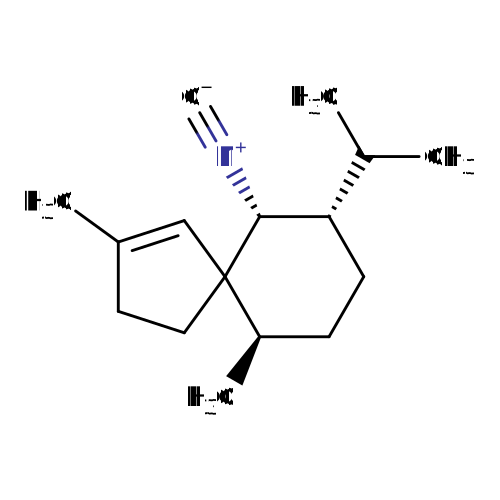
| Common Name | (6r,7s,10r)-6-isocyano-7-isopropyl-2,10-dimethylspiro[4.5]dec-1-ene |
|---|
| Description | Axisonitrile-3 belongs to the class of organic compounds known as menthane monoterpenoids. These are monoterpenoids with a structure based on the o-, m-, or p-menthane backbone. P-menthane consists of the cyclohexane ring with a methyl group and a (2-methyl)-propyl group at the 1 and 4 ring position, respectively. The o- and m- menthanes are much rarer, and presumably arise by alkyl migration of p-menthanes. (6r,7s,10r)-6-isocyano-7-isopropyl-2,10-dimethylspiro[4.5]dec-1-ene was first documented in 2003 (PMID: 12547260). Based on a literature review a small amount of articles have been published on Axisonitrile-3 (PMID: 31903473) (PMID: 21042642) (PMID: 18603800) (PMID: 16931436). |
|---|
| Structure | CC(C)[C@@H]1CC[C@@H](C)C2(CCC(C)=C2)[C@@H]1[N+]#[C-] InChI=1S/C16H25N/c1-11(2)14-7-6-13(4)16(15(14)17-5)9-8-12(3)10-16/h10-11,13-15H,6-9H2,1-4H3/t13-,14+,15-,16?/m1/s1 |
|---|
| Synonyms | | Value | Source |
|---|
| Axisonitrile 3 | MeSH |
|
|---|
| Chemical Formula | C16H25N |
|---|
| Average Mass | 231.3830 Da |
|---|
| Monoisotopic Mass | 231.19870 Da |
|---|
| IUPAC Name | (6R,7S,10R)-6-isocyano-2,10-dimethyl-7-(propan-2-yl)spiro[4.5]dec-1-ene |
|---|
| Traditional Name | (6R,7S,10R)-6-isocyano-7-isopropyl-2,10-dimethylspiro[4.5]dec-1-ene |
|---|
| CAS Registry Number | Not Available |
|---|
| SMILES | CC(C)[C@@H]1CC[C@@H](C)C2(CCC(C)=C2)[C@@H]1[N+]#[C-] |
|---|
| InChI Identifier | InChI=1S/C16H25N/c1-11(2)14-7-6-13(4)16(15(14)17-5)9-8-12(3)10-16/h10-11,13-15H,6-9H2,1-4H3/t13-,14+,15-,16?/m1/s1 |
|---|
| InChI Key | CLJZNXABBGEKKI-IUOOZAAYSA-N |
|---|
| Experimental Spectra |
|---|
|
| Not Available | | Predicted Spectra |
|---|
|
| | Spectrum Type | Description | Depositor ID | Depositor Organization | Depositor | Deposition Date | View |
|---|
| 1D NMR | 13C NMR Spectrum (1D, 25 MHz, H2O, predicted) | Wishart Lab | Wishart Lab | David Wishart | 2021-06-20 | View Spectrum | | 1D NMR | 1H NMR Spectrum (1D, 100 MHz, H2O, predicted) | Wishart Lab | Wishart Lab | David Wishart | 2021-06-20 | View Spectrum | | 1D NMR | 13C NMR Spectrum (1D, 252 MHz, H2O, predicted) | Wishart Lab | Wishart Lab | David Wishart | 2021-06-20 | View Spectrum | | 1D NMR | 1H NMR Spectrum (1D, 1000 MHz, H2O, predicted) | Wishart Lab | Wishart Lab | David Wishart | 2021-06-20 | View Spectrum | | 1D NMR | 13C NMR Spectrum (1D, 50 MHz, H2O, predicted) | Wishart Lab | Wishart Lab | David Wishart | 2021-06-20 | View Spectrum | | 1D NMR | 1H NMR Spectrum (1D, 200 MHz, H2O, predicted) | Wishart Lab | Wishart Lab | David Wishart | 2021-06-20 | View Spectrum | | 1D NMR | 13C NMR Spectrum (1D, 75 MHz, H2O, predicted) | Wishart Lab | Wishart Lab | David Wishart | 2021-06-20 | View Spectrum | | 1D NMR | 1H NMR Spectrum (1D, 300 MHz, H2O, predicted) | Wishart Lab | Wishart Lab | David Wishart | 2021-06-20 | View Spectrum | | 1D NMR | 13C NMR Spectrum (1D, 101 MHz, H2O, predicted) | Wishart Lab | Wishart Lab | David Wishart | 2021-06-20 | View Spectrum | | 1D NMR | 1H NMR Spectrum (1D, 400 MHz, H2O, predicted) | Wishart Lab | Wishart Lab | David Wishart | 2021-06-20 | View Spectrum | | 1D NMR | 13C NMR Spectrum (1D, 126 MHz, H2O, predicted) | Wishart Lab | Wishart Lab | David Wishart | 2021-06-20 | View Spectrum | | 1D NMR | 1H NMR Spectrum (1D, 500 MHz, H2O, predicted) | Wishart Lab | Wishart Lab | David Wishart | 2021-06-20 | View Spectrum | | 1D NMR | 13C NMR Spectrum (1D, 151 MHz, H2O, predicted) | Wishart Lab | Wishart Lab | David Wishart | 2021-06-20 | View Spectrum | | 1D NMR | 1H NMR Spectrum (1D, 600 MHz, H2O, predicted) | Wishart Lab | Wishart Lab | David Wishart | 2021-06-20 | View Spectrum | | 1D NMR | 13C NMR Spectrum (1D, 176 MHz, H2O, predicted) | Wishart Lab | Wishart Lab | David Wishart | 2021-06-20 | View Spectrum | | 1D NMR | 1H NMR Spectrum (1D, 700 MHz, H2O, predicted) | Wishart Lab | Wishart Lab | David Wishart | 2021-06-20 | View Spectrum | | 1D NMR | 13C NMR Spectrum (1D, 201 MHz, H2O, predicted) | Wishart Lab | Wishart Lab | David Wishart | 2021-06-20 | View Spectrum | | 1D NMR | 1H NMR Spectrum (1D, 800 MHz, H2O, predicted) | Wishart Lab | Wishart Lab | David Wishart | 2021-06-20 | View Spectrum | | 1D NMR | 13C NMR Spectrum (1D, 226 MHz, H2O, predicted) | Wishart Lab | Wishart Lab | David Wishart | 2021-06-20 | View Spectrum | | 1D NMR | 1H NMR Spectrum (1D, 900 MHz, H2O, predicted) | Wishart Lab | Wishart Lab | David Wishart | 2021-06-20 | View Spectrum |
| | Chemical Shift Submissions |
|---|
|
| Not Available | | Species |
|---|
| Species of Origin | Not Available |
|---|
| Chemical Taxonomy |
|---|
| Description | Belongs to the class of organic compounds known as menthane monoterpenoids. These are monoterpenoids with a structure based on the o-, m-, or p-menthane backbone. P-menthane consists of the cyclohexane ring with a methyl group and a (2-methyl)-propyl group at the 1 and 4 ring position, respectively. The o- and m- menthanes are much rarer, and presumably arise by alkyl migration of p-menthanes. |
|---|
| Kingdom | Organic compounds |
|---|
| Super Class | Lipids and lipid-like molecules |
|---|
| Class | Prenol lipids |
|---|
| Sub Class | Monoterpenoids |
|---|
| Direct Parent | Menthane monoterpenoids |
|---|
| Alternative Parents | |
|---|
| Substituents | - P-menthane monoterpenoid
- Organic isocyanide
- Organic nitrogen compound
- Organopnictogen compound
- Hydrocarbon derivative
- Organonitrogen compound
- Aliphatic homopolycyclic compound
|
|---|
| Molecular Framework | Aliphatic homopolycyclic compounds |
|---|
| External Descriptors | Not Available |
|---|
| Physical Properties |
|---|
| State | Not Available |
|---|
| Experimental Properties | | Property | Value | Reference |
|---|
| Melting Point | Not Available | Not Available | | Boiling Point | Not Available | Not Available | | Water Solubility | Not Available | Not Available | | LogP | Not Available | Not Available |
|
|---|
| Predicted Properties | |
|---|
| General References | - Wright AD: GC-MS and NMR analysis of Phyllidiella pustulosa and one of its dietary sources, the sponge Phakellia carduus. Comp Biochem Physiol A Mol Integr Physiol. 2003 Feb;134(2):307-13. doi: 10.1016/s1095-6433(02)00265-9. [PubMed:12547260 ]
- Hosokawa S, Nakanishi K, Udagawa Y, Maeda M, Sato S, Nakano K, Masuda T, Ichikawa Y: Total synthesis of exigurin: the Ugi reaction in a hypothetical biosynthesis of natural products. Org Biomol Chem. 2020 Jan 28;18(4):687-693. doi: 10.1039/c9ob02249j. Epub 2020 Jan 6. [PubMed:31903473 ]
- Wright AD, McCluskey A, Robertson MJ, MacGregor KA, Gordon CP, Guenther J: Anti-malarial, anti-algal, anti-tubercular, anti-bacterial, anti-photosynthetic, and anti-fouling activity of diterpene and diterpene isonitriles from the tropical marine sponge Cymbastela hooperi. Org Biomol Chem. 2011 Jan 21;9(2):400-7. doi: 10.1039/c0ob00326c. Epub 2010 Nov 2. [PubMed:21042642 ]
- Ohta E, Uy MM, Ohta S, Yanai M, Hirata T, Ikegami S: Anti-fertilization activity of a spirocyclic sesquiterpene isocyanide isolated from the marine sponge Geodia exigua and related compounds. Biosci Biotechnol Biochem. 2008 Jul;72(7):1764-71. doi: 10.1271/bbb.80071. Epub 2008 Jul 7. [PubMed:18603800 ]
- Yan XH, Zhu XZ, Yu JL, Jin DZ, Guo YW, Mollo E, Cimino G: 3-Oxo-axisonitrile-3, a new sesquiterpene isocyanide from the Chinese marine sponge Acanthella sp. J Asian Nat Prod Res. 2006 Sep;8(6):579-84. doi: 10.1080/10286020410001721096. [PubMed:16931436 ]
- LOTUS database [Link]
|
|---|