| Record Information |
|---|
| Version | 2.0 |
|---|
| Created at | 2022-09-03 21:53:04 UTC |
|---|
| Updated at | 2022-09-03 21:53:04 UTC |
|---|
| NP-MRD ID | NP0183044 |
|---|
| Secondary Accession Numbers | None |
|---|
| Natural Product Identification |
|---|
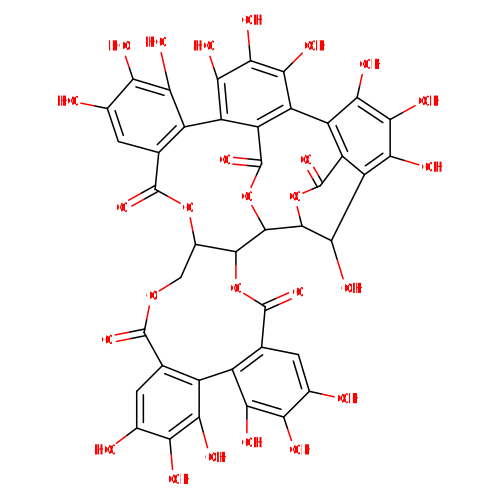
| Common Name | 7,8,9,12,13,14,25,26,27,30,31,32,35,36,37,46-hexadecahydroxy-3,18,21,41,43-pentaoxanonacyclo[27.13.3.1³⁸,⁴².0²,²⁰.0⁵,¹⁰.0¹¹,¹⁶.0²³,²⁸.0³³,⁴⁵.0³⁴,³⁹]hexatetraconta-5,7,9,11(16),12,14,23,25,27,29,31,33(45),34(39),35,37-pentadecaene-4,17,22,40,44-pentone |
|---|
| Description | Vescalagin, also known as vescalene or castalagin, belongs to the class of organic compounds known as hydrolyzable tannins. These are tannins with a structure characterized by either of the following models. In model 1, the structure contains galloyl units (in some cases, shikimic acid units) that are linked to diverse polyol carbohydrate-, catechin-, or triterpenoid units. In model 2, contains at least two galloyl units C-C coupled to each other, and do not contain a glycosidically linked catechin unit. Castalagin thus forms from a pentagalloyl-glucose structure. After conversion of casuarictin to pedunculagin, the pyranose ring of the glucose opens and the family of compounds including casuariin, casuarinin, castalagin, and castlin, vescalagin and vescalin forms. Vescalagin is an extremely weak basic (essentially neutral) compound (based on its pKa). Outside of the human body, vescalagin has been detected, but not quantified in, a few different foods, such as european chestnuts, nuts, and pomegranates. This could make vescalagin a potential biomarker for the consumption of these foods. Vescalagin is one of the most abundant ellagitannins extracted from oak wood using white wine. Castalagin is an ellagitannin, a type of hydrolyzable tannin, found in oak and chestnut wood and in the stem barks of Anogeissus leiocarpus and Terminalia avicennoides. During aging of alcohols in oak barrels, vescalagin can be extracted from the wood and can subsequently be transformed into new derivatives by chemical reactions. In some plants including oak and chestnut, the ellagitannins are formed from 1,2,3,4,6-pentagalloyl-glucose and further elaborated via oxidative dehydrogenation (tellimagrandin II and casuarictin formations). Castalagin and vescalagin (1,2,3,5-nonahydroxytriphenoyl-4,6-hexahydroxydiphenoyl-glucoses) can be further polymerized in their corresponding dimers roburin A and roburin D, and 33-carboxy-33-deoxyvescalagin. Castalagin is the (33beta)-isomer of vescalagin. Grandinin is a castalagin glycoside by binding of the pentose lyxose. 7,8,9,12,13,14,25,26,27,30,31,32,35,36,37,46-hexadecahydroxy-3,18,21,41,43-pentaoxanonacyclo[27.13.3.1³⁸,⁴².0²,²⁰.0⁵,¹⁰.0¹¹,¹⁶.0²³,²⁸.0³³,⁴⁵.0³⁴,³⁹]hexatetraconta-5,7,9,11(16),12,14,23,25,27,29,31,33(45),34(39),35,37-pentadecaene-4,17,22,40,44-pentone is found in Bredia tuberculata, Castanea crenata, Castanea sativa, Chrysolepis sempervirens, Combretum indicum, Hippophae rhamnoides, Lagerstroemia speciosa, Lumnitzera racemosa, Lythrum salicaria, Melaleuca leucadendra, Melastoma candidum, Morella esculenta, Psidium guajava, Quercus alba, Quercus lusitanica, Quercus mongolica, Quercus petraea, Quercus phillyraeoides, Quercus robur, Quercus salicina, Quercus suber, Siphoneugena densiflora, Syzygium aqueum, Syzygium grande, Terminalia catappa, Thiloa glaucocarpa and Pleroma semidecandrum. The flavono-ellagitannin known as acutissimin A is created when the oak tannin vescalagin interacts with a flavonoid in wine. |
|---|
| Structure | OC1C2OC(=O)C3=C(C(O)=C(O)C(O)=C13)C1=C3C(=C(O)C(O)=C1O)C1=C(C=C(O)C(O)=C1O)C(=O)OC1COC(=O)C4=C(C(O)=C(O)C(O)=C4)C4=C(C=C(O)C(O)=C4O)C(=O)OC1C2OC3=O InChI=1S/C41H26O26/c42-8-1-5-12(24(48)21(8)45)13-6(2-9(43)22(46)25(13)49)39(60)65-34-11(4-63-37(5)58)64-38(59)7-3-10(44)23(47)26(50)14(7)15-18-16(28(52)32(56)27(15)51)17-19-20(30(54)33(57)29(17)53)31(55)35(66-41(19)62)36(34)67-40(18)61/h1-3,11,31,34-36,42-57H,4H2 |
|---|
| Synonyms | | Value | Source |
|---|
| Vescalagin, (33beta)-isomer | HMDB | | Vescalene | HMDB | | Castalagin | HMDB | | Vescalin | HMDB | | Vescalagin | MeSH |
|
|---|
| Chemical Formula | C41H26O26 |
|---|
| Average Mass | 934.6295 Da |
|---|
| Monoisotopic Mass | 934.07123 Da |
|---|
| IUPAC Name | 7,8,9,12,13,14,25,26,27,30,31,32,35,36,37,46-hexadecahydroxy-3,18,21,41,43-pentaoxanonacyclo[27.13.3.1³⁸,⁴².0²,²⁰.0⁵,¹⁰.0¹¹,¹⁶.0²³,²⁸.0³³,⁴⁵.0³⁴,³⁹]hexatetraconta-5(10),6,8,11(16),12,14,23(28),24,26,29,31,33(45),34(39),35,37-pentadecaene-4,17,22,40,44-pentone |
|---|
| Traditional Name | 7,8,9,12,13,14,25,26,27,30,31,32,35,36,37,46-hexadecahydroxy-3,18,21,41,43-pentaoxanonacyclo[27.13.3.1³⁸,⁴².0²,²⁰.0⁵,¹⁰.0¹¹,¹⁶.0²³,²⁸.0³³,⁴⁵.0³⁴,³⁹]hexatetraconta-5(10),6,8,11(16),12,14,23(28),24,26,29,31,33(45),34(39),35,37-pentadecaene-4,17,22,40,44-pentone |
|---|
| CAS Registry Number | Not Available |
|---|
| SMILES | OC1C2OC(=O)C3=C(C(O)=C(O)C(O)=C13)C1=C3C(=C(O)C(O)=C1O)C1=C(C=C(O)C(O)=C1O)C(=O)OC1COC(=O)C4=C(C(O)=C(O)C(O)=C4)C4=C(C=C(O)C(O)=C4O)C(=O)OC1C2OC3=O |
|---|
| InChI Identifier | InChI=1S/C41H26O26/c42-8-1-5-12(24(48)21(8)45)13-6(2-9(43)22(46)25(13)49)39(60)65-34-11(4-63-37(5)58)64-38(59)7-3-10(44)23(47)26(50)14(7)15-18-16(28(52)32(56)27(15)51)17-19-20(30(54)33(57)29(17)53)31(55)35(66-41(19)62)36(34)67-40(18)61/h1-3,11,31,34-36,42-57H,4H2 |
|---|
| InChI Key | UDYKDZHZAKSYCO-UHFFFAOYSA-N |
|---|
| Experimental Spectra |
|---|
|
| Not Available | | Predicted Spectra |
|---|
|
| | Spectrum Type | Description | Depositor ID | Depositor Organization | Depositor | Deposition Date | View |
|---|
| 1D NMR | 13C NMR Spectrum (1D, 25 MHz, H2O, predicted) | Wishart Lab | Wishart Lab | David Wishart | 2021-06-20 | View Spectrum | | 1D NMR | 1H NMR Spectrum (1D, 100 MHz, H2O, predicted) | Wishart Lab | Wishart Lab | David Wishart | 2021-06-20 | View Spectrum | | 1D NMR | 13C NMR Spectrum (1D, 252 MHz, H2O, predicted) | Wishart Lab | Wishart Lab | David Wishart | 2021-06-20 | View Spectrum | | 1D NMR | 1H NMR Spectrum (1D, 1000 MHz, H2O, predicted) | Wishart Lab | Wishart Lab | David Wishart | 2021-06-20 | View Spectrum | | 1D NMR | 13C NMR Spectrum (1D, 50 MHz, H2O, predicted) | Wishart Lab | Wishart Lab | David Wishart | 2021-06-20 | View Spectrum | | 1D NMR | 1H NMR Spectrum (1D, 200 MHz, H2O, predicted) | Wishart Lab | Wishart Lab | David Wishart | 2021-06-20 | View Spectrum | | 1D NMR | 13C NMR Spectrum (1D, 75 MHz, H2O, predicted) | Wishart Lab | Wishart Lab | David Wishart | 2021-06-20 | View Spectrum | | 1D NMR | 1H NMR Spectrum (1D, 300 MHz, H2O, predicted) | Wishart Lab | Wishart Lab | David Wishart | 2021-06-20 | View Spectrum | | 1D NMR | 13C NMR Spectrum (1D, 101 MHz, H2O, predicted) | Wishart Lab | Wishart Lab | David Wishart | 2021-06-20 | View Spectrum | | 1D NMR | 1H NMR Spectrum (1D, 400 MHz, H2O, predicted) | Wishart Lab | Wishart Lab | David Wishart | 2021-06-20 | View Spectrum | | 1D NMR | 13C NMR Spectrum (1D, 126 MHz, H2O, predicted) | Wishart Lab | Wishart Lab | David Wishart | 2021-06-20 | View Spectrum | | 1D NMR | 1H NMR Spectrum (1D, 500 MHz, H2O, predicted) | Wishart Lab | Wishart Lab | David Wishart | 2021-06-20 | View Spectrum | | 1D NMR | 13C NMR Spectrum (1D, 151 MHz, H2O, predicted) | Wishart Lab | Wishart Lab | David Wishart | 2021-06-20 | View Spectrum | | 1D NMR | 1H NMR Spectrum (1D, 600 MHz, H2O, predicted) | Wishart Lab | Wishart Lab | David Wishart | 2021-06-20 | View Spectrum | | 1D NMR | 13C NMR Spectrum (1D, 176 MHz, H2O, predicted) | Wishart Lab | Wishart Lab | David Wishart | 2021-06-20 | View Spectrum | | 1D NMR | 1H NMR Spectrum (1D, 700 MHz, H2O, predicted) | Wishart Lab | Wishart Lab | David Wishart | 2021-06-20 | View Spectrum | | 1D NMR | 13C NMR Spectrum (1D, 201 MHz, H2O, predicted) | Wishart Lab | Wishart Lab | David Wishart | 2021-06-20 | View Spectrum | | 1D NMR | 1H NMR Spectrum (1D, 800 MHz, H2O, predicted) | Wishart Lab | Wishart Lab | David Wishart | 2021-06-20 | View Spectrum | | 1D NMR | 13C NMR Spectrum (1D, 226 MHz, H2O, predicted) | Wishart Lab | Wishart Lab | David Wishart | 2021-06-20 | View Spectrum | | 1D NMR | 1H NMR Spectrum (1D, 900 MHz, H2O, predicted) | Wishart Lab | Wishart Lab | David Wishart | 2021-06-20 | View Spectrum |
| | Chemical Shift Submissions |
|---|
|
| Not Available | | Species |
|---|
| Species of Origin | |
|---|
| Chemical Taxonomy |
|---|
| Description | Belongs to the class of organic compounds known as hydrolyzable tannins. These are tannins with a structure characterized by either of the following models. In model 1, the structure contains galloyl units (in some cases, shikimic acid units) that are linked to diverse polyol carbohydrate-, catechin-, or triterpenoid units. In model 2, contains at least two galloyl units C-C coupled to each other, and do not contain a glycosidically linked catechin unit. |
|---|
| Kingdom | Organic compounds |
|---|
| Super Class | Phenylpropanoids and polyketides |
|---|
| Class | Tannins |
|---|
| Sub Class | Hydrolyzable tannins |
|---|
| Direct Parent | Hydrolyzable tannins |
|---|
| Alternative Parents | |
|---|
| Substituents | - Hydrolyzable tannin
- Pentacarboxylic acid or derivatives
- Gallic acid or derivatives
- Benzopyran
- Isochromane
- 2-benzopyran
- 1-hydroxy-4-unsubstituted benzenoid
- 1-hydroxy-2-unsubstituted benzenoid
- Benzenoid
- Carboxylic acid ester
- Secondary alcohol
- Lactone
- Carboxylic acid derivative
- Oxacycle
- Organoheterocyclic compound
- Polyol
- Hydrocarbon derivative
- Alcohol
- Organic oxygen compound
- Organic oxide
- Organooxygen compound
- Aromatic heteropolycyclic compound
|
|---|
| Molecular Framework | Aromatic heteropolycyclic compounds |
|---|
| External Descriptors | Not Available |
|---|
| Physical Properties |
|---|
| State | Not Available |
|---|
| Experimental Properties | | Property | Value | Reference |
|---|
| Melting Point | Not Available | Not Available | | Boiling Point | Not Available | Not Available | | Water Solubility | Not Available | Not Available | | LogP | Not Available | Not Available |
|
|---|
| Predicted Properties | |
|---|