| Record Information |
|---|
| Version | 2.0 |
|---|
| Created at | 2022-09-03 21:00:52 UTC |
|---|
| Updated at | 2022-09-03 21:00:52 UTC |
|---|
| NP-MRD ID | NP0182351 |
|---|
| Secondary Accession Numbers | None |
|---|
| Natural Product Identification |
|---|
| Common Name | glycerylphosphorylcholine |
|---|
| Description | Glycerophosphocholine belongs to the class of organic compounds known as glycerophosphocholines. These are lipids containing a glycerol moiety carrying a phosphocholine at the 3-position. Alpha-GPC rapidly delivers choline to the brain across the blood–brain barrier and is a biosynthetic precursor of acetylcholine. Glycerophosphocholine is an extremely weak basic (essentially neutral) compound (based on its pKa). An Italian multicentre clinical trial on 2,044 patients suffering from recent stroke were supplied alpha-GPC in doses of 1,000 mg/day for 28 days and 400 mg three times per day for the five ensuing months. L-Alpha glycerylphosphorylcholine (alpha-GPC, choline alfoscerate) is a natural choline compound found in the brain. Glycerophosphocholine exists in both E. Coli (prokaryote) and yeast (eukaryote). Within humans, glycerophosphocholine participates in a number of enzymatic reactions. In particular, glycerophosphocholine can be biosynthesized from 11-cis-retinol and PC(24:1(15Z)/15:0) Through its interaction with the enzyme lecithin retinol acyltransferase. In addition, retinyl ester and glycerophosphocholine can be biosynthesized from vitamin a and PC(24:1(15Z)/15:0); Which is mediated by the enzyme lecithin retinol acyltransferase. Industrially, alpha-GPC is produced by the chemical or enzymatic deacylation of phosphatidylcholine enriched soya phospholipids followed by chromatographic purification. In humans, glycerophosphocholine is involved in retinol metabolism. It is a non-prescription drug in most countries. It is also a parasympathomimetic acetylcholine precursor which has been investigated for its potential for the treatment of Alzheimer's disease and other dementias. The trial confirmed the therapeutic role of alpha-GPC on the cognitive recovery of patients based on four measurement scales, three of which reached statistical significance. glycerylphosphorylcholine is found in Arabidopsis thaliana. Alpha-GPC may also be derived in small amounts from highly purified soy lecithin as well from purified sunflower lecithin. |
|---|
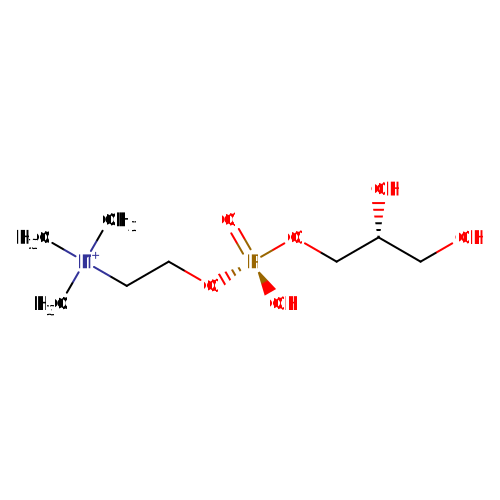
| Structure | C[N+](C)(C)CCO[P@](O)(=O)OC[C@H](O)CO InChI=1S/C8H20NO6P/c1-9(2,3)4-5-14-16(12,13)15-7-8(11)6-10/h8,10-11H,4-7H2,1-3H3/p+1/t8-/m1/s1 |
|---|
| Synonyms | | Value | Source |
|---|
| Choline alfoscerate | MeSH | | Choline glycerophosphate | MeSH | | Glycerol 3 phosphocholine | MeSH | | Glycerol 3-phosphocholine | MeSH | | 3-Phosphocholine, glycerol | MeSH | | Alphoscerate, choline | MeSH | | Glycerophosphorylcholine | MeSH | | L-alpha-Glycerylphosphorylcholine | MeSH | | Alfoscerate, choline | MeSH | | Choline alphoscerate | MeSH | | Glycerophosphate, choline | MeSH | | Glycerylphosphorylcholine | MeSH | | L alpha Glycerylphosphorylcholine | MeSH | | Glycerophosphocholine | KEGG |
|
|---|
| Chemical Formula | C8H21NO6P |
|---|
| Average Mass | 258.2292 Da |
|---|
| Monoisotopic Mass | 258.11065 Da |
|---|
| IUPAC Name | [(2R)-2,3-dihydroxypropoxy][2-(trimethylazaniumyl)ethoxy]phosphinic acid |
|---|
| Traditional Name | glycerylphosphorylcholine |
|---|
| CAS Registry Number | Not Available |
|---|
| SMILES | C[N+](C)(C)CCO[P@](O)(=O)OC[C@H](O)CO |
|---|
| InChI Identifier | InChI=1S/C8H20NO6P/c1-9(2,3)4-5-14-16(12,13)15-7-8(11)6-10/h8,10-11H,4-7H2,1-3H3/p+1/t8-/m1/s1 |
|---|
| InChI Key | SUHOQUVVVLNYQR-MRVPVSSYSA-O |
|---|
| Experimental Spectra |
|---|
|
| Not Available | | Predicted Spectra |
|---|
|
| | Spectrum Type | Description | Depositor ID | Depositor Organization | Depositor | Deposition Date | View |
|---|
| 1D NMR | 13C NMR Spectrum (1D, 25 MHz, H2O, predicted) | Wishart Lab | Wishart Lab | David Wishart | 2021-06-20 | View Spectrum | | 1D NMR | 1H NMR Spectrum (1D, 100 MHz, H2O, predicted) | Wishart Lab | Wishart Lab | David Wishart | 2021-06-20 | View Spectrum | | 1D NMR | 13C NMR Spectrum (1D, 252 MHz, H2O, predicted) | Wishart Lab | Wishart Lab | David Wishart | 2021-06-20 | View Spectrum | | 1D NMR | 1H NMR Spectrum (1D, 1000 MHz, H2O, predicted) | Wishart Lab | Wishart Lab | David Wishart | 2021-06-20 | View Spectrum | | 1D NMR | 13C NMR Spectrum (1D, 50 MHz, H2O, predicted) | Wishart Lab | Wishart Lab | David Wishart | 2021-06-20 | View Spectrum | | 1D NMR | 1H NMR Spectrum (1D, 200 MHz, H2O, predicted) | Wishart Lab | Wishart Lab | David Wishart | 2021-06-20 | View Spectrum | | 1D NMR | 13C NMR Spectrum (1D, 75 MHz, H2O, predicted) | Wishart Lab | Wishart Lab | David Wishart | 2021-06-20 | View Spectrum | | 1D NMR | 1H NMR Spectrum (1D, 300 MHz, H2O, predicted) | Wishart Lab | Wishart Lab | David Wishart | 2021-06-20 | View Spectrum | | 1D NMR | 13C NMR Spectrum (1D, 101 MHz, H2O, predicted) | Wishart Lab | Wishart Lab | David Wishart | 2021-06-20 | View Spectrum | | 1D NMR | 1H NMR Spectrum (1D, 400 MHz, H2O, predicted) | Wishart Lab | Wishart Lab | David Wishart | 2021-06-20 | View Spectrum | | 1D NMR | 13C NMR Spectrum (1D, 126 MHz, H2O, predicted) | Wishart Lab | Wishart Lab | David Wishart | 2021-06-20 | View Spectrum | | 1D NMR | 1H NMR Spectrum (1D, 500 MHz, H2O, predicted) | Wishart Lab | Wishart Lab | David Wishart | 2021-06-20 | View Spectrum | | 1D NMR | 13C NMR Spectrum (1D, 151 MHz, H2O, predicted) | Wishart Lab | Wishart Lab | David Wishart | 2021-06-20 | View Spectrum | | 1D NMR | 1H NMR Spectrum (1D, 600 MHz, H2O, predicted) | Wishart Lab | Wishart Lab | David Wishart | 2021-06-20 | View Spectrum | | 1D NMR | 13C NMR Spectrum (1D, 176 MHz, H2O, predicted) | Wishart Lab | Wishart Lab | David Wishart | 2021-06-20 | View Spectrum | | 1D NMR | 1H NMR Spectrum (1D, 700 MHz, H2O, predicted) | Wishart Lab | Wishart Lab | David Wishart | 2021-06-20 | View Spectrum | | 1D NMR | 13C NMR Spectrum (1D, 201 MHz, H2O, predicted) | Wishart Lab | Wishart Lab | David Wishart | 2021-06-20 | View Spectrum | | 1D NMR | 1H NMR Spectrum (1D, 800 MHz, H2O, predicted) | Wishart Lab | Wishart Lab | David Wishart | 2021-06-20 | View Spectrum | | 1D NMR | 13C NMR Spectrum (1D, 226 MHz, H2O, predicted) | Wishart Lab | Wishart Lab | David Wishart | 2021-06-20 | View Spectrum | | 1D NMR | 1H NMR Spectrum (1D, 900 MHz, H2O, predicted) | Wishart Lab | Wishart Lab | David Wishart | 2021-06-20 | View Spectrum |
| | Chemical Shift Submissions |
|---|
|
| Not Available | | Species |
|---|
| Species of Origin | |
|---|
| Chemical Taxonomy |
|---|
| Description | Belongs to the class of organic compounds known as glycerophosphocholines. These are lipids containing a glycerol moiety carrying a phosphocholine at the 3-position. |
|---|
| Kingdom | Organic compounds |
|---|
| Super Class | Lipids and lipid-like molecules |
|---|
| Class | Glycerophospholipids |
|---|
| Sub Class | Glycerophosphocholines |
|---|
| Direct Parent | Glycerophosphocholines |
|---|
| Alternative Parents | |
|---|
| Substituents | - Glycero-3-phosphocholine
- Phosphocholine
- Dialkyl phosphate
- Organic phosphoric acid derivative
- Phosphoric acid ester
- Alkyl phosphate
- Tetraalkylammonium salt
- Quaternary ammonium salt
- 1,2-diol
- Secondary alcohol
- Organic nitrogen compound
- Alcohol
- Organic salt
- Hydrocarbon derivative
- Primary alcohol
- Organic oxide
- Organopnictogen compound
- Organooxygen compound
- Organonitrogen compound
- Organic oxygen compound
- Amine
- Organic cation
- Aliphatic acyclic compound
|
|---|
| Molecular Framework | Aliphatic acyclic compounds |
|---|
| External Descriptors | Not Available |
|---|
| Physical Properties |
|---|
| State | Not Available |
|---|
| Experimental Properties | | Property | Value | Reference |
|---|
| Melting Point | Not Available | Not Available | | Boiling Point | Not Available | Not Available | | Water Solubility | Not Available | Not Available | | LogP | Not Available | Not Available |
|
|---|
| Predicted Properties | |
|---|