| Record Information |
|---|
| Version | 2.0 |
|---|
| Created at | 2022-09-03 19:32:10 UTC |
|---|
| Updated at | 2022-09-03 19:32:10 UTC |
|---|
| NP-MRD ID | NP0181082 |
|---|
| Secondary Accession Numbers | None |
|---|
| Natural Product Identification |
|---|
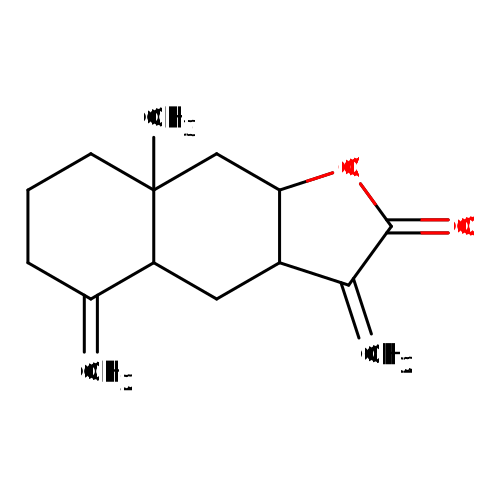
| Common Name | 8a-methyl-3,5-dimethylidene-octahydronaphtho[2,3-b]furan-2-one |
|---|
| Description | Isoalantolactone, also known as isohelenin, belongs to the class of organic compounds known as eudesmanolides, secoeudesmanolides, and derivatives. These are terpenoids with a structure based on the eudesmanolide (a 3,5a,9-trimethyl-naphtho[1,2-b]furan-2-one derivative) or secoeudesmanolide (a 3,6-dimethyl-5-(pentan-2-yl)-1-benzofuran-2-one derivative) skeleton. Isoalantolactone is an extremely weak basic (essentially neutral) compound (based on its pKa). Outside of the human body, Isoalantolactone has been detected, but not quantified in, herbs and spices. This could make isoalantolactone a potential biomarker for the consumption of these foods. Alantolactone occurs in the roots of Inula helenium and other Inula species. In 1895 the German scientists Julius Bredt and Wilhelm Posh extracted helenin from Inula helenium and determined its physical and chemical properties. Helenin is a phytochemical mixture found in many plant species, including the Inula helenium (elecampane) of the family Asteraceae. It is a mixture of two isomeric sesquiterpene lactones, alantolactone and isoalantolactone. Helenin can be extracted from the roots of Inula helenium using alcohol or other non-polar solvents to produce a mixture with a composition of about 40% alantolactone and 60% isoalantolactone. 8a-methyl-3,5-dimethylidene-octahydronaphtho[2,3-b]furan-2-one is found in Abutilon indicum, Artemisia feddei, Carpesium longifolium, Carpesium macrocephalum, Inula helenium, Inula magnifica, Inula racemosa, Inula salicina, Lophocolea heterophylla, Ratibida columnifera, Telekia speciosa, Tritomaria quinquedentata and Xanthium indicum. Alantolactone has a variety of in vitro biochemical properties, including:Induces apoptosis and cell cycle arrest in lung squamous cancer cellssuppresses STAT3 activationhas antiinflammatory effects by inhibiting chemokine production and STAT1 phosphorylationanti-fungalanti-microbialCertain individuals have experienced contact dermatitis when exposed to alantolactone. |
|---|
| Structure | CC12CCCC(=C)C1CC1C(C2)OC(=O)C1=C InChI=1S/C15H20O2/c1-9-5-4-6-15(3)8-13-11(7-12(9)15)10(2)14(16)17-13/h11-13H,1-2,4-8H2,3H3 |
|---|
| Synonyms | | Value | Source |
|---|
| Isohelenin | HMDB |
|
|---|
| Chemical Formula | C15H20O2 |
|---|
| Average Mass | 232.3181 Da |
|---|
| Monoisotopic Mass | 232.14633 Da |
|---|
| IUPAC Name | 8a-methyl-3,5-dimethylidene-dodecahydronaphtho[2,3-b]furan-2-one |
|---|
| Traditional Name | 8a-methyl-3,5-dimethylidene-octahydronaphtho[2,3-b]furan-2-one |
|---|
| CAS Registry Number | Not Available |
|---|
| SMILES | CC12CCCC(=C)C1CC1C(C2)OC(=O)C1=C |
|---|
| InChI Identifier | InChI=1S/C15H20O2/c1-9-5-4-6-15(3)8-13-11(7-12(9)15)10(2)14(16)17-13/h11-13H,1-2,4-8H2,3H3 |
|---|
| InChI Key | CVUANYCQTOGILD-UHFFFAOYSA-N |
|---|
| Experimental Spectra |
|---|
|
| Not Available | | Predicted Spectra |
|---|
|
| | Spectrum Type | Description | Depositor ID | Depositor Organization | Depositor | Deposition Date | View |
|---|
| 1D NMR | 13C NMR Spectrum (1D, 25 MHz, H2O, predicted) | Wishart Lab | Wishart Lab | David Wishart | 2021-06-20 | View Spectrum | | 1D NMR | 1H NMR Spectrum (1D, 100 MHz, H2O, predicted) | Wishart Lab | Wishart Lab | David Wishart | 2021-06-20 | View Spectrum | | 1D NMR | 13C NMR Spectrum (1D, 252 MHz, H2O, predicted) | Wishart Lab | Wishart Lab | David Wishart | 2021-06-20 | View Spectrum | | 1D NMR | 1H NMR Spectrum (1D, 1000 MHz, H2O, predicted) | Wishart Lab | Wishart Lab | David Wishart | 2021-06-20 | View Spectrum | | 1D NMR | 13C NMR Spectrum (1D, 50 MHz, H2O, predicted) | Wishart Lab | Wishart Lab | David Wishart | 2021-06-20 | View Spectrum | | 1D NMR | 1H NMR Spectrum (1D, 200 MHz, H2O, predicted) | Wishart Lab | Wishart Lab | David Wishart | 2021-06-20 | View Spectrum | | 1D NMR | 13C NMR Spectrum (1D, 75 MHz, H2O, predicted) | Wishart Lab | Wishart Lab | David Wishart | 2021-06-20 | View Spectrum | | 1D NMR | 1H NMR Spectrum (1D, 300 MHz, H2O, predicted) | Wishart Lab | Wishart Lab | David Wishart | 2021-06-20 | View Spectrum | | 1D NMR | 13C NMR Spectrum (1D, 101 MHz, H2O, predicted) | Wishart Lab | Wishart Lab | David Wishart | 2021-06-20 | View Spectrum | | 1D NMR | 1H NMR Spectrum (1D, 400 MHz, H2O, predicted) | Wishart Lab | Wishart Lab | David Wishart | 2021-06-20 | View Spectrum | | 1D NMR | 13C NMR Spectrum (1D, 126 MHz, H2O, predicted) | Wishart Lab | Wishart Lab | David Wishart | 2021-06-20 | View Spectrum | | 1D NMR | 1H NMR Spectrum (1D, 500 MHz, H2O, predicted) | Wishart Lab | Wishart Lab | David Wishart | 2021-06-20 | View Spectrum | | 1D NMR | 13C NMR Spectrum (1D, 151 MHz, H2O, predicted) | Wishart Lab | Wishart Lab | David Wishart | 2021-06-20 | View Spectrum | | 1D NMR | 1H NMR Spectrum (1D, 600 MHz, H2O, predicted) | Wishart Lab | Wishart Lab | David Wishart | 2021-06-20 | View Spectrum | | 1D NMR | 13C NMR Spectrum (1D, 176 MHz, H2O, predicted) | Wishart Lab | Wishart Lab | David Wishart | 2021-06-20 | View Spectrum | | 1D NMR | 1H NMR Spectrum (1D, 700 MHz, H2O, predicted) | Wishart Lab | Wishart Lab | David Wishart | 2021-06-20 | View Spectrum | | 1D NMR | 13C NMR Spectrum (1D, 201 MHz, H2O, predicted) | Wishart Lab | Wishart Lab | David Wishart | 2021-06-20 | View Spectrum | | 1D NMR | 1H NMR Spectrum (1D, 800 MHz, H2O, predicted) | Wishart Lab | Wishart Lab | David Wishart | 2021-06-20 | View Spectrum | | 1D NMR | 13C NMR Spectrum (1D, 226 MHz, H2O, predicted) | Wishart Lab | Wishart Lab | David Wishart | 2021-06-20 | View Spectrum | | 1D NMR | 1H NMR Spectrum (1D, 900 MHz, H2O, predicted) | Wishart Lab | Wishart Lab | David Wishart | 2021-06-20 | View Spectrum |
| | Chemical Shift Submissions |
|---|
|
| Not Available | | Species |
|---|
| Species of Origin | |
|---|
| Chemical Taxonomy |
|---|
| Description | Belongs to the class of organic compounds known as eudesmanolides, secoeudesmanolides, and derivatives. These are terpenoids with a structure based on the eudesmanolide (a 3,5a,9-trimethyl-naphtho[1,2-b]furan-2-one derivative) or secoeudesmanolide (a 3,6-dimethyl-5-(pentan-2-yl)-1-benzofuran-2-one derivative) skeleton. |
|---|
| Kingdom | Organic compounds |
|---|
| Super Class | Lipids and lipid-like molecules |
|---|
| Class | Prenol lipids |
|---|
| Sub Class | Terpene lactones |
|---|
| Direct Parent | Eudesmanolides, secoeudesmanolides, and derivatives |
|---|
| Alternative Parents | |
|---|
| Substituents | - Eudesmanolide
- Sesquiterpenoid
- Naphthofuran
- Gamma butyrolactone
- Tetrahydrofuran
- Enoate ester
- Alpha,beta-unsaturated carboxylic ester
- Lactone
- Carboxylic acid ester
- Oxacycle
- Monocarboxylic acid or derivatives
- Carboxylic acid derivative
- Organoheterocyclic compound
- Organooxygen compound
- Hydrocarbon derivative
- Organic oxide
- Organic oxygen compound
- Carbonyl group
- Aliphatic heteropolycyclic compound
|
|---|
| Molecular Framework | Aliphatic heteropolycyclic compounds |
|---|
| External Descriptors | Not Available |
|---|
| Physical Properties |
|---|
| State | Not Available |
|---|
| Experimental Properties | | Property | Value | Reference |
|---|
| Melting Point | Not Available | Not Available | | Boiling Point | Not Available | Not Available | | Water Solubility | Not Available | Not Available | | LogP | Not Available | Not Available |
|
|---|
| Predicted Properties | |
|---|