| Record Information |
|---|
| Version | 2.0 |
|---|
| Created at | 2022-09-03 10:47:24 UTC |
|---|
| Updated at | 2022-09-03 10:47:24 UTC |
|---|
| NP-MRD ID | NP0173623 |
|---|
| Secondary Accession Numbers | None |
|---|
| Natural Product Identification |
|---|
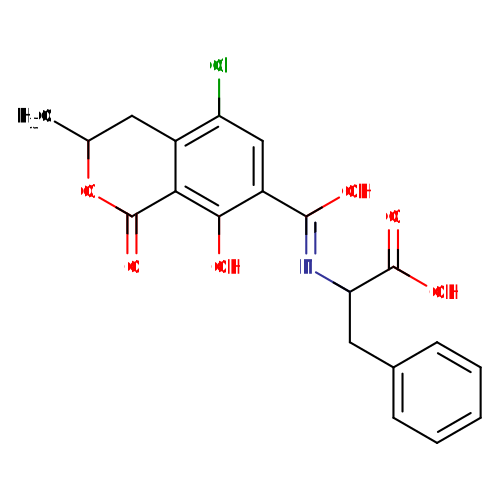
| Common Name | 2-{[(5-chloro-8-hydroxy-3-methyl-1-oxo-3,4-dihydro-2-benzopyran-7-yl)(hydroxy)methylidene]amino}-3-phenylpropanoic acid |
|---|
| Description | Ochratoxin A belongs to the class of organic compounds known as ochratoxins and related substances. These are a group of chemically related metabolites containing a 3,4-dihydro-3-methylisocoumarin moiety linked through a carboxyl group to L-beta-phenylalanine by a secondary amine bond. Ochratoxin A has been shown to be weakly mutagenic, possibly by induction of oxidative DNA damage. Ochratoxin A is cleaved into phenylalanine and a less toxic iso-coumarin derivative (ochratoxin alpha) by the microbial flora of the colon, and by carboxypeptidase A and alpha-chymotrypsim. Ochratoxin A is an extremely weak basic (essentially neutral) compound (based on its pKa). 4-Hydroxyochratoxin A is the main hepatic metabolite and its formation appears to be via a polymorphic-like debrisoquine 4-hydroxylation. Ochratoxin A has been shown to be nephrotoxic and might delay sexual maturation. Ochratoxin A is formally rated as a possible carcinogen (by IARC 2B) and is also a potentially toxic compound. It is a nephrotoxin which blocks plasma membrane anion conductance in Madin-Darby canine kidney (MDCK) cells. It can cause immunosuppression and immunotoxicity in animals. It's immunosuppressant activity in animals may include depressed antibody responses, reduced size of immune organs (such as the thymus, spleen, and lymph nodes), changes in immune cell number and function, and altered cytokine production. 2-{[(5-chloro-8-hydroxy-3-methyl-1-oxo-3,4-dihydro-2-benzopyran-7-yl)(hydroxy)methylidene]amino}-3-phenylpropanoic acid is found in Aspergillus melleus and Aspergillus ochraceus. The nephrotoxin ochratoxin A (OTA) causes a reduction of glomerular filtration rate (GFR) and of para-aminohippuric acid (PAH) clearance. |
|---|
| Structure | CC1CC2=C(Cl)C=C(C(O)=NC(CC3=CC=CC=C3)C(O)=O)C(O)=C2C(=O)O1 InChI=1S/C20H18ClNO6/c1-10-7-12-14(21)9-13(17(23)16(12)20(27)28-10)18(24)22-15(19(25)26)8-11-5-3-2-4-6-11/h2-6,9-10,15,23H,7-8H2,1H3,(H,22,24)(H,25,26) |
|---|
| Synonyms | Not Available |
|---|
| Chemical Formula | C20H18ClNO6 |
|---|
| Average Mass | 403.8130 Da |
|---|
| Monoisotopic Mass | 403.08227 Da |
|---|
| IUPAC Name | 2-{[(5-chloro-8-hydroxy-3-methyl-1-oxo-3,4-dihydro-1H-2-benzopyran-7-yl)(hydroxy)methylidene]amino}-3-phenylpropanoic acid |
|---|
| Traditional Name | 2-{[(5-chloro-8-hydroxy-3-methyl-1-oxo-3,4-dihydro-2-benzopyran-7-yl)(hydroxy)methylidene]amino}-3-phenylpropanoic acid |
|---|
| CAS Registry Number | Not Available |
|---|
| SMILES | CC1CC2=C(Cl)C=C(C(O)=NC(CC3=CC=CC=C3)C(O)=O)C(O)=C2C(=O)O1 |
|---|
| InChI Identifier | InChI=1S/C20H18ClNO6/c1-10-7-12-14(21)9-13(17(23)16(12)20(27)28-10)18(24)22-15(19(25)26)8-11-5-3-2-4-6-11/h2-6,9-10,15,23H,7-8H2,1H3,(H,22,24)(H,25,26) |
|---|
| InChI Key | RWQKHEORZBHNRI-UHFFFAOYSA-N |
|---|
| Experimental Spectra |
|---|
|
| Not Available | | Predicted Spectra |
|---|
|
| | Spectrum Type | Description | Depositor ID | Depositor Organization | Depositor | Deposition Date | View |
|---|
| 1D NMR | 13C NMR Spectrum (1D, 25 MHz, H2O, predicted) | Wishart Lab | Wishart Lab | David Wishart | 2021-06-20 | View Spectrum | | 1D NMR | 1H NMR Spectrum (1D, 100 MHz, H2O, predicted) | Wishart Lab | Wishart Lab | David Wishart | 2021-06-20 | View Spectrum | | 1D NMR | 13C NMR Spectrum (1D, 252 MHz, H2O, predicted) | Wishart Lab | Wishart Lab | David Wishart | 2021-06-20 | View Spectrum | | 1D NMR | 1H NMR Spectrum (1D, 1000 MHz, H2O, predicted) | Wishart Lab | Wishart Lab | David Wishart | 2021-06-20 | View Spectrum | | 1D NMR | 13C NMR Spectrum (1D, 50 MHz, H2O, predicted) | Wishart Lab | Wishart Lab | David Wishart | 2021-06-20 | View Spectrum | | 1D NMR | 1H NMR Spectrum (1D, 200 MHz, H2O, predicted) | Wishart Lab | Wishart Lab | David Wishart | 2021-06-20 | View Spectrum | | 1D NMR | 13C NMR Spectrum (1D, 75 MHz, H2O, predicted) | Wishart Lab | Wishart Lab | David Wishart | 2021-06-20 | View Spectrum | | 1D NMR | 1H NMR Spectrum (1D, 300 MHz, H2O, predicted) | Wishart Lab | Wishart Lab | David Wishart | 2021-06-20 | View Spectrum | | 1D NMR | 13C NMR Spectrum (1D, 101 MHz, H2O, predicted) | Wishart Lab | Wishart Lab | David Wishart | 2021-06-20 | View Spectrum | | 1D NMR | 1H NMR Spectrum (1D, 400 MHz, H2O, predicted) | Wishart Lab | Wishart Lab | David Wishart | 2021-06-20 | View Spectrum | | 1D NMR | 13C NMR Spectrum (1D, 126 MHz, H2O, predicted) | Wishart Lab | Wishart Lab | David Wishart | 2021-06-20 | View Spectrum | | 1D NMR | 1H NMR Spectrum (1D, 500 MHz, H2O, predicted) | Wishart Lab | Wishart Lab | David Wishart | 2021-06-20 | View Spectrum | | 1D NMR | 13C NMR Spectrum (1D, 151 MHz, H2O, predicted) | Wishart Lab | Wishart Lab | David Wishart | 2021-06-20 | View Spectrum | | 1D NMR | 1H NMR Spectrum (1D, 600 MHz, H2O, predicted) | Wishart Lab | Wishart Lab | David Wishart | 2021-06-20 | View Spectrum | | 1D NMR | 13C NMR Spectrum (1D, 176 MHz, H2O, predicted) | Wishart Lab | Wishart Lab | David Wishart | 2021-06-20 | View Spectrum | | 1D NMR | 1H NMR Spectrum (1D, 700 MHz, H2O, predicted) | Wishart Lab | Wishart Lab | David Wishart | 2021-06-20 | View Spectrum | | 1D NMR | 13C NMR Spectrum (1D, 201 MHz, H2O, predicted) | Wishart Lab | Wishart Lab | David Wishart | 2021-06-20 | View Spectrum | | 1D NMR | 1H NMR Spectrum (1D, 800 MHz, H2O, predicted) | Wishart Lab | Wishart Lab | David Wishart | 2021-06-20 | View Spectrum | | 1D NMR | 13C NMR Spectrum (1D, 226 MHz, H2O, predicted) | Wishart Lab | Wishart Lab | David Wishart | 2021-06-20 | View Spectrum | | 1D NMR | 1H NMR Spectrum (1D, 900 MHz, H2O, predicted) | Wishart Lab | Wishart Lab | David Wishart | 2021-06-20 | View Spectrum |
| | Chemical Shift Submissions |
|---|
|
| Not Available | | Species |
|---|
| Species of Origin | |
|---|
| Chemical Taxonomy |
|---|
| Description | Belongs to the class of organic compounds known as ochratoxins and related substances. These are a group of chemically related metabolites containing a 3,4-dihydro-3-methylisocoumarin moiety linked through a carboxyl group to L-beta-phenylalanine by a secondary amine bond. |
|---|
| Kingdom | Organic compounds |
|---|
| Super Class | Phenylpropanoids and polyketides |
|---|
| Class | Ochratoxins and related substances |
|---|
| Sub Class | Not Available |
|---|
| Direct Parent | Ochratoxins and related substances |
|---|
| Alternative Parents | |
|---|
| Substituents | - Ochratoxin-skeleton
- Phenylalanine or derivatives
- N-acyl-alpha amino acid or derivatives
- N-acyl-alpha-amino acid
- 3-phenylpropanoic-acid
- Alpha-amino acid or derivatives
- Amphetamine or derivatives
- Salicylic acid or derivatives
- 2-benzopyran
- Isochromane
- Benzopyran
- Aryl halide
- Benzenoid
- Aryl chloride
- Dicarboxylic acid or derivatives
- Monocyclic benzene moiety
- Vinylogous acid
- Carboxamide group
- Carboxylic acid ester
- Secondary carboxylic acid amide
- Lactone
- Carboxylic acid
- Carboxylic acid derivative
- Organoheterocyclic compound
- Oxacycle
- Organopnictogen compound
- Organic oxygen compound
- Organic nitrogen compound
- Carbonyl group
- Hydrocarbon derivative
- Organic oxide
- Organooxygen compound
- Organonitrogen compound
- Organochloride
- Organohalogen compound
- Aromatic heteropolycyclic compound
|
|---|
| Molecular Framework | Aromatic heteropolycyclic compounds |
|---|
| External Descriptors | Not Available |
|---|
| Physical Properties |
|---|
| State | Not Available |
|---|
| Experimental Properties | | Property | Value | Reference |
|---|
| Melting Point | Not Available | Not Available | | Boiling Point | Not Available | Not Available | | Water Solubility | Not Available | Not Available | | LogP | Not Available | Not Available |
|
|---|
| Predicted Properties | |
|---|