| Record Information |
|---|
| Version | 2.0 |
|---|
| Created at | 2022-09-03 10:14:39 UTC |
|---|
| Updated at | 2022-09-03 10:14:39 UTC |
|---|
| NP-MRD ID | NP0173153 |
|---|
| Secondary Accession Numbers | None |
|---|
| Natural Product Identification |
|---|
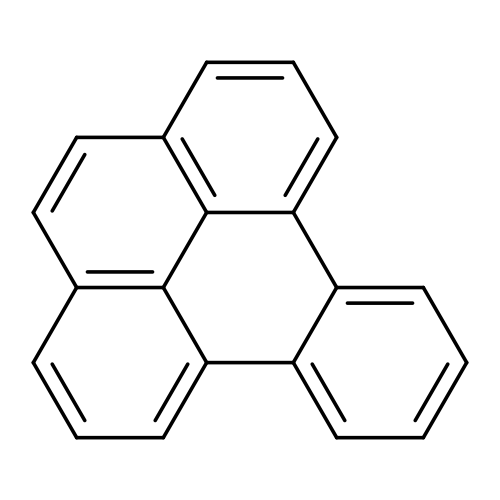
| Common Name | benzo(e)pyrene |
|---|
| Description | Benzo[e]pyrene, also known as 1,2-benzpyrene or b(e)p, belongs to the class of organic compounds known as benzopyrenes. These are organic compounds containing a benzene fused to a pyrene(benzo[def]phenanthrene) ring system. Benzo[e]pyrene is possibly neutral. Benzopyrene is one of over 100 different polycyclic aromatic hydrocarbons (PAHs). Benzo[e]pyrene is a potentially toxic compound. They are usually found as a mixture containing two or more of these compounds. PAH metabolism occurs in all tissues, usually by cytochrome P-450 and its associated enzymes. PAHs are metabolized into reactive intermediates, which include epoxide intermediates, dihydrodiols, phenols, quinones, and their various combinations. PAHs are carcinogens and have been associated with the increased risk of skin, respiratory tract, bladder, stomach, and kidney cancers. They may also cause reproductive effects and depress the immune system. The phenols, quinones, and dihydrodiols can all be conjugated to glucuronides and sulfate esters; the quinones also form glutathione conjugates. The ability of PAH's to bind to blood proteins such as albumin allows them to be transported throughout the body. These enzymes metabolize PAH's into their toxic intermediates. benzo(e)pyrene is found in Nicotiana tabacum. benzo(e)pyrene was first documented in 2014 (PMID: 24812998). The reactive metabolites of PAHs (epoxide intermediates, dihydrodiols, phenols, quinones, and their various combinations) covalently bind to DNA and other cellular macromolecules, initiating mutagenesis and carcinogenesis (PMID: 25903191). |
|---|
| Structure | C1=CC=C2C(=C1)C1=CC=CC3=C1C1=C(C=CC=C21)C=C3 InChI=1S/C20H12/c1-2-8-16-15(7-1)17-9-3-5-13-11-12-14-6-4-10-18(16)20(14)19(13)17/h1-12H |
|---|
| Synonyms | | Value | Source |
|---|
| 1,2-Benzopyrene | ChEBI | | 1,2-Benzpyrene | ChEBI | | 4,5-Benzopyrene | ChEBI | | 4,5-Benzpyrene | ChEBI | | 9,10-Benzpyrene | ChEBI | | b(e)p | ChEBI | | Benzo(e)pyrene | ChEBI | | Benzo(L)pyrene | ChEBI | | 1,2-benzo(e)Pyrene | MeSH |
|
|---|
| Chemical Formula | C20H12 |
|---|
| Average Mass | 252.3093 Da |
|---|
| Monoisotopic Mass | 252.09390 Da |
|---|
| IUPAC Name | pentacyclo[10.6.2.0^{2,7}.0^{8,20}.0^{15,19}]icosa-1(18),2,4,6,8,10,12(20),13,15(19),16-decaene |
|---|
| Traditional Name | pentacyclo[10.6.2.0^{2,7}.0^{8,20}.0^{15,19}]icosa-1(18),2,4,6,8,10,12(20),13,15(19),16-decaene |
|---|
| CAS Registry Number | Not Available |
|---|
| SMILES | C1=CC=C2C(=C1)C1=CC=CC3=C1C1=C(C=CC=C21)C=C3 |
|---|
| InChI Identifier | InChI=1S/C20H12/c1-2-8-16-15(7-1)17-9-3-5-13-11-12-14-6-4-10-18(16)20(14)19(13)17/h1-12H |
|---|
| InChI Key | TXVHTIQJNYSSKO-UHFFFAOYSA-N |
|---|
| Experimental Spectra |
|---|
|
| | Spectrum Type | Description | Depositor Email | Depositor Organization | Depositor | Deposition Date | View |
|---|
| 1D NMR | 13C NMR Spectrum (1D, 25.16 MHz, CDCl3, experimental) | Wishart Lab | Wishart Lab | David Wishart | 2021-06-20 | View Spectrum |
| | Predicted Spectra |
|---|
|
| Not Available | | Chemical Shift Submissions |
|---|
|
| Not Available | | Species |
|---|
| Species of Origin | |
|---|
| Chemical Taxonomy |
|---|
| Description | Belongs to the class of organic compounds known as benzopyrenes. These are organic compounds containing a benzene fused to a pyrene(benzo[def]phenanthrene) ring system. |
|---|
| Kingdom | Organic compounds |
|---|
| Super Class | Benzenoids |
|---|
| Class | Pyrenes |
|---|
| Sub Class | Benzopyrenes |
|---|
| Direct Parent | Benzopyrenes |
|---|
| Alternative Parents | |
|---|
| Substituents | - Benzo-e-pyrene
- Triphenylene
- Phenanthrene
- Anthracene
- Aromatic hydrocarbon
- Polycyclic hydrocarbon
- Unsaturated hydrocarbon
- Hydrocarbon
- Aromatic homopolycyclic compound
|
|---|
| Molecular Framework | Aromatic homopolycyclic compounds |
|---|
| External Descriptors | |
|---|
| Physical Properties |
|---|
| State | Not Available |
|---|
| Experimental Properties | | Property | Value | Reference |
|---|
| Melting Point | Not Available | Not Available | | Boiling Point | Not Available | Not Available | | Water Solubility | Not Available | Not Available | | LogP | Not Available | Not Available |
|
|---|
| Predicted Properties | |
|---|
| General References | - Arulazhagan P, Sivaraman C, Kumar SA, Aslam M, Banu JR: Co-metabolic degradation of benzo(e)pyrene by halophilic bacterial consortium at different saline conditions. J Environ Biol. 2014 May;35(3):445-52. [PubMed:24812998 ]
- Shang J, Chen J, Shen Z, Xiao X, Yang H, Wang Y, Ruan A: Photochemical degradation of PAHs in estuarine surface water: effects of DOM, salinity, and suspended particulate matter. Environ Sci Pollut Res Int. 2015 Aug;22(16):12374-83. doi: 10.1007/s11356-015-4543-2. Epub 2015 Apr 23. [PubMed:25903191 ]
- LOTUS database [Link]
|
|---|