| Record Information |
|---|
| Version | 2.0 |
|---|
| Created at | 2022-09-03 09:25:44 UTC |
|---|
| Updated at | 2022-09-03 09:25:44 UTC |
|---|
| NP-MRD ID | NP0172492 |
|---|
| Secondary Accession Numbers | None |
|---|
| Natural Product Identification |
|---|
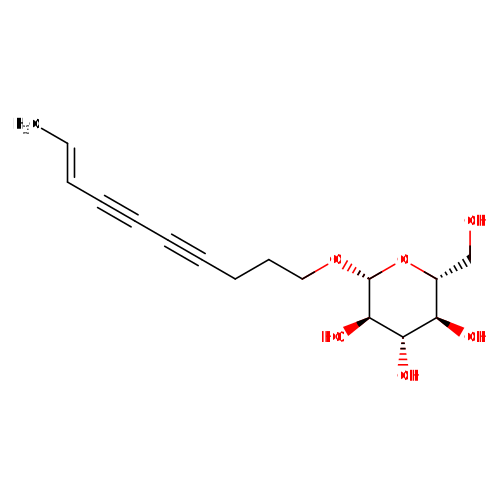
| Common Name | (2r,3r,4s,5s,6r)-2-[(8z)-dec-8-en-4,6-diyn-1-yloxy]-6-(hydroxymethyl)oxane-3,4,5-triol |
|---|
| Description | Bidenoside C belongs to the class of organic compounds known as fatty acyl glycosides of mono- and disaccharides. Fatty acyl glycosides of mono- and disaccharides are compounds composed of a mono- or disaccharide moiety linked to one hydroxyl group of a fatty alcohol or of a phosphorylated alcohol (phosphoprenols), a hydroxy fatty acid or to one carboxyl group of a fatty acid (ester linkage) or to an amino alcohol. (2r,3r,4s,5s,6r)-2-[(8z)-dec-8-en-4,6-diyn-1-yloxy]-6-(hydroxymethyl)oxane-3,4,5-triol is found in Bidens bipinnata and Carthamus tinctorius. (2r,3r,4s,5s,6r)-2-[(8z)-dec-8-en-4,6-diyn-1-yloxy]-6-(hydroxymethyl)oxane-3,4,5-triol was first documented in 2004 (PMID: 15056959). Based on a literature review a small amount of articles have been published on Bidenoside C (PMID: 32977609) (PMID: 28927288) (PMID: 27296281) (PMID: 24849034). |
|---|
| Structure | C\C=C/C#CC#CCCCO[C@@H]1O[C@H](CO)[C@@H](O)[C@H](O)[C@H]1O InChI=1S/C16H22O6/c1-2-3-4-5-6-7-8-9-10-21-16-15(20)14(19)13(18)12(11-17)22-16/h2-3,12-20H,8-11H2,1H3/b3-2-/t12-,13-,14+,15-,16-/m1/s1 |
|---|
| Synonyms | | Value | Source |
|---|
| 8Z-Decaene-4,6-diyn-1-O-beta-D-glucopyranoside | MeSH |
|
|---|
| Chemical Formula | C16H22O6 |
|---|
| Average Mass | 310.3460 Da |
|---|
| Monoisotopic Mass | 310.14164 Da |
|---|
| IUPAC Name | (2R,3R,4S,5S,6R)-2-[(8Z)-dec-8-en-4,6-diyn-1-yloxy]-6-(hydroxymethyl)oxane-3,4,5-triol |
|---|
| Traditional Name | (2R,3R,4S,5S,6R)-2-[(8Z)-dec-8-en-4,6-diyn-1-yloxy]-6-(hydroxymethyl)oxane-3,4,5-triol |
|---|
| CAS Registry Number | Not Available |
|---|
| SMILES | C\C=C/C#CC#CCCCO[C@@H]1O[C@H](CO)[C@@H](O)[C@H](O)[C@H]1O |
|---|
| InChI Identifier | InChI=1S/C16H22O6/c1-2-3-4-5-6-7-8-9-10-21-16-15(20)14(19)13(18)12(11-17)22-16/h2-3,12-20H,8-11H2,1H3/b3-2-/t12-,13-,14+,15-,16-/m1/s1 |
|---|
| InChI Key | QIFYDSMWESCVBZ-JNDSXIQISA-N |
|---|
| Experimental Spectra |
|---|
|
| Not Available | | Predicted Spectra |
|---|
|
| | Spectrum Type | Description | Depositor ID | Depositor Organization | Depositor | Deposition Date | View |
|---|
| 1D NMR | 13C NMR Spectrum (1D, 25 MHz, H2O, predicted) | Wishart Lab | Wishart Lab | David Wishart | 2021-06-20 | View Spectrum | | 1D NMR | 1H NMR Spectrum (1D, 100 MHz, H2O, predicted) | Wishart Lab | Wishart Lab | David Wishart | 2021-06-20 | View Spectrum | | 1D NMR | 13C NMR Spectrum (1D, 252 MHz, H2O, predicted) | Wishart Lab | Wishart Lab | David Wishart | 2021-06-20 | View Spectrum | | 1D NMR | 1H NMR Spectrum (1D, 1000 MHz, H2O, predicted) | Wishart Lab | Wishart Lab | David Wishart | 2021-06-20 | View Spectrum | | 1D NMR | 13C NMR Spectrum (1D, 50 MHz, H2O, predicted) | Wishart Lab | Wishart Lab | David Wishart | 2021-06-20 | View Spectrum | | 1D NMR | 1H NMR Spectrum (1D, 200 MHz, H2O, predicted) | Wishart Lab | Wishart Lab | David Wishart | 2021-06-20 | View Spectrum | | 1D NMR | 13C NMR Spectrum (1D, 75 MHz, H2O, predicted) | Wishart Lab | Wishart Lab | David Wishart | 2021-06-20 | View Spectrum | | 1D NMR | 1H NMR Spectrum (1D, 300 MHz, H2O, predicted) | Wishart Lab | Wishart Lab | David Wishart | 2021-06-20 | View Spectrum | | 1D NMR | 13C NMR Spectrum (1D, 101 MHz, H2O, predicted) | Wishart Lab | Wishart Lab | David Wishart | 2021-06-20 | View Spectrum | | 1D NMR | 1H NMR Spectrum (1D, 400 MHz, H2O, predicted) | Wishart Lab | Wishart Lab | David Wishart | 2021-06-20 | View Spectrum | | 1D NMR | 13C NMR Spectrum (1D, 126 MHz, H2O, predicted) | Wishart Lab | Wishart Lab | David Wishart | 2021-06-20 | View Spectrum | | 1D NMR | 1H NMR Spectrum (1D, 500 MHz, H2O, predicted) | Wishart Lab | Wishart Lab | David Wishart | 2021-06-20 | View Spectrum | | 1D NMR | 13C NMR Spectrum (1D, 151 MHz, H2O, predicted) | Wishart Lab | Wishart Lab | David Wishart | 2021-06-20 | View Spectrum | | 1D NMR | 1H NMR Spectrum (1D, 600 MHz, H2O, predicted) | Wishart Lab | Wishart Lab | David Wishart | 2021-06-20 | View Spectrum | | 1D NMR | 13C NMR Spectrum (1D, 176 MHz, H2O, predicted) | Wishart Lab | Wishart Lab | David Wishart | 2021-06-20 | View Spectrum | | 1D NMR | 1H NMR Spectrum (1D, 700 MHz, H2O, predicted) | Wishart Lab | Wishart Lab | David Wishart | 2021-06-20 | View Spectrum | | 1D NMR | 13C NMR Spectrum (1D, 201 MHz, H2O, predicted) | Wishart Lab | Wishart Lab | David Wishart | 2021-06-20 | View Spectrum | | 1D NMR | 1H NMR Spectrum (1D, 800 MHz, H2O, predicted) | Wishart Lab | Wishart Lab | David Wishart | 2021-06-20 | View Spectrum | | 1D NMR | 13C NMR Spectrum (1D, 226 MHz, H2O, predicted) | Wishart Lab | Wishart Lab | David Wishart | 2021-06-20 | View Spectrum | | 1D NMR | 1H NMR Spectrum (1D, 900 MHz, H2O, predicted) | Wishart Lab | Wishart Lab | David Wishart | 2021-06-20 | View Spectrum |
| | Chemical Shift Submissions |
|---|
|
| Not Available | | Species |
|---|
| Species of Origin | |
|---|
| Chemical Taxonomy |
|---|
| Description | Belongs to the class of organic compounds known as fatty acyl glycosides of mono- and disaccharides. Fatty acyl glycosides of mono- and disaccharides are compounds composed of a mono- or disaccharide moiety linked to one hydroxyl group of a fatty alcohol or of a phosphorylated alcohol (phosphoprenols), a hydroxy fatty acid or to one carboxyl group of a fatty acid (ester linkage) or to an amino alcohol. |
|---|
| Kingdom | Organic compounds |
|---|
| Super Class | Lipids and lipid-like molecules |
|---|
| Class | Fatty Acyls |
|---|
| Sub Class | Fatty acyl glycosides |
|---|
| Direct Parent | Fatty acyl glycosides of mono- and disaccharides |
|---|
| Alternative Parents | |
|---|
| Substituents | - Fatty acyl glycoside of mono- or disaccharide
- Alkyl glycoside
- Hexose monosaccharide
- Glycosyl compound
- O-glycosyl compound
- Monosaccharide
- Oxane
- Secondary alcohol
- Acetal
- Organoheterocyclic compound
- Oxacycle
- Polyol
- Organooxygen compound
- Primary alcohol
- Hydrocarbon derivative
- Organic oxygen compound
- Alcohol
- Aliphatic heteromonocyclic compound
|
|---|
| Molecular Framework | Aliphatic heteromonocyclic compounds |
|---|
| External Descriptors | Not Available |
|---|
| Physical Properties |
|---|
| State | Not Available |
|---|
| Experimental Properties | | Property | Value | Reference |
|---|
| Melting Point | Not Available | Not Available | | Boiling Point | Not Available | Not Available | | Water Solubility | Not Available | Not Available | | LogP | Not Available | Not Available |
|
|---|
| Predicted Properties | |
|---|
| General References | - Kim BR, Paudel SB, Nam JW, Jin CH, Lee IS, Han AR: Constituents of Coreopsis lanceolata Flower and Their Dipeptidyl Peptidase IV Inhibitory Effects. Molecules. 2020 Sep 23;25(19):4370. doi: 10.3390/molecules25194370. [PubMed:32977609 ]
- Wang GK, Wang Z, Yu Y, Zhang N, Zhou ZY, Wang G, Liu JS: A new sesquiterpene from Kalimeris integrifolia. Nat Prod Res. 2018 May;32(9):1004-1009. doi: 10.1080/14786419.2017.1375917. Epub 2017 Sep 19. [PubMed:28927288 ]
- Xu H, Ma Q, Ma J, Wu Z, Wang Y, Ma C: Hepato-protective effects and chemical constituents of a bioactive fraction of the traditional compound medicine-Gurigumu-7. BMC Complement Altern Med. 2016 Jun 13;16:179. doi: 10.1186/s12906-016-1156-3. [PubMed:27296281 ]
- Li Y, Piao D, Zhang H, Kim T, Lee SH, Chang HW, Woo MH, Son JK: Quality evaluation of Carthami Flos by HPLC-UV. Arch Pharm Res. 2015;38(5):776-84. doi: 10.1007/s12272-014-0402-9. Epub 2014 May 22. [PubMed:24849034 ]
- Li S, Kuang HX, Okada Y, Okuyama T: New acetylenic glucosides from Bidens bipinnata LINNE. Chem Pharm Bull (Tokyo). 2004 Apr;52(4):439-40. doi: 10.1248/cpb.52.439. [PubMed:15056959 ]
- LOTUS database [Link]
|
|---|