| Record Information |
|---|
| Version | 2.0 |
|---|
| Created at | 2022-09-03 09:10:32 UTC |
|---|
| Updated at | 2022-09-03 09:10:32 UTC |
|---|
| NP-MRD ID | NP0172295 |
|---|
| Secondary Accession Numbers | None |
|---|
| Natural Product Identification |
|---|
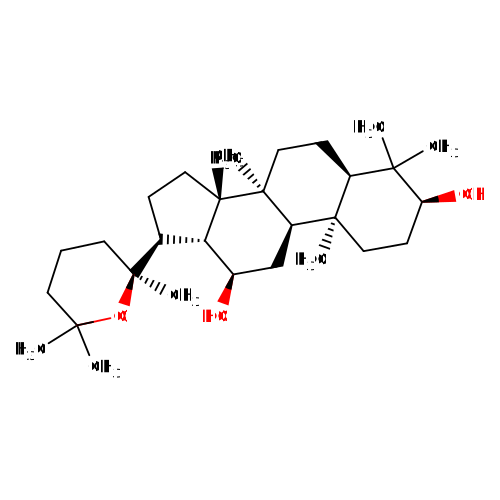
| Common Name | (1s,3ar,3br,5ar,7s,9ar,9br,11r,11ar)-3a,3b,6,6,9a-pentamethyl-1-[(2r)-2,6,6-trimethyloxan-2-yl]-dodecahydro-1h-cyclopenta[a]phenanthrene-7,11-diol |
|---|
| Description | Panaxadiol belongs to the class of organic compounds known as triterpene saponins. These are glycosylated derivatives of triterpene sapogenins. The sapogenin moiety backbone is usually based on the oleanane, ursane, taraxastane, bauerane, lanostane, lupeol, lupane, dammarane, cycloartane, friedelane, hopane, 9b,19-cyclo-lanostane, cycloartane, or cycloartanol skeleton. Thus, panaxadiol is considered to be an isoprenoid. (1s,3ar,3br,5ar,7s,9ar,9br,11r,11ar)-3a,3b,6,6,9a-pentamethyl-1-[(2r)-2,6,6-trimethyloxan-2-yl]-dodecahydro-1h-cyclopenta[a]phenanthrene-7,11-diol is found in Panax ginseng. (1s,3ar,3br,5ar,7s,9ar,9br,11r,11ar)-3a,3b,6,6,9a-pentamethyl-1-[(2r)-2,6,6-trimethyloxan-2-yl]-dodecahydro-1h-cyclopenta[a]phenanthrene-7,11-diol was first documented in 2021 (PMID: 35003297). Based on a literature review a significant number of articles have been published on Panaxadiol (PMID: 35938749) (PMID: 35792078) (PMID: 35600780) (PMID: 35458705) (PMID: 35401188) (PMID: 35282082). |
|---|
| Structure | C[C@@]12CC[C@@H]([C@H]1[C@H](O)C[C@@H]1[C@@]3(C)CC[C@H](O)C(C)(C)[C@@H]3CC[C@@]21C)[C@@]1(C)CCCC(C)(C)O1 InChI=1S/C30H52O3/c1-25(2)13-9-14-30(8,33-25)19-10-16-29(7)24(19)20(31)18-22-27(5)15-12-23(32)26(3,4)21(27)11-17-28(22,29)6/h19-24,31-32H,9-18H2,1-8H3/t19-,20+,21-,22+,23-,24-,27-,28+,29+,30+/m0/s1 |
|---|
| Synonyms | | Value | Source |
|---|
| Panaxadiol, (3beta,12beta)-isomer | MeSH |
|
|---|
| Chemical Formula | C30H52O3 |
|---|
| Average Mass | 460.7430 Da |
|---|
| Monoisotopic Mass | 460.39165 Da |
|---|
| IUPAC Name | (1R,2R,5S,7R,10R,11R,14S,15R,16R)-2,6,6,10,11-pentamethyl-14-[(2R)-2,6,6-trimethyloxan-2-yl]tetracyclo[8.7.0.0^{2,7}.0^{11,15}]heptadecane-5,16-diol |
|---|
| Traditional Name | (1R,2R,5S,7R,10R,11R,14S,15R,16R)-2,6,6,10,11-pentamethyl-14-[(2R)-2,6,6-trimethyloxan-2-yl]tetracyclo[8.7.0.0^{2,7}.0^{11,15}]heptadecane-5,16-diol |
|---|
| CAS Registry Number | Not Available |
|---|
| SMILES | C[C@@]12CC[C@@H]([C@H]1[C@H](O)C[C@@H]1[C@@]3(C)CC[C@H](O)C(C)(C)[C@@H]3CC[C@@]21C)[C@@]1(C)CCCC(C)(C)O1 |
|---|
| InChI Identifier | InChI=1S/C30H52O3/c1-25(2)13-9-14-30(8,33-25)19-10-16-29(7)24(19)20(31)18-22-27(5)15-12-23(32)26(3,4)21(27)11-17-28(22,29)6/h19-24,31-32H,9-18H2,1-8H3/t19-,20+,21-,22+,23-,24-,27-,28+,29+,30+/m0/s1 |
|---|
| InChI Key | PVLHOJXLNBFHDX-XHJPDDKBSA-N |
|---|
| Experimental Spectra |
|---|
|
| Not Available | | Predicted Spectra |
|---|
|
| | Spectrum Type | Description | Depositor ID | Depositor Organization | Depositor | Deposition Date | View |
|---|
| 1D NMR | 13C NMR Spectrum (1D, 25 MHz, H2O, predicted) | Wishart Lab | Wishart Lab | David Wishart | 2021-06-20 | View Spectrum | | 1D NMR | 1H NMR Spectrum (1D, 100 MHz, H2O, predicted) | Wishart Lab | Wishart Lab | David Wishart | 2021-06-20 | View Spectrum | | 1D NMR | 13C NMR Spectrum (1D, 252 MHz, H2O, predicted) | Wishart Lab | Wishart Lab | David Wishart | 2021-06-20 | View Spectrum | | 1D NMR | 1H NMR Spectrum (1D, 1000 MHz, H2O, predicted) | Wishart Lab | Wishart Lab | David Wishart | 2021-06-20 | View Spectrum | | 1D NMR | 13C NMR Spectrum (1D, 50 MHz, H2O, predicted) | Wishart Lab | Wishart Lab | David Wishart | 2021-06-20 | View Spectrum | | 1D NMR | 1H NMR Spectrum (1D, 200 MHz, H2O, predicted) | Wishart Lab | Wishart Lab | David Wishart | 2021-06-20 | View Spectrum | | 1D NMR | 13C NMR Spectrum (1D, 75 MHz, H2O, predicted) | Wishart Lab | Wishart Lab | David Wishart | 2021-06-20 | View Spectrum | | 1D NMR | 1H NMR Spectrum (1D, 300 MHz, H2O, predicted) | Wishart Lab | Wishart Lab | David Wishart | 2021-06-20 | View Spectrum | | 1D NMR | 13C NMR Spectrum (1D, 101 MHz, H2O, predicted) | Wishart Lab | Wishart Lab | David Wishart | 2021-06-20 | View Spectrum | | 1D NMR | 1H NMR Spectrum (1D, 400 MHz, H2O, predicted) | Wishart Lab | Wishart Lab | David Wishart | 2021-06-20 | View Spectrum | | 1D NMR | 13C NMR Spectrum (1D, 126 MHz, H2O, predicted) | Wishart Lab | Wishart Lab | David Wishart | 2021-06-20 | View Spectrum | | 1D NMR | 1H NMR Spectrum (1D, 500 MHz, H2O, predicted) | Wishart Lab | Wishart Lab | David Wishart | 2021-06-20 | View Spectrum | | 1D NMR | 13C NMR Spectrum (1D, 151 MHz, H2O, predicted) | Wishart Lab | Wishart Lab | David Wishart | 2021-06-20 | View Spectrum | | 1D NMR | 1H NMR Spectrum (1D, 600 MHz, H2O, predicted) | Wishart Lab | Wishart Lab | David Wishart | 2021-06-20 | View Spectrum | | 1D NMR | 13C NMR Spectrum (1D, 176 MHz, H2O, predicted) | Wishart Lab | Wishart Lab | David Wishart | 2021-06-20 | View Spectrum | | 1D NMR | 1H NMR Spectrum (1D, 700 MHz, H2O, predicted) | Wishart Lab | Wishart Lab | David Wishart | 2021-06-20 | View Spectrum | | 1D NMR | 13C NMR Spectrum (1D, 201 MHz, H2O, predicted) | Wishart Lab | Wishart Lab | David Wishart | 2021-06-20 | View Spectrum | | 1D NMR | 1H NMR Spectrum (1D, 800 MHz, H2O, predicted) | Wishart Lab | Wishart Lab | David Wishart | 2021-06-20 | View Spectrum | | 1D NMR | 13C NMR Spectrum (1D, 226 MHz, H2O, predicted) | Wishart Lab | Wishart Lab | David Wishart | 2021-06-20 | View Spectrum | | 1D NMR | 1H NMR Spectrum (1D, 900 MHz, H2O, predicted) | Wishart Lab | Wishart Lab | David Wishart | 2021-06-20 | View Spectrum |
| | Chemical Shift Submissions |
|---|
|
| Not Available | | Species |
|---|
| Species of Origin | |
|---|
| Chemical Taxonomy |
|---|
| Description | Belongs to the class of organic compounds known as triterpene saponins. These are glycosylated derivatives of triterpene sapogenins. The sapogenin moiety backbone is usually based on the oleanane, ursane, taraxastane, bauerane, lanostane, lupeol, lupane, dammarane, cycloartane, friedelane, hopane, 9b,19-cyclo-lanostane, cycloartane, or cycloartanol skeleton. |
|---|
| Kingdom | Organic compounds |
|---|
| Super Class | Lipids and lipid-like molecules |
|---|
| Class | Prenol lipids |
|---|
| Sub Class | Terpene glycosides |
|---|
| Direct Parent | Triterpene saponins |
|---|
| Alternative Parents | |
|---|
| Substituents | - Triterpene saponin
- Triterpenoid
- 3-hydroxysteroid
- 14-alpha-methylsteroid
- 12-hydroxysteroid
- Hydroxysteroid
- 3-beta-hydroxysteroid
- Steroid
- Oxane
- Cyclic alcohol
- Secondary alcohol
- Dialkyl ether
- Ether
- Oxacycle
- Organoheterocyclic compound
- Organic oxygen compound
- Alcohol
- Hydrocarbon derivative
- Organooxygen compound
- Aliphatic heteropolycyclic compound
|
|---|
| Molecular Framework | Aliphatic heteropolycyclic compounds |
|---|
| External Descriptors | Not Available |
|---|
| Physical Properties |
|---|
| State | Not Available |
|---|
| Experimental Properties | | Property | Value | Reference |
|---|
| Melting Point | Not Available | Not Available | | Boiling Point | Not Available | Not Available | | Water Solubility | Not Available | Not Available | | LogP | Not Available | Not Available |
|
|---|
| Predicted Properties | |
|---|
| General References | - Xu X, Wang W, Chen Y, Zhang Q, Li B, Zhong Y, Tu Y, Zhang W, Xu G, Jiang L: Simultaneous Determination of Ten Bioactive Components from Shenling Baizhu San in Rat Plasma by UHPLC-MS/MS: Application to a Comparative Pharmacokinetic Study in Normal and Two Models of Ulcerative Colitis Rats. Evid Based Complement Alternat Med. 2021 Dec 29;2021:3518241. doi: 10.1155/2021/3518241. eCollection 2021. [PubMed:35003297 ]
- Han L, Li T, Miao D, Lee J, Xiao S, Piao H, Zhao Y: Design, Synthesis and Cytotoxicity Evaluation of Novel Indole Derivatives of Panaxadiol. Chem Biodivers. 2022 Aug;19(8):e202200372. doi: 10.1002/cbdv.202200372. Epub 2022 Aug 8. [PubMed:35938749 ]
- Xu L, Xiao S, Lee JJ, Li X, Zhao Y: Gender-Related Differences in Tissue Distribution, Excretion, and Metabolism Studies of Panaxadiol in Rats and Anti-inflammatory Study. J Agric Food Chem. 2022 Jul 20;70(28):8672-8679. doi: 10.1021/acs.jafc.2c02618. Epub 2022 Jul 6. [PubMed:35792078 ]
- Lee JO, Yang Y, Tao Y, Yi YS, Cho JY: Korean Red Ginseng saponin fraction exerts anti-inflammatory effects by targeting the NF-kappaB and AP-1 pathways. J Ginseng Res. 2022 May;46(3):489-495. doi: 10.1016/j.jgr.2022.02.004. Epub 2022 Feb 24. [PubMed:35600780 ]
- Lv Y, Zhang Y, Feng J, Zhao T, Zhao J, Ge Y, Yang X, Han H, Zhang M, Chen L, Xu M, Guan F: (20R)-Panaxadiol as a Natural Active Component with Anti-Obesity Effects on ob/ob Mice via Modulating the Gut Microbiota. Molecules. 2022 Apr 13;27(8):2502. doi: 10.3390/molecules27082502. [PubMed:35458705 ]
- Xu H, Liu M, Chen G, Wu Y, Xie L, Han X, Zhang G, Tan Z, Ding W, Fan H, Chen H, Liu B, Zhou Y: Anti-Inflammatory Effects of Ginsenoside Rb3 in LPS-Induced Macrophages Through Direct Inhibition of TLR4 Signaling Pathway. Front Pharmacol. 2022 Mar 24;13:714554. doi: 10.3389/fphar.2022.714554. eCollection 2022. [PubMed:35401188 ]
- Dai TY, Lan JJ, Gao RL, Zhao YN, Yu XL, Liang SX, Liu WB, Sun X: Panaxdiol saponins component promotes hematopoiesis by regulating GATA transcription factors of intracellular signaling pathway in mouse bone marrow. Ann Transl Med. 2022 Jan;10(2):38. doi: 10.21037/atm-21-4800. [PubMed:35282082 ]
- Wang JY, Xing Y, Li MY, Zhang ZH, Jin HL, Ma J, Lee JJ, Zhong Y, Zuo HX, Jin X: Panaxadiol inhibits IL-1beta secretion by suppressing zinc finger protein 91-regulated activation of non-canonical caspase-8 inflammasome and MAPKs in macrophages. J Ethnopharmacol. 2022 Jan 30;283:114715. doi: 10.1016/j.jep.2021.114715. Epub 2021 Oct 12. [PubMed:34648898 ]
- Fan X, Fu H, Xie N, Guo H, Fu T, Shan Y: Inhibition of JAK2/STAT3 signaling pathway by panaxadiol limits the progression of pancreatic cancer. Aging (Albany NY). 2021 Oct 8;13(19):22830-22842. doi: 10.18632/aging.203575. Epub 2021 Oct 8. [PubMed:34623971 ]
- Xu L, Zhang X, Xiao S, Li X, Jiang H, Wang Z, Sun B, Zhao Y: Panaxadiol as a major metabolite of AD-1 can significantly inhibit the proliferation and migration of breast cancer cells: In vitro and in vivo study. Bioorg Chem. 2021 Nov;116:105392. doi: 10.1016/j.bioorg.2021.105392. Epub 2021 Sep 30. [PubMed:34619469 ]
- LOTUS database [Link]
|
|---|