| Record Information |
|---|
| Version | 2.0 |
|---|
| Created at | 2022-09-02 23:07:54 UTC |
|---|
| Updated at | 2022-09-02 23:07:55 UTC |
|---|
| NP-MRD ID | NP0164282 |
|---|
| Secondary Accession Numbers | None |
|---|
| Natural Product Identification |
|---|
| Common Name | dmnq |
|---|
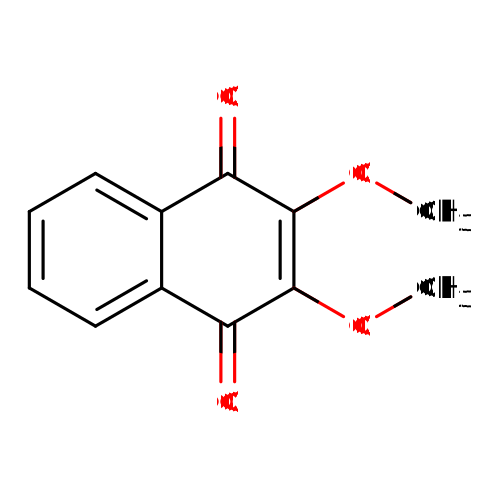
| Description | 2,3-Dimethoxynaphthalene-1,4-dione, also known as DMNQ or NSC 69355, belongs to the class of organic compounds known as naphthoquinones. Naphthoquinones are compounds containing a naphthohydroquinone moiety, which consists of a benzene ring linearly fused to a bezene-1,4-dione (quinone). 2,3-Dimethoxynaphthalene-1,4-dione is an extremely weak basic (essentially neutral) compound (based on its pKa). Used to study the role of ROS in cell toxicity, apoptosis, and necrosis. Redox-cycling agent that induces intracellular superoxide anion formation and, depending on the concentration, induces cell proliferation, apoptosis or necrosis. dmnq is found in Newbouldia laevis. dmnq was first documented in 1993 (PMID: 8103030). A naphthoquinone that is 1,4-naphthoquinone bearing two methoxy substituents at positions 2 and 3 (PMID: 19338340) (PMID: 20803752) (PMID: 8393647). |
|---|
| Structure | COC1=C(OC)C(=O)C2=CC=CC=C2C1=O InChI=1S/C12H10O4/c1-15-11-9(13)7-5-3-4-6-8(7)10(14)12(11)16-2/h3-6H,1-2H3 |
|---|
| Synonyms | | Value | Source |
|---|
| 2,3-Dimethoxy-1,4-naphthalenedione | ChEBI | | DMNQ | ChEBI | | NSC 69355 | ChEBI | | 2,3-Dimethoxy-1,4-naphthoquinone | MeSH |
|
|---|
| Chemical Formula | C12H10O4 |
|---|
| Average Mass | 218.2080 Da |
|---|
| Monoisotopic Mass | 218.05791 Da |
|---|
| IUPAC Name | 2,3-dimethoxy-1,4-dihydronaphthalene-1,4-dione |
|---|
| Traditional Name | DMNQ |
|---|
| CAS Registry Number | Not Available |
|---|
| SMILES | COC1=C(OC)C(=O)C2=CC=CC=C2C1=O |
|---|
| InChI Identifier | InChI=1S/C12H10O4/c1-15-11-9(13)7-5-3-4-6-8(7)10(14)12(11)16-2/h3-6H,1-2H3 |
|---|
| InChI Key | ZEGDFCCYTFPECB-UHFFFAOYSA-N |
|---|
| Experimental Spectra |
|---|
|
| Not Available | | Predicted Spectra |
|---|
|
| | Spectrum Type | Description | Depositor ID | Depositor Organization | Depositor | Deposition Date | View |
|---|
| 1D NMR | 13C NMR Spectrum (1D, 25 MHz, H2O, predicted) | Wishart Lab | Wishart Lab | David Wishart | 2021-06-20 | View Spectrum | | 1D NMR | 1H NMR Spectrum (1D, 100 MHz, H2O, predicted) | Wishart Lab | Wishart Lab | David Wishart | 2021-06-20 | View Spectrum | | 1D NMR | 13C NMR Spectrum (1D, 252 MHz, H2O, predicted) | Wishart Lab | Wishart Lab | David Wishart | 2021-06-20 | View Spectrum | | 1D NMR | 1H NMR Spectrum (1D, 1000 MHz, H2O, predicted) | Wishart Lab | Wishart Lab | David Wishart | 2021-06-20 | View Spectrum | | 1D NMR | 13C NMR Spectrum (1D, 50 MHz, H2O, predicted) | Wishart Lab | Wishart Lab | David Wishart | 2021-06-20 | View Spectrum | | 1D NMR | 1H NMR Spectrum (1D, 200 MHz, H2O, predicted) | Wishart Lab | Wishart Lab | David Wishart | 2021-06-20 | View Spectrum | | 1D NMR | 13C NMR Spectrum (1D, 75 MHz, H2O, predicted) | Wishart Lab | Wishart Lab | David Wishart | 2021-06-20 | View Spectrum | | 1D NMR | 1H NMR Spectrum (1D, 300 MHz, H2O, predicted) | Wishart Lab | Wishart Lab | David Wishart | 2021-06-20 | View Spectrum | | 1D NMR | 13C NMR Spectrum (1D, 101 MHz, H2O, predicted) | Wishart Lab | Wishart Lab | David Wishart | 2021-06-20 | View Spectrum | | 1D NMR | 1H NMR Spectrum (1D, 400 MHz, H2O, predicted) | Wishart Lab | Wishart Lab | David Wishart | 2021-06-20 | View Spectrum | | 1D NMR | 13C NMR Spectrum (1D, 126 MHz, H2O, predicted) | Wishart Lab | Wishart Lab | David Wishart | 2021-06-20 | View Spectrum | | 1D NMR | 1H NMR Spectrum (1D, 500 MHz, H2O, predicted) | Wishart Lab | Wishart Lab | David Wishart | 2021-06-20 | View Spectrum | | 1D NMR | 13C NMR Spectrum (1D, 151 MHz, H2O, predicted) | Wishart Lab | Wishart Lab | David Wishart | 2021-06-20 | View Spectrum | | 1D NMR | 1H NMR Spectrum (1D, 600 MHz, H2O, predicted) | Wishart Lab | Wishart Lab | David Wishart | 2021-06-20 | View Spectrum | | 1D NMR | 13C NMR Spectrum (1D, 176 MHz, H2O, predicted) | Wishart Lab | Wishart Lab | David Wishart | 2021-06-20 | View Spectrum | | 1D NMR | 1H NMR Spectrum (1D, 700 MHz, H2O, predicted) | Wishart Lab | Wishart Lab | David Wishart | 2021-06-20 | View Spectrum | | 1D NMR | 13C NMR Spectrum (1D, 201 MHz, H2O, predicted) | Wishart Lab | Wishart Lab | David Wishart | 2021-06-20 | View Spectrum | | 1D NMR | 1H NMR Spectrum (1D, 800 MHz, H2O, predicted) | Wishart Lab | Wishart Lab | David Wishart | 2021-06-20 | View Spectrum | | 1D NMR | 13C NMR Spectrum (1D, 226 MHz, H2O, predicted) | Wishart Lab | Wishart Lab | David Wishart | 2021-06-20 | View Spectrum | | 1D NMR | 1H NMR Spectrum (1D, 900 MHz, H2O, predicted) | Wishart Lab | Wishart Lab | David Wishart | 2021-06-20 | View Spectrum |
| | Chemical Shift Submissions |
|---|
|
| Not Available | | Species |
|---|
| Species of Origin | |
|---|
| Chemical Taxonomy |
|---|
| Description | Belongs to the class of organic compounds known as naphthoquinones. Naphthoquinones are compounds containing a naphthohydroquinone moiety, which consists of a benzene ring linearly fused to a bezene-1,4-dione (quinone). |
|---|
| Kingdom | Organic compounds |
|---|
| Super Class | Benzenoids |
|---|
| Class | Naphthalenes |
|---|
| Sub Class | Naphthoquinones |
|---|
| Direct Parent | Naphthoquinones |
|---|
| Alternative Parents | |
|---|
| Substituents | - Naphthoquinone
- Aryl ketone
- Quinone
- Vinylogous ester
- Ketone
- Organic oxygen compound
- Organic oxide
- Hydrocarbon derivative
- Organooxygen compound
- Aromatic homopolycyclic compound
|
|---|
| Molecular Framework | Aromatic homopolycyclic compounds |
|---|
| External Descriptors | |
|---|
| Physical Properties |
|---|
| State | Not Available |
|---|
| Experimental Properties | | Property | Value | Reference |
|---|
| Melting Point | Not Available | Not Available | | Boiling Point | Not Available | Not Available | | Water Solubility | Not Available | Not Available | | LogP | Not Available | Not Available |
|
|---|
| Predicted Properties | |
|---|
| General References | - Parry JD, Pointon AV, Lutz U, Teichert F, Charlwood JK, Chan PH, Athersuch TJ, Taylor EL, Singh R, Luo J, Phillips KM, Vetillard A, Lyon JJ, Keun HC, Lutz WK, Gant TW: Pivotal role for two electron reduction in 2,3-dimethoxy-1,4-naphthoquinone and 2-methyl-1,4-naphthoquinone metabolism and kinetics in vivo that prevents liver redox stress. Chem Res Toxicol. 2009 Apr;22(4):717-25. doi: 10.1021/tx800472z. [PubMed:19338340 ]
- Ishihara Y, Ishii S, Sakai Y, Yamamura N, Onishi Y, Shimamoto N: Crucial role of cytochrome P450 in hepatotoxicity induced by 2,3-dimethoxy-1,4-naphthoquinone in rats. J Appl Toxicol. 2011 Mar;31(2):173-8. doi: 10.1002/jat.1578. Epub 2010 Aug 30. [PubMed:20803752 ]
- Shi M, Gozal E, Choy HA, Forman HJ: Extracellular glutathione and gamma-glutamyl transpeptidase prevent H2O2-induced injury by 2,3-dimethoxy-1,4-naphthoquinone. Free Radic Biol Med. 1993 Jul;15(1):57-67. doi: 10.1016/0891-5849(93)90125-e. [PubMed:8103030 ]
- Chen Y, Chan TM: Orthovanadate and 2,3-dimethoxy-1,4-naphthoquinone augment growth factor-induced cell proliferation and c-fos gene expression in 3T3-L1 cells. Arch Biochem Biophys. 1993 Aug 15;305(1):9-16. doi: 10.1006/abbi.1993.1387. [PubMed:8393647 ]
- LOTUS database [Link]
|
|---|