| Record Information |
|---|
| Version | 2.0 |
|---|
| Created at | 2022-09-02 22:37:32 UTC |
|---|
| Updated at | 2022-09-02 22:37:32 UTC |
|---|
| NP-MRD ID | NP0163871 |
|---|
| Secondary Accession Numbers | None |
|---|
| Natural Product Identification |
|---|
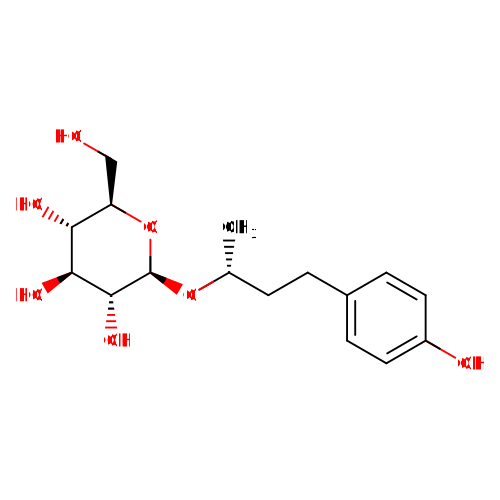
| Common Name | rhododendrin |
|---|
| Description | Rhododendrin belongs to the class of organic compounds known as fatty acyl glycosides of mono- and disaccharides. Fatty acyl glycosides of mono- and disaccharides are compounds composed of a mono- or disaccharide moiety linked to one hydroxyl group of a fatty alcohol or of a phosphorylated alcohol (phosphoprenols), a hydroxy fatty acid or to one carboxyl group of a fatty acid (ester linkage) or to an amino alcohol. rhododendrin is found in Abies nephrolepis, Abies spectabilis, Betula ovalifolia, Betula pendula, Betula platyphylla, Betula pubescens, Rhododendron brachycarpum, Taxus baccata, Taxus canadensis and Taxus cuspidata. Rhododendrin is an extremely weak basic (essentially neutral) compound (based on its pKa). |
|---|
| Structure | C[C@H](CCC1=CC=C(O)C=C1)O[C@@H]1O[C@H](CO)[C@@H](O)[C@H](O)[C@H]1O InChI=1S/C16H24O7/c1-9(2-3-10-4-6-11(18)7-5-10)22-16-15(21)14(20)13(19)12(8-17)23-16/h4-7,9,12-21H,2-3,8H2,1H3/t9-,12-,13-,14+,15-,16-/m1/s1 |
|---|
| Synonyms | | Value | Source |
|---|
| (2R)-4-(4-Hydroxyphenyl)-2-butanyl beta-D-glucopyranoside | MeSH | | (-)-Rhododendrin | MeSH | | (1R)-3-(4-Hydroxyphenyl)-1-methylpropyl beta-D-glucopyranoside | PhytoBank | | (1R)-3-(4-Hydroxyphenyl)-1-methylpropyl β-D-glucopyranoside | PhytoBank | | Betuloside | PhytoBank |
|
|---|
| Chemical Formula | C16H24O7 |
|---|
| Average Mass | 328.3610 Da |
|---|
| Monoisotopic Mass | 328.15220 Da |
|---|
| IUPAC Name | (2R,3S,4S,5R,6R)-2-(hydroxymethyl)-6-{[(2R)-4-(4-hydroxyphenyl)butan-2-yl]oxy}oxane-3,4,5-triol |
|---|
| Traditional Name | rhododendrin |
|---|
| CAS Registry Number | Not Available |
|---|
| SMILES | C[C@H](CCC1=CC=C(O)C=C1)O[C@@H]1O[C@H](CO)[C@@H](O)[C@H](O)[C@H]1O |
|---|
| InChI Identifier | InChI=1S/C16H24O7/c1-9(2-3-10-4-6-11(18)7-5-10)22-16-15(21)14(20)13(19)12(8-17)23-16/h4-7,9,12-21H,2-3,8H2,1H3/t9-,12-,13-,14+,15-,16-/m1/s1 |
|---|
| InChI Key | KLLYDTMVSVIJEH-YYMOATHLSA-N |
|---|
| Experimental Spectra |
|---|
|
| Not Available | | Predicted Spectra |
|---|
|
| | Spectrum Type | Description | Depositor ID | Depositor Organization | Depositor | Deposition Date | View |
|---|
| 1D NMR | 13C NMR Spectrum (1D, 25 MHz, H2O, predicted) | Wishart Lab | Wishart Lab | David Wishart | 2021-06-20 | View Spectrum | | 1D NMR | 1H NMR Spectrum (1D, 100 MHz, H2O, predicted) | Wishart Lab | Wishart Lab | David Wishart | 2021-06-20 | View Spectrum | | 1D NMR | 13C NMR Spectrum (1D, 252 MHz, H2O, predicted) | Wishart Lab | Wishart Lab | David Wishart | 2021-06-20 | View Spectrum | | 1D NMR | 1H NMR Spectrum (1D, 1000 MHz, H2O, predicted) | Wishart Lab | Wishart Lab | David Wishart | 2021-06-20 | View Spectrum | | 1D NMR | 13C NMR Spectrum (1D, 50 MHz, H2O, predicted) | Wishart Lab | Wishart Lab | David Wishart | 2021-06-20 | View Spectrum | | 1D NMR | 1H NMR Spectrum (1D, 200 MHz, H2O, predicted) | Wishart Lab | Wishart Lab | David Wishart | 2021-06-20 | View Spectrum | | 1D NMR | 13C NMR Spectrum (1D, 75 MHz, H2O, predicted) | Wishart Lab | Wishart Lab | David Wishart | 2021-06-20 | View Spectrum | | 1D NMR | 1H NMR Spectrum (1D, 300 MHz, H2O, predicted) | Wishart Lab | Wishart Lab | David Wishart | 2021-06-20 | View Spectrum | | 1D NMR | 13C NMR Spectrum (1D, 101 MHz, H2O, predicted) | Wishart Lab | Wishart Lab | David Wishart | 2021-06-20 | View Spectrum | | 1D NMR | 1H NMR Spectrum (1D, 400 MHz, H2O, predicted) | Wishart Lab | Wishart Lab | David Wishart | 2021-06-20 | View Spectrum | | 1D NMR | 13C NMR Spectrum (1D, 126 MHz, H2O, predicted) | Wishart Lab | Wishart Lab | David Wishart | 2021-06-20 | View Spectrum | | 1D NMR | 1H NMR Spectrum (1D, 500 MHz, H2O, predicted) | Wishart Lab | Wishart Lab | David Wishart | 2021-06-20 | View Spectrum | | 1D NMR | 13C NMR Spectrum (1D, 151 MHz, H2O, predicted) | Wishart Lab | Wishart Lab | David Wishart | 2021-06-20 | View Spectrum | | 1D NMR | 1H NMR Spectrum (1D, 600 MHz, H2O, predicted) | Wishart Lab | Wishart Lab | David Wishart | 2021-06-20 | View Spectrum | | 1D NMR | 13C NMR Spectrum (1D, 176 MHz, H2O, predicted) | Wishart Lab | Wishart Lab | David Wishart | 2021-06-20 | View Spectrum | | 1D NMR | 1H NMR Spectrum (1D, 700 MHz, H2O, predicted) | Wishart Lab | Wishart Lab | David Wishart | 2021-06-20 | View Spectrum | | 1D NMR | 13C NMR Spectrum (1D, 201 MHz, H2O, predicted) | Wishart Lab | Wishart Lab | David Wishart | 2021-06-20 | View Spectrum | | 1D NMR | 1H NMR Spectrum (1D, 800 MHz, H2O, predicted) | Wishart Lab | Wishart Lab | David Wishart | 2021-06-20 | View Spectrum | | 1D NMR | 13C NMR Spectrum (1D, 226 MHz, H2O, predicted) | Wishart Lab | Wishart Lab | David Wishart | 2021-06-20 | View Spectrum | | 1D NMR | 1H NMR Spectrum (1D, 900 MHz, H2O, predicted) | Wishart Lab | Wishart Lab | David Wishart | 2021-06-20 | View Spectrum |
| | Chemical Shift Submissions |
|---|
|
| Not Available | | Species |
|---|
| Species of Origin | |
|---|
| Chemical Taxonomy |
|---|
| Description | Belongs to the class of organic compounds known as fatty acyl glycosides of mono- and disaccharides. Fatty acyl glycosides of mono- and disaccharides are compounds composed of a mono- or disaccharide moiety linked to one hydroxyl group of a fatty alcohol or of a phosphorylated alcohol (phosphoprenols), a hydroxy fatty acid or to one carboxyl group of a fatty acid (ester linkage) or to an amino alcohol. |
|---|
| Kingdom | Organic compounds |
|---|
| Super Class | Lipids and lipid-like molecules |
|---|
| Class | Fatty Acyls |
|---|
| Sub Class | Fatty acyl glycosides |
|---|
| Direct Parent | Fatty acyl glycosides of mono- and disaccharides |
|---|
| Alternative Parents | |
|---|
| Substituents | - Fatty acyl glycoside of mono- or disaccharide
- Alkyl glycoside
- Glycosyl compound
- O-glycosyl compound
- 1-hydroxy-2-unsubstituted benzenoid
- Phenol
- Monocyclic benzene moiety
- Monosaccharide
- Oxane
- Benzenoid
- Secondary alcohol
- Organoheterocyclic compound
- Oxacycle
- Acetal
- Polyol
- Organic oxygen compound
- Organooxygen compound
- Alcohol
- Hydrocarbon derivative
- Primary alcohol
- Aromatic heteromonocyclic compound
|
|---|
| Molecular Framework | Aromatic heteromonocyclic compounds |
|---|
| External Descriptors | |
|---|
| Physical Properties |
|---|
| State | Not Available |
|---|
| Experimental Properties | | Property | Value | Reference |
|---|
| Melting Point | Not Available | Not Available | | Boiling Point | Not Available | Not Available | | Water Solubility | Not Available | Not Available | | LogP | Not Available | Not Available |
|
|---|
| Predicted Properties | |
|---|