| Record Information |
|---|
| Version | 2.0 |
|---|
| Created at | 2022-09-02 22:19:39 UTC |
|---|
| Updated at | 2022-09-02 22:19:39 UTC |
|---|
| NP-MRD ID | NP0163630 |
|---|
| Secondary Accession Numbers | None |
|---|
| Natural Product Identification |
|---|
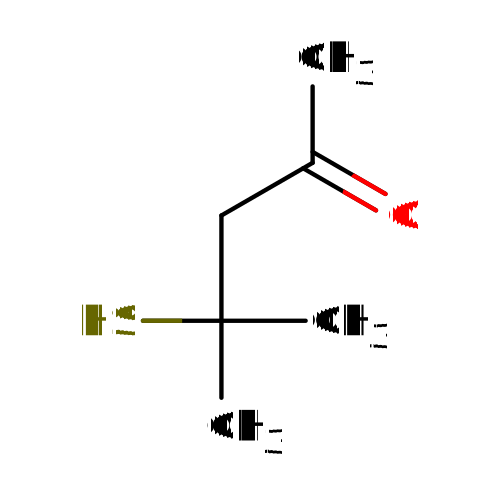
| Common Name | 4-methyl-4-sulfanylpentan-2-one |
|---|
| Description | 4-Mercapto-4-methyl-2-pentanone, also known as 4-sulfanyl-4-methylpentan-2-one or 4-methyl-4-sulfanyl-2-pentanone, belongs to the class of organic compounds known as ketones. These are organic compounds in which a carbonyl group is bonded to two carbon atoms R2C=O (neither R may be a hydrogen atom). Ketones that have one or more alpha-hydrogen atoms undergo keto-enol tautomerization, the tautomer being an enol. Thus, 4-mercapto-4-methyl-2-pentanone is considered to be an oxygenated hydrocarbon lipid molecule. An alkylthiol that is 4-methylpentan-2-one substituted at position 4 by a mercapto group. 4-Mercapto-4-methyl-2-pentanone is a very hydrophobic molecule, practically insoluble (in water), and relatively neutral. 4-Mercapto-4-methyl-2-pentanone is a blackcurrant, box tree, and cat-urine tasting compound. Outside of the human body, 4-Mercapto-4-methyl-2-pentanone has been detected, but not quantified in, alcoholic beverages. 4-methyl-4-sulfanylpentan-2-one is found in Cytisus scoparius, Humulus lupulus and Vitis vinifera. 4-methyl-4-sulfanylpentan-2-one was first documented in 2008 (PMID: 18173243). This could make 4-mercapto-4-methyl-2-pentanone a potential biomarker for the consumption of these foods (PMID: 19125618) (PMID: 20122692) (PMID: 21569935) (PMID: 24034138). |
|---|
| Structure | InChI=1S/C6H12OS/c1-5(7)4-6(2,3)8/h8H,4H2,1-3H3 |
|---|
| Synonyms | | Value | Source |
|---|
| 4-Methyl-4-mercapto-2-pentanone | ChEBI | | 4-Methyl-4-mercaptopentan-2-one | ChEBI | | 4-Methyl-4-sulfanyl-2-pentanone | ChEBI | | 4-Methyl-4-thiolpentan-2-one | ChEBI | | 4-Sulfanyl-4-methylpentan-2-one | ChEBI | | 4-Sulphanyl-4-methylpentan-2-one | ChEBI | | 4-Methyl-4-sulphanyl-2-pentanone | Generator | | 4-Mercapto-4-methyl-pentan-2-one | HMDB | | 4-Mercapto-4-methylpentan-2-one | HMDB | | 4-Methyl-4-mercapto-pentan-2-one | HMDB | | 4-Mercapto-4-methyl-2-pentanone | ChEBI |
|
|---|
| Chemical Formula | C6H12OS |
|---|
| Average Mass | 132.2240 Da |
|---|
| Monoisotopic Mass | 132.06089 Da |
|---|
| IUPAC Name | 4-methyl-4-sulfanylpentan-2-one |
|---|
| Traditional Name | 4-methyl-4-sulfanylpentan-2-one |
|---|
| CAS Registry Number | Not Available |
|---|
| SMILES | CC(=O)CC(C)(C)S |
|---|
| InChI Identifier | InChI=1S/C6H12OS/c1-5(7)4-6(2,3)8/h8H,4H2,1-3H3 |
|---|
| InChI Key | QRNZMFDCKKEPSX-UHFFFAOYSA-N |
|---|
| Experimental Spectra |
|---|
|
| Not Available | | Predicted Spectra |
|---|
|
| | Spectrum Type | Description | Depositor ID | Depositor Organization | Depositor | Deposition Date | View |
|---|
| 1D NMR | 13C NMR Spectrum (1D, 25 MHz, H2O, predicted) | Wishart Lab | Wishart Lab | David Wishart | 2021-06-20 | View Spectrum | | 1D NMR | 1H NMR Spectrum (1D, 100 MHz, H2O, predicted) | Wishart Lab | Wishart Lab | David Wishart | 2021-06-20 | View Spectrum | | 1D NMR | 13C NMR Spectrum (1D, 252 MHz, H2O, predicted) | Wishart Lab | Wishart Lab | David Wishart | 2021-06-20 | View Spectrum | | 1D NMR | 1H NMR Spectrum (1D, 1000 MHz, H2O, predicted) | Wishart Lab | Wishart Lab | David Wishart | 2021-06-20 | View Spectrum | | 1D NMR | 13C NMR Spectrum (1D, 50 MHz, H2O, predicted) | Wishart Lab | Wishart Lab | David Wishart | 2021-06-20 | View Spectrum | | 1D NMR | 1H NMR Spectrum (1D, 200 MHz, H2O, predicted) | Wishart Lab | Wishart Lab | David Wishart | 2021-06-20 | View Spectrum | | 1D NMR | 13C NMR Spectrum (1D, 75 MHz, H2O, predicted) | Wishart Lab | Wishart Lab | David Wishart | 2021-06-20 | View Spectrum | | 1D NMR | 1H NMR Spectrum (1D, 300 MHz, H2O, predicted) | Wishart Lab | Wishart Lab | David Wishart | 2021-06-20 | View Spectrum | | 1D NMR | 13C NMR Spectrum (1D, 101 MHz, H2O, predicted) | Wishart Lab | Wishart Lab | David Wishart | 2021-06-20 | View Spectrum | | 1D NMR | 1H NMR Spectrum (1D, 400 MHz, H2O, predicted) | Wishart Lab | Wishart Lab | David Wishart | 2021-06-20 | View Spectrum | | 1D NMR | 13C NMR Spectrum (1D, 126 MHz, H2O, predicted) | Wishart Lab | Wishart Lab | David Wishart | 2021-06-20 | View Spectrum | | 1D NMR | 1H NMR Spectrum (1D, 500 MHz, H2O, predicted) | Wishart Lab | Wishart Lab | David Wishart | 2021-06-20 | View Spectrum | | 1D NMR | 13C NMR Spectrum (1D, 151 MHz, H2O, predicted) | Wishart Lab | Wishart Lab | David Wishart | 2021-06-20 | View Spectrum | | 1D NMR | 1H NMR Spectrum (1D, 600 MHz, H2O, predicted) | Wishart Lab | Wishart Lab | David Wishart | 2021-06-20 | View Spectrum | | 1D NMR | 13C NMR Spectrum (1D, 176 MHz, H2O, predicted) | Wishart Lab | Wishart Lab | David Wishart | 2021-06-20 | View Spectrum | | 1D NMR | 1H NMR Spectrum (1D, 700 MHz, H2O, predicted) | Wishart Lab | Wishart Lab | David Wishart | 2021-06-20 | View Spectrum | | 1D NMR | 13C NMR Spectrum (1D, 201 MHz, H2O, predicted) | Wishart Lab | Wishart Lab | David Wishart | 2021-06-20 | View Spectrum | | 1D NMR | 1H NMR Spectrum (1D, 800 MHz, H2O, predicted) | Wishart Lab | Wishart Lab | David Wishart | 2021-06-20 | View Spectrum | | 1D NMR | 13C NMR Spectrum (1D, 226 MHz, H2O, predicted) | Wishart Lab | Wishart Lab | David Wishart | 2021-06-20 | View Spectrum | | 1D NMR | 1H NMR Spectrum (1D, 900 MHz, H2O, predicted) | Wishart Lab | Wishart Lab | David Wishart | 2021-06-20 | View Spectrum |
| | Chemical Shift Submissions |
|---|
|
| Not Available | | Species |
|---|
| Species of Origin | |
|---|
| Chemical Taxonomy |
|---|
| Description | Belongs to the class of organic compounds known as ketones. These are organic compounds in which a carbonyl group is bonded to two carbon atoms R2C=O (neither R may be a hydrogen atom). Ketones that have one or more alpha-hydrogen atoms undergo keto-enol tautomerization, the tautomer being an enol. |
|---|
| Kingdom | Organic compounds |
|---|
| Super Class | Organic oxygen compounds |
|---|
| Class | Organooxygen compounds |
|---|
| Sub Class | Carbonyl compounds |
|---|
| Direct Parent | Ketones |
|---|
| Alternative Parents | |
|---|
| Substituents | - Ketone
- Alkylthiol
- Organic oxide
- Hydrocarbon derivative
- Organosulfur compound
- Aliphatic acyclic compound
|
|---|
| Molecular Framework | Aliphatic acyclic compounds |
|---|
| External Descriptors | |
|---|
| Physical Properties |
|---|
| State | Not Available |
|---|
| Experimental Properties | | Property | Value | Reference |
|---|
| Melting Point | Not Available | Not Available | | Boiling Point | Not Available | Not Available | | Water Solubility | Not Available | Not Available | | LogP | Not Available | Not Available |
|
|---|
| Predicted Properties | |
|---|
| General References | - Kishimoto T, Kobayashi M, Yako N, Iida A, Wanikawa A: Comparison of 4-Mercapto-4-methylpentan-2-one contents in hop cultivars from different growing regions. J Agric Food Chem. 2008 Feb 13;56(3):1051-7. doi: 10.1021/jf072173e. Epub 2008 Jan 4. [PubMed:18173243 ]
- Fedrizzi B, Pardon KH, Sefton MA, Elsey GM, Jeffery DW: First identification of 4-S-glutathionyl-4-methylpentan-2-one, a potential precursor of 4-mercapto-4-methylpentan-2-one, in Sauvignon Blanc juice. J Agric Food Chem. 2009 Feb 11;57(3):991-5. doi: 10.1021/jf802799w. [PubMed:19125618 ]
- Roland A, Vialaret J, Moniatte M, Rigou P, Razungles A, Schneider R: Validation of a nanoliquid chromatography-tandem mass spectrometry method for the identification and the accurate quantification by isotopic dilution of glutathionylated and cysteinylated precursors of 3-mercaptohexan-1-ol and 4-mercapto-4-methylpentan-2-one in white grape juices. J Chromatogr A. 2010 Mar 5;1217(10):1626-35. doi: 10.1016/j.chroma.2010.01.031. Epub 2010 Jan 18. [PubMed:20122692 ]
- Roncoroni M, Santiago M, Hooks DO, Moroney S, Harsch MJ, Lee SA, Richards KD, Nicolau L, Gardner RC: The yeast IRC7 gene encodes a beta-lyase responsible for production of the varietal thiol 4-mercapto-4-methylpentan-2-one in wine. Food Microbiol. 2011 Aug;28(5):926-35. doi: 10.1016/j.fm.2011.01.002. Epub 2011 Jan 13. [PubMed:21569935 ]
- Herbst-Johnstone M, Piano F, Duhamel N, Barker D, Fedrizzi B: Ethyl propiolate derivatisation for the analysis of varietal thiols in wine. J Chromatogr A. 2013 Oct 18;1312:104-10. doi: 10.1016/j.chroma.2013.08.066. Epub 2013 Aug 26. [PubMed:24034138 ]
- LOTUS database [Link]
|
|---|