| Record Information |
|---|
| Version | 2.0 |
|---|
| Created at | 2022-09-02 12:06:05 UTC |
|---|
| Updated at | 2022-09-02 12:06:05 UTC |
|---|
| NP-MRD ID | NP0155095 |
|---|
| Secondary Accession Numbers | None |
|---|
| Natural Product Identification |
|---|
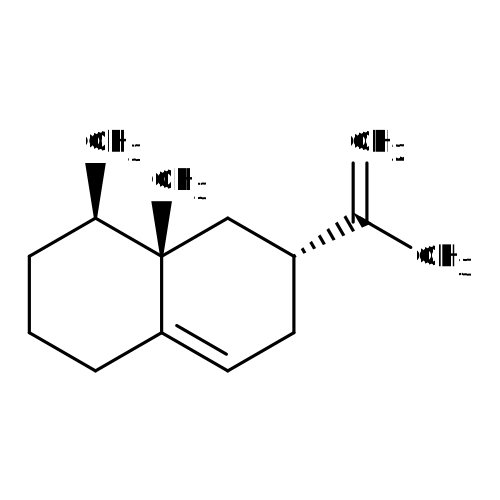
| Common Name | (+)-5-epi-aristolochene |
|---|
| Description | (+)-5-Epi-aristolochene belongs to the class of organic compounds known as eremophilane, 8,9-secoeremophilane and furoeremophilane sesquiterpenoids. These are sesquiterpenoids with a structure based either on the eremophilane skeleton, its 8,9-seco derivative, or the furoeremophilane skeleton. Eremophilanes have been shown to be derived from eudesmanes by migration of the methyl group at C-10 to C-5. Thus, (+)-5-epi-aristolochene is considered to be an isoprenoid. (+)-5-epi-aristolochene is found in Nicotiana tabacum. (+)-5-epi-aristolochene was first documented in 2016 (PMID: 27328867). Based on a literature review a significant number of articles have been published on (+)-5-epi-aristolochene (PMID: 34264250) (PMID: 32694584) (PMID: 31864296) (PMID: 31534022) (PMID: 31294452) (PMID: 30919065). |
|---|
| Structure | C[C@@H]1CCCC2=CC[C@H](C[C@]12C)C(C)=C InChI=1S/C15H24/c1-11(2)13-8-9-14-7-5-6-12(3)15(14,4)10-13/h9,12-13H,1,5-8,10H2,2-4H3/t12-,13-,15-/m1/s1 |
|---|
| Synonyms | | Value | Source |
|---|
| Epi-aristolochene | ChEBI | | (+)-5-Epiaristolochene | Kegg | | 5-Epi-aristolochene | Kegg |
|
|---|
| Chemical Formula | C15H24 |
|---|
| Average Mass | 204.3570 Da |
|---|
| Monoisotopic Mass | 204.18780 Da |
|---|
| IUPAC Name | (4R,4aR,6R)-4,4a-dimethyl-6-(prop-1-en-2-yl)-1,2,3,4,4a,5,6,7-octahydronaphthalene |
|---|
| Traditional Name | (+)-5-epi-aristolochene |
|---|
| CAS Registry Number | Not Available |
|---|
| SMILES | C[C@@H]1CCCC2=CC[C@H](C[C@]12C)C(C)=C |
|---|
| InChI Identifier | InChI=1S/C15H24/c1-11(2)13-8-9-14-7-5-6-12(3)15(14,4)10-13/h9,12-13H,1,5-8,10H2,2-4H3/t12-,13-,15-/m1/s1 |
|---|
| InChI Key | YONHOSLUBQJXPR-UMVBOHGHSA-N |
|---|
| Experimental Spectra |
|---|
|
| Not Available | | Predicted Spectra |
|---|
|
| | Spectrum Type | Description | Depositor ID | Depositor Organization | Depositor | Deposition Date | View |
|---|
| 1D NMR | 13C NMR Spectrum (1D, 25 MHz, H2O, predicted) | Wishart Lab | Wishart Lab | David Wishart | 2021-06-20 | View Spectrum | | 1D NMR | 1H NMR Spectrum (1D, 100 MHz, H2O, predicted) | Wishart Lab | Wishart Lab | David Wishart | 2021-06-20 | View Spectrum | | 1D NMR | 13C NMR Spectrum (1D, 252 MHz, H2O, predicted) | Wishart Lab | Wishart Lab | David Wishart | 2021-06-20 | View Spectrum | | 1D NMR | 1H NMR Spectrum (1D, 1000 MHz, H2O, predicted) | Wishart Lab | Wishart Lab | David Wishart | 2021-06-20 | View Spectrum | | 1D NMR | 13C NMR Spectrum (1D, 50 MHz, H2O, predicted) | Wishart Lab | Wishart Lab | David Wishart | 2021-06-20 | View Spectrum | | 1D NMR | 1H NMR Spectrum (1D, 200 MHz, H2O, predicted) | Wishart Lab | Wishart Lab | David Wishart | 2021-06-20 | View Spectrum | | 1D NMR | 13C NMR Spectrum (1D, 75 MHz, H2O, predicted) | Wishart Lab | Wishart Lab | David Wishart | 2021-06-20 | View Spectrum | | 1D NMR | 1H NMR Spectrum (1D, 300 MHz, H2O, predicted) | Wishart Lab | Wishart Lab | David Wishart | 2021-06-20 | View Spectrum | | 1D NMR | 13C NMR Spectrum (1D, 101 MHz, H2O, predicted) | Wishart Lab | Wishart Lab | David Wishart | 2021-06-20 | View Spectrum | | 1D NMR | 1H NMR Spectrum (1D, 400 MHz, H2O, predicted) | Wishart Lab | Wishart Lab | David Wishart | 2021-06-20 | View Spectrum | | 1D NMR | 13C NMR Spectrum (1D, 126 MHz, H2O, predicted) | Wishart Lab | Wishart Lab | David Wishart | 2021-06-20 | View Spectrum | | 1D NMR | 1H NMR Spectrum (1D, 500 MHz, H2O, predicted) | Wishart Lab | Wishart Lab | David Wishart | 2021-06-20 | View Spectrum | | 1D NMR | 13C NMR Spectrum (1D, 151 MHz, H2O, predicted) | Wishart Lab | Wishart Lab | David Wishart | 2021-06-20 | View Spectrum | | 1D NMR | 1H NMR Spectrum (1D, 600 MHz, H2O, predicted) | Wishart Lab | Wishart Lab | David Wishart | 2021-06-20 | View Spectrum | | 1D NMR | 13C NMR Spectrum (1D, 176 MHz, H2O, predicted) | Wishart Lab | Wishart Lab | David Wishart | 2021-06-20 | View Spectrum | | 1D NMR | 1H NMR Spectrum (1D, 700 MHz, H2O, predicted) | Wishart Lab | Wishart Lab | David Wishart | 2021-06-20 | View Spectrum | | 1D NMR | 13C NMR Spectrum (1D, 201 MHz, H2O, predicted) | Wishart Lab | Wishart Lab | David Wishart | 2021-06-20 | View Spectrum | | 1D NMR | 1H NMR Spectrum (1D, 800 MHz, H2O, predicted) | Wishart Lab | Wishart Lab | David Wishart | 2021-06-20 | View Spectrum | | 1D NMR | 13C NMR Spectrum (1D, 226 MHz, H2O, predicted) | Wishart Lab | Wishart Lab | David Wishart | 2021-06-20 | View Spectrum | | 1D NMR | 1H NMR Spectrum (1D, 900 MHz, H2O, predicted) | Wishart Lab | Wishart Lab | David Wishart | 2021-06-20 | View Spectrum |
| | Chemical Shift Submissions |
|---|
|
| Not Available | | Species |
|---|
| Species of Origin | |
|---|
| Chemical Taxonomy |
|---|
| Description | Belongs to the class of organic compounds known as eremophilane, 8,9-secoeremophilane and furoeremophilane sesquiterpenoids. These are sesquiterpenoids with a structure based either on the eremophilane skeleton, its 8,9-seco derivative, or the furoeremophilane skeleton. Eremophilanes have been shown to be derived from eudesmanes by migration of the methyl group at C-10 to C-5. |
|---|
| Kingdom | Organic compounds |
|---|
| Super Class | Lipids and lipid-like molecules |
|---|
| Class | Prenol lipids |
|---|
| Sub Class | Sesquiterpenoids |
|---|
| Direct Parent | Eremophilane, 8,9-secoeremophilane and furoeremophilane sesquiterpenoids |
|---|
| Alternative Parents | |
|---|
| Substituents | - Eremophilane sesquiterpenoid
- Branched unsaturated hydrocarbon
- Polycyclic hydrocarbon
- Cyclic olefin
- Unsaturated aliphatic hydrocarbon
- Unsaturated hydrocarbon
- Olefin
- Hydrocarbon
- Aliphatic homopolycyclic compound
|
|---|
| Molecular Framework | Aliphatic homopolycyclic compounds |
|---|
| External Descriptors | |
|---|
| Physical Properties |
|---|
| State | Not Available |
|---|
| Experimental Properties | | Property | Value | Reference |
|---|
| Melting Point | Not Available | Not Available | | Boiling Point | Not Available | Not Available | | Water Solubility | Not Available | Not Available | | LogP | Not Available | Not Available |
|
|---|
| Predicted Properties | |
|---|
| General References | - Huang JQ, Li DM, Li JX, Lin JL, Tian X, Wang LJ, Chen XY, Fang X: 1,10/1,11-Cyclization catalyzed by diverged plant sesquiterpene synthases is dependent on a single residue. Org Biomol Chem. 2021 Aug 5;19(30):6650-6656. doi: 10.1039/d1ob00827g. [PubMed:34264250 ]
- Baba VY, Powell AF, Ivamoto-Suzuki ST, Pereira LFP, Vanzela ALL, Giacomin RM, Strickler SR, Mueller LA, Rodrigues R, Goncalves LSA: Capsidiol-related genes are highly expressed in response to Colletotrichum scovillei during Capsicum annuum fruit development stages. Sci Rep. 2020 Jul 21;10(1):12048. doi: 10.1038/s41598-020-68949-5. [PubMed:32694584 ]
- Kojima T, Asakura N, Hasegawa S, Hirasawa T, Mizuno Y, Takemoto D, Katou S: Transcriptional induction of capsidiol synthesis genes by wounding can promote pathogen signal-induced capsidiol synthesis. BMC Plant Biol. 2019 Dec 21;19(1):576. doi: 10.1186/s12870-019-2204-1. [PubMed:31864296 ]
- Nguyen TD, Kwon M, Kim SU, Fischer C, Ro DK: Catalytic Plasticity of Germacrene A Oxidase Underlies Sesquiterpene Lactone Diversification. Plant Physiol. 2019 Nov;181(3):945-960. doi: 10.1104/pp.19.00629. Epub 2019 Sep 18. [PubMed:31534022 ]
- Song N, Ma L, Wang W, Sun H, Wang L, Baldwin IT, Wu J: An ERF2-like transcription factor regulates production of the defense sesquiterpene capsidiol upon Alternaria alternata infection. J Exp Bot. 2019 Oct 24;70(20):5895-5908. doi: 10.1093/jxb/erz327. [PubMed:31294452 ]
- Cai Y, Whitehead P, Chappell J, Chapman KD: Mouse lipogenic proteins promote the co-accumulation of triacylglycerols and sesquiterpenes in plant cells. Planta. 2019 Jul;250(1):79-94. doi: 10.1007/s00425-019-03148-9. Epub 2019 Mar 27. [PubMed:30919065 ]
- Koo HJ, Vickery CR, Xu Y, Louie GV, O'Maille PE, Bowman M, Nartey CM, Burkart MD, Noel JP: Biosynthetic potential of sesquiterpene synthases: product profiles of Egyptian Henbane premnaspirodiene synthase and related mutants. J Antibiot (Tokyo). 2016 Jul;69(7):524-33. doi: 10.1038/ja.2016.68. Epub 2016 Jun 22. [PubMed:27328867 ]
- Imano S, Fushimi M, Camagna M, Tsuyama-Koike A, Mori H, Ashida A, Tanaka A, Sato I, Chiba S, Kawakita K, Ojika M, Takemoto D: AP2/ERF Transcription Factor NbERF-IX-33 Is Involved in the Regulation of Phytoalexin Production for the Resistance of Nicotiana benthamiana to Phytophthora infestans. Front Plant Sci. 2022 Jan 27;12:821574. doi: 10.3389/fpls.2021.821574. eCollection 2021. [PubMed:35154216 ]
- Lee HA, Kim S, Kim S, Choi D: Expansion of sesquiterpene biosynthetic gene clusters in pepper confers nonhost resistance to the Irish potato famine pathogen. New Phytol. 2017 Aug;215(3):1132-1143. doi: 10.1111/nph.14637. Epub 2017 Jun 20. [PubMed:28631815 ]
- Shibata Y, Ojika M, Sugiyama A, Yazaki K, Jones DA, Kawakita K, Takemoto D: The Full-Size ABCG Transporters Nb-ABCG1 and Nb-ABCG2 Function in Pre- and Postinvasion Defense against Phytophthora infestans in Nicotiana benthamiana. Plant Cell. 2016 May;28(5):1163-81. doi: 10.1105/tpc.15.00721. Epub 2016 Apr 21. [PubMed:27102667 ]
- LOTUS database [Link]
|
|---|