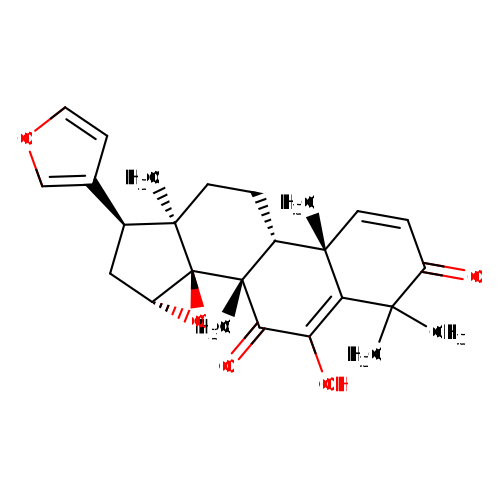
| Record Information |
|---|
| Version | 2.0 |
|---|
| Created at | 2022-09-02 11:30:18 UTC |
|---|
| Updated at | 2022-09-02 11:30:18 UTC |
|---|
| NP-MRD ID | NP0154571 |
|---|
| Secondary Accession Numbers | None |
|---|
| Natural Product Identification |
|---|
| Common Name | (1r,2r,4r,6s,7s,10r,11r)-6-(furan-3-yl)-17-hydroxy-1,7,11,15,15-pentamethyl-3-oxapentacyclo[8.8.0.0²,⁴.0²,⁷.0¹¹,¹⁶]octadeca-12,16-diene-14,18-dione |
|---|
| Description | Cedrelone belongs to the class of organic compounds known as limonoids. These are highly oxygenated, modified terpenoids with a prototypical structure either containing or derived from a precursor with a 4,4,8-trimethyl-17-furanylsteroid skeleton. All naturally occurring citrus limonoids contain a furan ring attached to the D-ring, at C-17, as well as oxygen containing functional groups at C-3, C-4, C-7, C-16 and C-17. (1r,2r,4r,6s,7s,10r,11r)-6-(furan-3-yl)-17-hydroxy-1,7,11,15,15-pentamethyl-3-oxapentacyclo[8.8.0.0²,⁴.0²,⁷.0¹¹,¹⁶]octadeca-12,16-diene-14,18-dione is found in Toona ciliata. (1r,2r,4r,6s,7s,10r,11r)-6-(furan-3-yl)-17-hydroxy-1,7,11,15,15-pentamethyl-3-oxapentacyclo[8.8.0.0²,⁴.0²,⁷.0¹¹,¹⁶]octadeca-12,16-diene-14,18-dione was first documented in 2017 (PMID: 28129886). Based on a literature review a significant number of articles have been published on Cedrelone (PMID: 33164370) (PMID: 35628141) (PMID: 35686814) (PMID: 31551955) (PMID: 34107900) (PMID: 31857088). |
|---|
| Structure | C[C@@]12CC[C@@H]3[C@@]4(C)C=CC(=O)C(C)(C)C4=C(O)C(=O)[C@@]3(C)[C@]11O[C@@H]1C[C@H]2C1=COC=C1 InChI=1S/C26H30O5/c1-22(2)17(27)7-9-23(3)16-6-10-24(4)15(14-8-11-30-13-14)12-18-26(24,31-18)25(16,5)21(29)19(28)20(22)23/h7-9,11,13,15-16,18,28H,6,10,12H2,1-5H3/t15-,16+,18+,23+,24-,25-,26+/m0/s1 |
|---|
| Synonyms | Not Available |
|---|
| Chemical Formula | C26H30O5 |
|---|
| Average Mass | 422.5210 Da |
|---|
| Monoisotopic Mass | 422.20932 Da |
|---|
| IUPAC Name | (1R,2R,4R,6R,7S,10R,11R)-6-(furan-3-yl)-17-hydroxy-1,7,11,15,15-pentamethyl-3-oxapentacyclo[8.8.0.0^{2,4}.0^{2,7}.0^{11,16}]octadeca-12,16-diene-14,18-dione |
|---|
| Traditional Name | (1R,2R,4R,6R,7S,10R,11R)-6-(furan-3-yl)-17-hydroxy-1,7,11,15,15-pentamethyl-3-oxapentacyclo[8.8.0.0^{2,4}.0^{2,7}.0^{11,16}]octadeca-12,16-diene-14,18-dione |
|---|
| CAS Registry Number | Not Available |
|---|
| SMILES | C[C@@]12CC[C@@H]3[C@@]4(C)C=CC(=O)C(C)(C)C4=C(O)C(=O)[C@@]3(C)[C@]11O[C@@H]1C[C@H]2C1=COC=C1 |
|---|
| InChI Identifier | InChI=1S/C26H30O5/c1-22(2)17(27)7-9-23(3)16-6-10-24(4)15(14-8-11-30-13-14)12-18-26(24,31-18)25(16,5)21(29)19(28)20(22)23/h7-9,11,13,15-16,18,28H,6,10,12H2,1-5H3/t15-,16+,18+,23+,24-,25-,26+/m0/s1 |
|---|
| InChI Key | OQMUOVSEPOBWMK-BWLMZZBKSA-N |
|---|
| Experimental Spectra |
|---|
|
| Not Available | | Predicted Spectra |
|---|
|
| | Spectrum Type | Description | Depositor ID | Depositor Organization | Depositor | Deposition Date | View |
|---|
| 1D NMR | 13C NMR Spectrum (1D, 25 MHz, H2O, predicted) | Wishart Lab | Wishart Lab | David Wishart | 2021-06-20 | View Spectrum | | 1D NMR | 1H NMR Spectrum (1D, 100 MHz, H2O, predicted) | Wishart Lab | Wishart Lab | David Wishart | 2021-06-20 | View Spectrum | | 1D NMR | 13C NMR Spectrum (1D, 252 MHz, H2O, predicted) | Wishart Lab | Wishart Lab | David Wishart | 2021-06-20 | View Spectrum | | 1D NMR | 1H NMR Spectrum (1D, 1000 MHz, H2O, predicted) | Wishart Lab | Wishart Lab | David Wishart | 2021-06-20 | View Spectrum | | 1D NMR | 13C NMR Spectrum (1D, 50 MHz, H2O, predicted) | Wishart Lab | Wishart Lab | David Wishart | 2021-06-20 | View Spectrum | | 1D NMR | 1H NMR Spectrum (1D, 200 MHz, H2O, predicted) | Wishart Lab | Wishart Lab | David Wishart | 2021-06-20 | View Spectrum | | 1D NMR | 13C NMR Spectrum (1D, 75 MHz, H2O, predicted) | Wishart Lab | Wishart Lab | David Wishart | 2021-06-20 | View Spectrum | | 1D NMR | 1H NMR Spectrum (1D, 300 MHz, H2O, predicted) | Wishart Lab | Wishart Lab | David Wishart | 2021-06-20 | View Spectrum | | 1D NMR | 13C NMR Spectrum (1D, 101 MHz, H2O, predicted) | Wishart Lab | Wishart Lab | David Wishart | 2021-06-20 | View Spectrum | | 1D NMR | 1H NMR Spectrum (1D, 400 MHz, H2O, predicted) | Wishart Lab | Wishart Lab | David Wishart | 2021-06-20 | View Spectrum | | 1D NMR | 13C NMR Spectrum (1D, 126 MHz, H2O, predicted) | Wishart Lab | Wishart Lab | David Wishart | 2021-06-20 | View Spectrum | | 1D NMR | 1H NMR Spectrum (1D, 500 MHz, H2O, predicted) | Wishart Lab | Wishart Lab | David Wishart | 2021-06-20 | View Spectrum | | 1D NMR | 13C NMR Spectrum (1D, 151 MHz, H2O, predicted) | Wishart Lab | Wishart Lab | David Wishart | 2021-06-20 | View Spectrum | | 1D NMR | 1H NMR Spectrum (1D, 600 MHz, H2O, predicted) | Wishart Lab | Wishart Lab | David Wishart | 2021-06-20 | View Spectrum | | 1D NMR | 13C NMR Spectrum (1D, 176 MHz, H2O, predicted) | Wishart Lab | Wishart Lab | David Wishart | 2021-06-20 | View Spectrum | | 1D NMR | 1H NMR Spectrum (1D, 700 MHz, H2O, predicted) | Wishart Lab | Wishart Lab | David Wishart | 2021-06-20 | View Spectrum | | 1D NMR | 13C NMR Spectrum (1D, 201 MHz, H2O, predicted) | Wishart Lab | Wishart Lab | David Wishart | 2021-06-20 | View Spectrum | | 1D NMR | 1H NMR Spectrum (1D, 800 MHz, H2O, predicted) | Wishart Lab | Wishart Lab | David Wishart | 2021-06-20 | View Spectrum | | 1D NMR | 13C NMR Spectrum (1D, 226 MHz, H2O, predicted) | Wishart Lab | Wishart Lab | David Wishart | 2021-06-20 | View Spectrum | | 1D NMR | 1H NMR Spectrum (1D, 900 MHz, H2O, predicted) | Wishart Lab | Wishart Lab | David Wishart | 2021-06-20 | View Spectrum |
| | Chemical Shift Submissions |
|---|
|
| Not Available | | Species |
|---|
| Species of Origin | |
|---|
| Chemical Taxonomy |
|---|
| Description | Belongs to the class of organic compounds known as limonoids. These are highly oxygenated, modified terpenoids with a prototypical structure either containing or derived from a precursor with a 4,4,8-trimethyl-17-furanylsteroid skeleton. All naturally occurring citrus limonoids contain a furan ring attached to the D-ring, at C-17, as well as oxygen containing functional groups at C-3, C-4, C-7, C-16 and C-17. |
|---|
| Kingdom | Organic compounds |
|---|
| Super Class | Lipids and lipid-like molecules |
|---|
| Class | Prenol lipids |
|---|
| Sub Class | Triterpenoids |
|---|
| Direct Parent | Limonoids |
|---|
| Alternative Parents | |
|---|
| Substituents | - Limonoid skeleton
- 17-furanylsteroid skeleton
- 3-oxo-delta-1-steroid
- 7-oxosteroid
- Oxosteroid
- Delta-1-steroid
- Steroid
- Naphthopyran
- Naphthalene
- Cyclohexenone
- Pyran
- Oxane
- Heteroaromatic compound
- Furan
- Ketone
- Cyclic ketone
- Dialkyl ether
- Enol
- Oxirane
- Ether
- Oxacycle
- Organoheterocyclic compound
- Organic oxide
- Carbonyl group
- Hydrocarbon derivative
- Organic oxygen compound
- Organooxygen compound
- Aromatic heteropolycyclic compound
|
|---|
| Molecular Framework | Aromatic heteropolycyclic compounds |
|---|
| External Descriptors | Not Available |
|---|
| Physical Properties |
|---|
| State | Not Available |
|---|
| Experimental Properties | | Property | Value | Reference |
|---|
| Melting Point | Not Available | Not Available | | Boiling Point | Not Available | Not Available | | Water Solubility | Not Available | Not Available | | LogP | Not Available | Not Available |
|
|---|
| Predicted Properties | |
|---|
| General References | - Zhang Y, An FL, Huang SS, Yang L, Gu YC, Luo J, Kong LY: Diverse tritepenoids from the fruits of Walsura robusta and their reversal of multidrug resistance phenotype in human breast cancer cells. Phytochemistry. 2017 Apr;136:108-118. doi: 10.1016/j.phytochem.2017.01.008. Epub 2017 Jan 24. [PubMed:28129886 ]
- Jiang HU, Jia-Xun LI, Qiang LI, Tian-Feng P, Xiao-Dong S, Tao L, Jian C, Nian-Hua J, Wei-Xing Y, Wei W: [Terpenoids from Toona sinensis]. Zhongguo Zhong Yao Za Zhi. 2020 Sep;45(18):4411-4415. doi: 10.19540/j.cnki.cjcmm.20200608.202. [PubMed:33164370 ]
- Lin M, Bi X, Zhou L, Huang J: Insecticidal Triterpenes in Meliaceae: Plant Species, Molecules, and Activities: Part II (Cipadessa, Melia). Int J Mol Sci. 2022 May 10;23(10):5329. doi: 10.3390/ijms23105329. [PubMed:35628141 ]
- Vergoten G, Bailly C: Molecular docking study of GSK-3beta interaction with nomilin, kihadanin B, and related limonoids and triterpenes with a furyl-delta-lactone core. J Biochem Mol Toxicol. 2022 Sep;36(9):e23130. doi: 10.1002/jbt.23130. Epub 2022 Jun 10. [PubMed:35686814 ]
- Jin Z, Ma J, Zhu G, Zhang H: Discovery of Novel Anti-cryptosporidial Activities From Natural Products by in vitro High-Throughput Phenotypic Screening. Front Microbiol. 2019 Aug 29;10:1999. doi: 10.3389/fmicb.2019.01999. eCollection 2019. [PubMed:31551955 ]
- Yu F, Gajendran B, Wang N, Sample KM, Liu W, Wang C, Hu A, Zacksenhaus E, Hao X, Ben-David Y: ERK activation via A1542/3 limonoids attenuates erythroleukemia through transcriptional stimulation of cholesterol biosynthesis genes. BMC Cancer. 2021 Jun 9;21(1):680. doi: 10.1186/s12885-021-08402-6. [PubMed:34107900 ]
- Becceneri AB, Fuzer AM, Popolin CP, Cazal CM, Domingues VC, Fernandes JB, Vieira PC, Cominetti MR: Acetylation of cedrelone increases its cytotoxic activity and reverts the malignant phenotype of breast cancer cells in 3D culture. Chem Biol Interact. 2020 Jan 25;316:108920. doi: 10.1016/j.cbi.2019.108920. Epub 2019 Dec 16. [PubMed:31857088 ]
- Wu J, Niu Q, Yuan J, Xu X, Cao L: Novel compound cedrelone inhibits hepatocellular carcinoma progression via PBLD and Ras/Rap1. Exp Ther Med. 2019 Dec;18(6):4209-4220. doi: 10.3892/etm.2019.8080. Epub 2019 Oct 7. [PubMed:31777531 ]
- Cao Y, Zhang L, Wang Y: Antitumor activity of Cedrelone in temozolomide-resistant human glioma cells is accompanied by mitochondrial mediated apoptosis, inhibition of angiogenesis, cell cycle disruption and modulation of ERK/MAPK signalling pathway. J BUON. 2019 May-Jun;24(3):1204-1209. [PubMed:31424680 ]
- Wang N, Fan Y, Yuan CM, Song J, Yao Y, Liu W, Gajendran B, Zacksenhaus E, Li Y, Liu J, Hao XJ, Ben-David Y: Selective ERK1/2 agonists isolated from Melia azedarach with potent anti-leukemic activity. BMC Cancer. 2019 Aug 2;19(1):764. doi: 10.1186/s12885-019-5914-8. [PubMed:31375085 ]
- LOTUS database [Link]
|
|---|