| Record Information |
|---|
| Version | 2.0 |
|---|
| Created at | 2022-09-02 04:51:54 UTC |
|---|
| Updated at | 2022-09-02 04:51:54 UTC |
|---|
| NP-MRD ID | NP0149036 |
|---|
| Secondary Accession Numbers | None |
|---|
| Natural Product Identification |
|---|
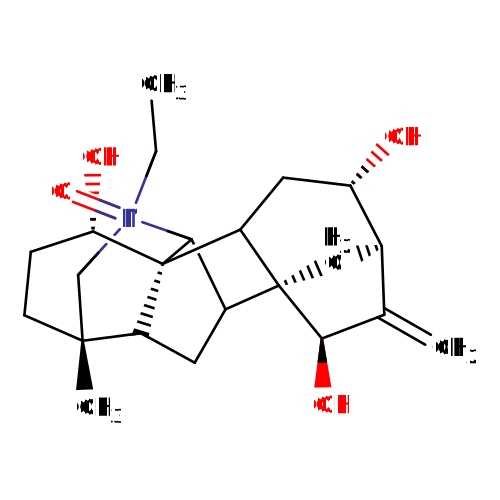
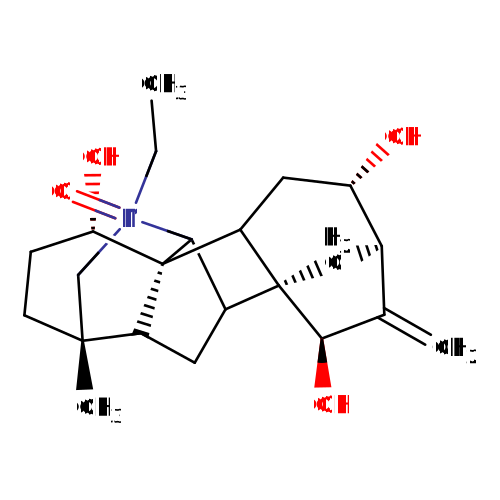
| Common Name | (1r,4s,5r,7r,8s,13r,16s)-11-ethyl-4,7,16-trihydroxy-13-methyl-6-methylidene-11-azahexacyclo[7.7.2.1⁵,⁸.0¹,¹⁰.0²,⁸.0¹³,¹⁷]nonadecan-11-ium-11-olate |
|---|
| Description | Napelline N-oxide belongs to the class of organic compounds known as kaurane diterpenoids. These are diterpene alkaloids with a structure that is based on the kaurane skeleton. Kaurane is a tetracyclic compound that arises by cyclisation of a pimarane precursor followed by rearrangement. It possesses a [3,2,1]-bicyclic ring system with C15-C16 bridge connected to C13, forming the five-membered ring D. (1r,4s,5r,7r,8s,13r,16s)-11-ethyl-4,7,16-trihydroxy-13-methyl-6-methylidene-11-azahexacyclo[7.7.2.1⁵,⁸.0¹,¹⁰.0²,⁸.0¹³,¹⁷]nonadecan-11-ium-11-olate is found in Aconitum karakolicum. (1r,4s,5r,7r,8s,13r,16s)-11-ethyl-4,7,16-trihydroxy-13-methyl-6-methylidene-11-azahexacyclo[7.7.2.1⁵,⁸.0¹,¹⁰.0²,⁸.0¹³,¹⁷]nonadecan-11-ium-11-olate was first documented in 2012 (PMID: 22803106). Based on a literature review a small amount of articles have been published on Napelline N-oxide (PMID: 25110090) (PMID: 24770754). |
|---|
| Structure | CC[N+]1([O-])C[C@]2(C)CC[C@H](O)[C@@]34C2CC(C13)[C@]12C[C@@H]([C@@H](O)CC41)C(=C)[C@H]2O InChI=1S/C22H33NO4/c1-4-23(27)10-20(3)6-5-17(25)22-15(20)7-13(18(22)23)21-9-12(11(2)19(21)26)14(24)8-16(21)22/h12-19,24-26H,2,4-10H2,1,3H3/t12-,13?,14+,15?,16?,17+,18?,19-,20+,21-,22+,23?/m1/s1 |
|---|
| Synonyms | Not Available |
|---|
| Chemical Formula | C22H33NO4 |
|---|
| Average Mass | 375.5090 Da |
|---|
| Monoisotopic Mass | 375.24096 Da |
|---|
| IUPAC Name | Not Available |
|---|
| Traditional Name | Not Available |
|---|
| CAS Registry Number | Not Available |
|---|
| SMILES | CC[N+]1([O-])C[C@]2(C)CC[C@H](O)[C@@]34C2CC(C13)[C@]12C[C@@H]([C@@H](O)CC41)C(=C)[C@H]2O |
|---|
| InChI Identifier | InChI=1S/C22H33NO4/c1-4-23(27)10-20(3)6-5-17(25)22-15(20)7-13(18(22)23)21-9-12(11(2)19(21)26)14(24)8-16(21)22/h12-19,24-26H,2,4-10H2,1,3H3/t12-,13?,14+,15?,16?,17+,18?,19-,20+,21-,22+,23?/m1/s1 |
|---|
| InChI Key | DEMQJEXKIJFBRD-LGTBQFFLSA-N |
|---|
| Experimental Spectra |
|---|
|
| Not Available | | Predicted Spectra |
|---|
|
| | Spectrum Type | Description | Depositor ID | Depositor Organization | Depositor | Deposition Date | View |
|---|
| 1D NMR | 13C NMR Spectrum (1D, 25 MHz, H2O, predicted) | Wishart Lab | Wishart Lab | David Wishart | 2021-06-20 | View Spectrum | | 1D NMR | 1H NMR Spectrum (1D, 100 MHz, H2O, predicted) | Wishart Lab | Wishart Lab | David Wishart | 2021-06-20 | View Spectrum | | 1D NMR | 13C NMR Spectrum (1D, 252 MHz, H2O, predicted) | Wishart Lab | Wishart Lab | David Wishart | 2021-06-20 | View Spectrum | | 1D NMR | 1H NMR Spectrum (1D, 1000 MHz, H2O, predicted) | Wishart Lab | Wishart Lab | David Wishart | 2021-06-20 | View Spectrum | | 1D NMR | 13C NMR Spectrum (1D, 50 MHz, H2O, predicted) | Wishart Lab | Wishart Lab | David Wishart | 2021-06-20 | View Spectrum | | 1D NMR | 1H NMR Spectrum (1D, 200 MHz, H2O, predicted) | Wishart Lab | Wishart Lab | David Wishart | 2021-06-20 | View Spectrum | | 1D NMR | 13C NMR Spectrum (1D, 75 MHz, H2O, predicted) | Wishart Lab | Wishart Lab | David Wishart | 2021-06-20 | View Spectrum | | 1D NMR | 1H NMR Spectrum (1D, 300 MHz, H2O, predicted) | Wishart Lab | Wishart Lab | David Wishart | 2021-06-20 | View Spectrum | | 1D NMR | 13C NMR Spectrum (1D, 101 MHz, H2O, predicted) | Wishart Lab | Wishart Lab | David Wishart | 2021-06-20 | View Spectrum | | 1D NMR | 1H NMR Spectrum (1D, 400 MHz, H2O, predicted) | Wishart Lab | Wishart Lab | David Wishart | 2021-06-20 | View Spectrum | | 1D NMR | 13C NMR Spectrum (1D, 126 MHz, H2O, predicted) | Wishart Lab | Wishart Lab | David Wishart | 2021-06-20 | View Spectrum | | 1D NMR | 1H NMR Spectrum (1D, 500 MHz, H2O, predicted) | Wishart Lab | Wishart Lab | David Wishart | 2021-06-20 | View Spectrum | | 1D NMR | 13C NMR Spectrum (1D, 151 MHz, H2O, predicted) | Wishart Lab | Wishart Lab | David Wishart | 2021-06-20 | View Spectrum | | 1D NMR | 1H NMR Spectrum (1D, 600 MHz, H2O, predicted) | Wishart Lab | Wishart Lab | David Wishart | 2021-06-20 | View Spectrum | | 1D NMR | 13C NMR Spectrum (1D, 176 MHz, H2O, predicted) | Wishart Lab | Wishart Lab | David Wishart | 2021-06-20 | View Spectrum | | 1D NMR | 1H NMR Spectrum (1D, 700 MHz, H2O, predicted) | Wishart Lab | Wishart Lab | David Wishart | 2021-06-20 | View Spectrum | | 1D NMR | 13C NMR Spectrum (1D, 201 MHz, H2O, predicted) | Wishart Lab | Wishart Lab | David Wishart | 2021-06-20 | View Spectrum | | 1D NMR | 1H NMR Spectrum (1D, 800 MHz, H2O, predicted) | Wishart Lab | Wishart Lab | David Wishart | 2021-06-20 | View Spectrum | | 1D NMR | 13C NMR Spectrum (1D, 226 MHz, H2O, predicted) | Wishart Lab | Wishart Lab | David Wishart | 2021-06-20 | View Spectrum | | 1D NMR | 1H NMR Spectrum (1D, 900 MHz, H2O, predicted) | Wishart Lab | Wishart Lab | David Wishart | 2021-06-20 | View Spectrum |
| | Chemical Shift Submissions |
|---|
|
| Not Available | | Species |
|---|
| Species of Origin | |
|---|
| Chemical Taxonomy |
|---|
| Description | Belongs to the class of organic compounds known as kaurane diterpenoids. These are diterpene alkaloids with a structure that is based on the kaurane skeleton. Kaurane is a tetracyclic compound that arises by cyclisation of a pimarane precursor followed by rearrangement. It possesses a [3,2,1]-bicyclic ring system with C15-C16 bridge connected to C13, forming the five-membered ring D. |
|---|
| Kingdom | Organic compounds |
|---|
| Super Class | Lipids and lipid-like molecules |
|---|
| Class | Prenol lipids |
|---|
| Sub Class | Diterpenoids |
|---|
| Direct Parent | Kaurane diterpenoids |
|---|
| Alternative Parents | |
|---|
| Substituents | - Kaurane diterpenoid
- Azepane
- Piperidine
- Trialkyl amine oxide
- Cyclic alcohol
- Secondary alcohol
- Azacycle
- Organoheterocyclic compound
- Trisubstituted n-oxide
- Polyol
- N-oxide
- Organic nitrogen compound
- Organic oxygen compound
- Organopnictogen compound
- Organic oxide
- Hydrocarbon derivative
- Organic zwitterion
- Organooxygen compound
- Organonitrogen compound
- Alcohol
- Aliphatic heteropolycyclic compound
|
|---|
| Molecular Framework | Aliphatic heteropolycyclic compounds |
|---|
| External Descriptors | Not Available |
|---|
| Physical Properties |
|---|
| State | Not Available |
|---|
| Experimental Properties | | Property | Value | Reference |
|---|
| Melting Point | Not Available | Not Available | | Boiling Point | Not Available | Not Available | | Water Solubility | Not Available | Not Available | | LogP | Not Available | Not Available |
|
|---|
| Predicted Properties | |
|---|