| Record Information |
|---|
| Version | 2.0 |
|---|
| Created at | 2022-09-02 04:20:29 UTC |
|---|
| Updated at | 2022-09-02 04:20:29 UTC |
|---|
| NP-MRD ID | NP0148576 |
|---|
| Secondary Accession Numbers | None |
|---|
| Natural Product Identification |
|---|
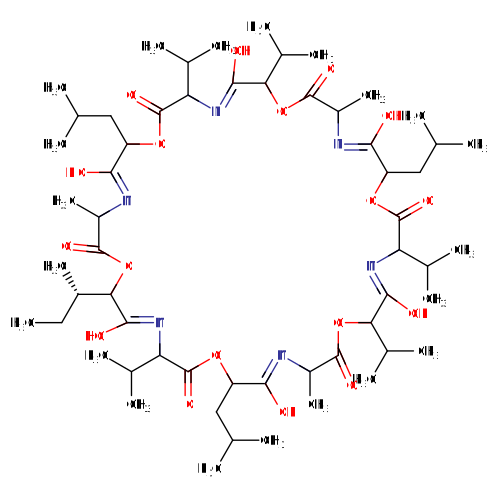
| Common Name | 6-[(2s)-butan-2-yl]-5,11,17,23,29,35-hexahydroxy-3,15,18,27,30-pentaisopropyl-9,21,33-trimethyl-12,24,36-tris(2-methylpropyl)-1,7,13,19,25,31-hexaoxa-4,10,16,22,28,34-hexaazacyclohexatriaconta-4,10,16,22,28,34-hexaene-2,8,14,20,26,32-hexone |
|---|
| Description | Homocereulide belongs to the class of organic compounds known as cyclic depsipeptides. These are natural or synthetic compounds having sequences of amino and hydroxy carboxylic acid residues (usually α-amino and α-hydroxy acids) connected in a ring. The residues are commonly but not necessarily regularly alternating. 6-[(2s)-butan-2-yl]-5,11,17,23,29,35-hexahydroxy-3,15,18,27,30-pentaisopropyl-9,21,33-trimethyl-12,24,36-tris(2-methylpropyl)-1,7,13,19,25,31-hexaoxa-4,10,16,22,28,34-hexaazacyclohexatriaconta-4,10,16,22,28,34-hexaene-2,8,14,20,26,32-hexone was first documented in 2019 (PMID: 30665680). Based on a literature review very few articles have been published on Homocereulide. |
|---|
| Structure | CC[C@H](C)C1OC(=O)C(C)N=C(O)C(CC(C)C)OC(=O)C(N=C(O)C(OC(=O)C(C)N=C(O)C(CC(C)C)OC(=O)C(N=C(O)C(OC(=O)C(C)N=C(O)C(CC(C)C)OC(=O)C(N=C1O)C(C)C)C(C)C)C(C)C)C(C)C)C(C)C InChI=1S/C58H98N6O18/c1-22-34(18)46-52(70)64-43(31(12)13)58(76)79-39(24-27(4)5)48(66)60-36(20)54(72)81-44(32(14)15)50(68)62-41(29(8)9)56(74)77-38(23-26(2)3)47(65)59-35(19)53(71)80-45(33(16)17)51(69)63-42(30(10)11)57(75)78-40(25-28(6)7)49(67)61-37(21)55(73)82-46/h26-46H,22-25H2,1-21H3,(H,59,65)(H,60,66)(H,61,67)(H,62,68)(H,63,69)(H,64,70)/t34-,35?,36?,37?,38?,39?,40?,41?,42?,43?,44?,45?,46?/m0/s1 |
|---|
| Synonyms | Not Available |
|---|
| Chemical Formula | C58H98N6O18 |
|---|
| Average Mass | 1167.4460 Da |
|---|
| Monoisotopic Mass | 1166.69376 Da |
|---|
| IUPAC Name | 6-[(2S)-butan-2-yl]-5,11,17,23,29,35-hexahydroxy-9,21,33-trimethyl-12,24,36-tris(2-methylpropyl)-3,15,18,27,30-pentakis(propan-2-yl)-1,7,13,19,25,31-hexaoxa-4,10,16,22,28,34-hexaazacyclohexatriaconta-4,10,16,22,28,34-hexaene-2,8,14,20,26,32-hexone |
|---|
| Traditional Name | 6-[(2S)-butan-2-yl]-5,11,17,23,29,35-hexahydroxy-3,15,18,27,30-pentaisopropyl-9,21,33-trimethyl-12,24,36-tris(2-methylpropyl)-1,7,13,19,25,31-hexaoxa-4,10,16,22,28,34-hexaazacyclohexatriaconta-4,10,16,22,28,34-hexaene-2,8,14,20,26,32-hexone |
|---|
| CAS Registry Number | Not Available |
|---|
| SMILES | CC[C@H](C)C1OC(=O)C(C)N=C(O)C(CC(C)C)OC(=O)C(N=C(O)C(OC(=O)C(C)N=C(O)C(CC(C)C)OC(=O)C(N=C(O)C(OC(=O)C(C)N=C(O)C(CC(C)C)OC(=O)C(N=C1O)C(C)C)C(C)C)C(C)C)C(C)C)C(C)C |
|---|
| InChI Identifier | InChI=1S/C58H98N6O18/c1-22-34(18)46-52(70)64-43(31(12)13)58(76)79-39(24-27(4)5)48(66)60-36(20)54(72)81-44(32(14)15)50(68)62-41(29(8)9)56(74)77-38(23-26(2)3)47(65)59-35(19)53(71)80-45(33(16)17)51(69)63-42(30(10)11)57(75)78-40(25-28(6)7)49(67)61-37(21)55(73)82-46/h26-46H,22-25H2,1-21H3,(H,59,65)(H,60,66)(H,61,67)(H,62,68)(H,63,69)(H,64,70)/t34-,35?,36?,37?,38?,39?,40?,41?,42?,43?,44?,45?,46?/m0/s1 |
|---|
| InChI Key | CFCIXEUIPLBOOH-SORGKVSXSA-N |
|---|
| Experimental Spectra |
|---|
|
| Not Available | | Predicted Spectra |
|---|
|
| Not Available | | Chemical Shift Submissions |
|---|
|
| Not Available | | Species |
|---|
| Species of Origin | Not Available |
|---|
| Chemical Taxonomy |
|---|
| Description | Belongs to the class of organic compounds known as cyclic depsipeptides. These are natural or synthetic compounds having sequences of amino and hydroxy carboxylic acid residues (usually α-amino and α-hydroxy acids) connected in a ring. The residues are commonly but not necessarily regularly alternating. |
|---|
| Kingdom | Organic compounds |
|---|
| Super Class | Organic acids and derivatives |
|---|
| Class | Peptidomimetics |
|---|
| Sub Class | Depsipeptides |
|---|
| Direct Parent | Cyclic depsipeptides |
|---|
| Alternative Parents | |
|---|
| Substituents | - Cyclic depsipeptide
- Hexacarboxylic acid or derivatives
- Macrolide lactam
- Alpha-amino acid ester
- Macrolactam
- Macrolide
- Alpha-amino acid or derivatives
- Carboxamide group
- Carboxylic acid ester
- Lactam
- Lactone
- Secondary carboxylic acid amide
- Oxacycle
- Carboxylic acid derivative
- Azacycle
- Organoheterocyclic compound
- Hydrocarbon derivative
- Carbonyl group
- Organic oxygen compound
- Organic oxide
- Organopnictogen compound
- Organic nitrogen compound
- Organonitrogen compound
- Organooxygen compound
- Aliphatic heteromonocyclic compound
|
|---|
| Molecular Framework | Aliphatic heteromonocyclic compounds |
|---|
| External Descriptors | Not Available |
|---|
| Physical Properties |
|---|
| State | Not Available |
|---|
| Experimental Properties | | Property | Value | Reference |
|---|
| Melting Point | Not Available | Not Available | | Boiling Point | Not Available | Not Available | | Water Solubility | Not Available | Not Available | | LogP | Not Available | Not Available |
|
|---|
| Predicted Properties | |
|---|