| Record Information |
|---|
| Version | 2.0 |
|---|
| Created at | 2022-09-02 04:19:41 UTC |
|---|
| Updated at | 2022-09-02 04:19:41 UTC |
|---|
| NP-MRD ID | NP0148563 |
|---|
| Secondary Accession Numbers | None |
|---|
| Natural Product Identification |
|---|
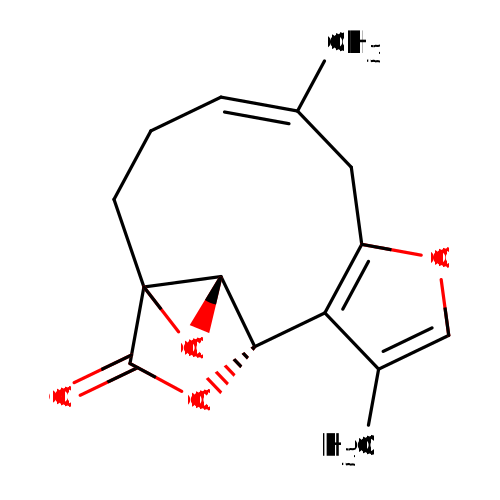
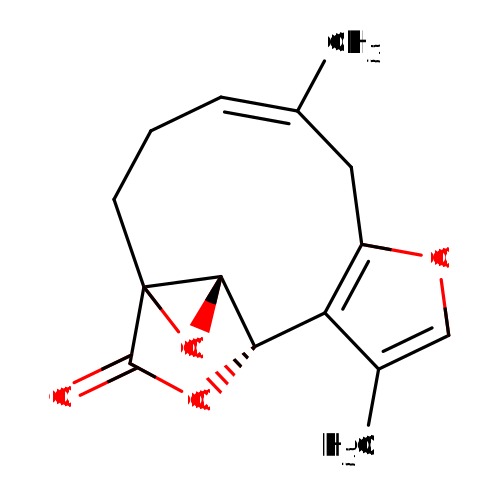
| Common Name | (4e,12s,13s)-5,10-dimethyl-8,14,16-trioxatetracyclo[10.2.2.0¹,¹³.0⁷,¹¹]hexadeca-4,7(11),9-trien-15-one |
|---|
| Description | Linderane, also known as LDR CPD, belongs to the class of organic compounds known as 1,4-dioxanes. These are organic compounds containing 1,4-dioxane, an aliphatic six-member ring with two oxygen atoms in ring positions 1 and 4. (4e,12s,13s)-5,10-dimethyl-8,14,16-trioxatetracyclo[10.2.2.0¹,¹³.0⁷,¹¹]hexadeca-4,7(11),9-trien-15-one is found in Cryptocarya densiflora, Lindera aggregata, Neolitsea buisanensis, Neolitsea hiiranensis and Neolitsea villosa. (4e,12s,13s)-5,10-dimethyl-8,14,16-trioxatetracyclo[10.2.2.0¹,¹³.0⁷,¹¹]hexadeca-4,7(11),9-trien-15-one was first documented in 2009 (PMID: 20209914). Based on a literature review a significant number of articles have been published on Linderane (PMID: 35309717) (PMID: 34800885) (PMID: 34343060) (PMID: 31394125) (PMID: 30036998) (PMID: 29867482). |
|---|
| Structure | CC1=COC2=C1[C@@H]1OC(=O)C3(CC\C=C(C)\C2)O[C@@H]13 InChI=1S/C15H16O4/c1-8-4-3-5-15-13(19-15)12(18-14(15)16)11-9(2)7-17-10(11)6-8/h4,7,12-13H,3,5-6H2,1-2H3/b8-4+/t12-,13-,15?/m0/s1 |
|---|
| Synonyms | |
|---|
| Chemical Formula | C15H16O4 |
|---|
| Average Mass | 260.2890 Da |
|---|
| Monoisotopic Mass | 260.10486 Da |
|---|
| IUPAC Name | (4E,12S,13S)-5,10-dimethyl-8,14,16-trioxatetracyclo[10.2.2.0^{1,13}.0^{7,11}]hexadeca-4,7(11),9-trien-15-one |
|---|
| Traditional Name | (4E,12S,13S)-5,10-dimethyl-8,14,16-trioxatetracyclo[10.2.2.0^{1,13}.0^{7,11}]hexadeca-4,7(11),9-trien-15-one |
|---|
| CAS Registry Number | Not Available |
|---|
| SMILES | CC1=COC2=C1[C@@H]1OC(=O)C3(CC\C=C(C)\C2)O[C@@H]13 |
|---|
| InChI Identifier | InChI=1S/C15H16O4/c1-8-4-3-5-15-13(19-15)12(18-14(15)16)11-9(2)7-17-10(11)6-8/h4,7,12-13H,3,5-6H2,1-2H3/b8-4+/t12-,13-,15?/m0/s1 |
|---|
| InChI Key | KBMSVODXFLAQNJ-IUKAEILTSA-N |
|---|
| Experimental Spectra |
|---|
|
| Not Available | | Predicted Spectra |
|---|
|
| | Spectrum Type | Description | Depositor ID | Depositor Organization | Depositor | Deposition Date | View |
|---|
| 1D NMR | 13C NMR Spectrum (1D, 25 MHz, H2O, predicted) | Wishart Lab | Wishart Lab | David Wishart | 2021-06-20 | View Spectrum | | 1D NMR | 1H NMR Spectrum (1D, 100 MHz, H2O, predicted) | Wishart Lab | Wishart Lab | David Wishart | 2021-06-20 | View Spectrum | | 1D NMR | 13C NMR Spectrum (1D, 252 MHz, H2O, predicted) | Wishart Lab | Wishart Lab | David Wishart | 2021-06-20 | View Spectrum | | 1D NMR | 1H NMR Spectrum (1D, 1000 MHz, H2O, predicted) | Wishart Lab | Wishart Lab | David Wishart | 2021-06-20 | View Spectrum | | 1D NMR | 13C NMR Spectrum (1D, 50 MHz, H2O, predicted) | Wishart Lab | Wishart Lab | David Wishart | 2021-06-20 | View Spectrum | | 1D NMR | 1H NMR Spectrum (1D, 200 MHz, H2O, predicted) | Wishart Lab | Wishart Lab | David Wishart | 2021-06-20 | View Spectrum | | 1D NMR | 13C NMR Spectrum (1D, 75 MHz, H2O, predicted) | Wishart Lab | Wishart Lab | David Wishart | 2021-06-20 | View Spectrum | | 1D NMR | 1H NMR Spectrum (1D, 300 MHz, H2O, predicted) | Wishart Lab | Wishart Lab | David Wishart | 2021-06-20 | View Spectrum | | 1D NMR | 13C NMR Spectrum (1D, 101 MHz, H2O, predicted) | Wishart Lab | Wishart Lab | David Wishart | 2021-06-20 | View Spectrum | | 1D NMR | 1H NMR Spectrum (1D, 400 MHz, H2O, predicted) | Wishart Lab | Wishart Lab | David Wishart | 2021-06-20 | View Spectrum | | 1D NMR | 13C NMR Spectrum (1D, 126 MHz, H2O, predicted) | Wishart Lab | Wishart Lab | David Wishart | 2021-06-20 | View Spectrum | | 1D NMR | 1H NMR Spectrum (1D, 500 MHz, H2O, predicted) | Wishart Lab | Wishart Lab | David Wishart | 2021-06-20 | View Spectrum | | 1D NMR | 13C NMR Spectrum (1D, 151 MHz, H2O, predicted) | Wishart Lab | Wishart Lab | David Wishart | 2021-06-20 | View Spectrum | | 1D NMR | 1H NMR Spectrum (1D, 600 MHz, H2O, predicted) | Wishart Lab | Wishart Lab | David Wishart | 2021-06-20 | View Spectrum | | 1D NMR | 13C NMR Spectrum (1D, 176 MHz, H2O, predicted) | Wishart Lab | Wishart Lab | David Wishart | 2021-06-20 | View Spectrum | | 1D NMR | 1H NMR Spectrum (1D, 700 MHz, H2O, predicted) | Wishart Lab | Wishart Lab | David Wishart | 2021-06-20 | View Spectrum | | 1D NMR | 13C NMR Spectrum (1D, 201 MHz, H2O, predicted) | Wishart Lab | Wishart Lab | David Wishart | 2021-06-20 | View Spectrum | | 1D NMR | 1H NMR Spectrum (1D, 800 MHz, H2O, predicted) | Wishart Lab | Wishart Lab | David Wishart | 2021-06-20 | View Spectrum | | 1D NMR | 13C NMR Spectrum (1D, 226 MHz, H2O, predicted) | Wishart Lab | Wishart Lab | David Wishart | 2021-06-20 | View Spectrum | | 1D NMR | 1H NMR Spectrum (1D, 900 MHz, H2O, predicted) | Wishart Lab | Wishart Lab | David Wishart | 2021-06-20 | View Spectrum |
| | Chemical Shift Submissions |
|---|
|
| Not Available | | Species |
|---|
| Species of Origin | |
|---|
| Chemical Taxonomy |
|---|
| Description | Belongs to the class of organic compounds known as 1,4-dioxanes. These are organic compounds containing 1,4-dioxane, an aliphatic six-member ring with two oxygen atoms in ring positions 1 and 4. |
|---|
| Kingdom | Organic compounds |
|---|
| Super Class | Organoheterocyclic compounds |
|---|
| Class | Dioxanes |
|---|
| Sub Class | 1,4-dioxanes |
|---|
| Direct Parent | 1,4-dioxanes |
|---|
| Alternative Parents | |
|---|
| Substituents | - Para-dioxane
- Gamma butyrolactone
- Furan
- Oxolane
- Heteroaromatic compound
- Lactone
- Carboxylic acid ester
- Monocarboxylic acid or derivatives
- Ether
- Oxirane
- Dialkyl ether
- Carboxylic acid derivative
- Oxacycle
- Organooxygen compound
- Organic oxide
- Organic oxygen compound
- Carbonyl group
- Hydrocarbon derivative
- Aromatic heteropolycyclic compound
|
|---|
| Molecular Framework | Aromatic heteropolycyclic compounds |
|---|
| External Descriptors | Not Available |
|---|
| Physical Properties |
|---|
| State | Not Available |
|---|
| Experimental Properties | | Property | Value | Reference |
|---|
| Melting Point | Not Available | Not Available | | Boiling Point | Not Available | Not Available | | Water Solubility | Not Available | Not Available | | LogP | Not Available | Not Available |
|
|---|
| Predicted Properties | |
|---|
| General References | - Zhang T, Peng T, Rao J, Wang K, Qiu F: Quantitation of Diclofenac, Tolbutamide, and Warfarin as Typical CYP2C9 Substrates in Rat Plasma by UPLC-MS/MS and Its Application to Evaluate Linderane-Mediated Herb-Drug Interactions. J Anal Methods Chem. 2022 Mar 10;2022:1900037. doi: 10.1155/2022/1900037. eCollection 2022. [PubMed:35309717 ]
- Wang K, Zhang T, Rao J, Peng T, Gao Q, Feng X, Qiu F: Drug-drug interactions induced by Linderane based on mechanism-based inactivation of CYP2C9 and the molecular mechanisms. Bioorg Chem. 2022 Jan;118:105478. doi: 10.1016/j.bioorg.2021.105478. Epub 2021 Nov 15. [PubMed:34800885 ]
- Jani NA, Sirat HM, Ahmad F, Aminudin NI: New sesquiterpene dilactone and beta-carboline alkaloid and the alpha-glucosidase inhibitory activity of selected phytochemicals from Neolitsea cassia (L.) Kosterm. Nat Prod Res. 2021 Aug 3:1-9. doi: 10.1080/14786419.2021.1961134. [PubMed:34343060 ]
- Zhang H, Zhu C, Sun Z, Yan X, Wang H, Xu H, Ma J, Zhang Y: Linderane protects pancreatic beta cells from streptozotocin (STZ)-induced oxidative damage. Life Sci. 2019 Sep 15;233:116732. doi: 10.1016/j.lfs.2019.116732. Epub 2019 Aug 5. [PubMed:31394125 ]
- He Y, Cheng P, Wang W, Yan S, Tang Q, Liu D, Xie H: Rapid Investigation and Screening of Bioactive Components in Simo Decoction via LC-Q-TOF-MS and UF-HPLC-MD Methods. Molecules. 2018 Jul 20;23(7). pii: molecules23071792. doi: 10.3390/molecules23071792. [PubMed:30036998 ]
- Xie W, Ye Y, Feng Y, Xu T, Huang S, Shen J, Leng Y: Linderane Suppresses Hepatic Gluconeogenesis by Inhibiting the cAMP/PKA/CREB Pathway Through Indirect Activation of PDE 3 via ERK/STAT3. Front Pharmacol. 2018 May 15;9:476. doi: 10.3389/fphar.2018.00476. eCollection 2018. [PubMed:29867482 ]
- Yaermaimaiti S, Wang P, Luo J, Li RJ, Kong LY: Sesquiterpenoids from the seeds of Sarcandra glabra and the potential anti-inflammatory effects. Fitoterapia. 2016 Jun;111:7-11. doi: 10.1016/j.fitote.2016.03.020. Epub 2016 Apr 2. [PubMed:27050720 ]
- Wang H, Wang K, Mao X, Zhang Q, Yao T, Peng Y, Zheng J: Mechanism-based inactivation of CYP2C9 by linderane. Xenobiotica. 2015;45(12):1037-46. doi: 10.3109/00498254.2015.1041002. Epub 2015 Jun 11. [PubMed:26068520 ]
- Zheng Y, Luan L, Gan L, Zhou C, Wu Y: [Simultaneous determination of three sesquiterpene lactones in Radix Linderae by HPLC]. Zhongguo Zhong Yao Za Zhi. 2009 Nov;34(21):2777-80. [PubMed:20209914 ]
- LOTUS database [Link]
|
|---|