| Record Information |
|---|
| Version | 2.0 |
|---|
| Created at | 2022-09-02 03:19:03 UTC |
|---|
| Updated at | 2022-09-02 03:19:03 UTC |
|---|
| NP-MRD ID | NP0147667 |
|---|
| Secondary Accession Numbers | None |
|---|
| Natural Product Identification |
|---|
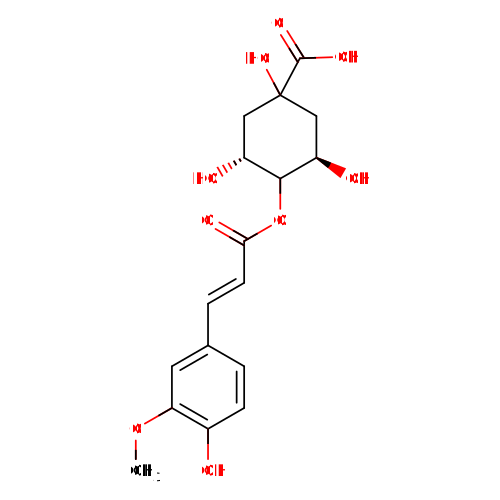
| Common Name | (3r,5r)-1,3,5-trihydroxy-4-{[(2e)-3-(4-hydroxy-3-methoxyphenyl)prop-2-enoyl]oxy}cyclohexane-1-carboxylic acid |
|---|
| Description | 4-Feruloylquinic acid, also known as 4-feruloylquinate, belongs to the class of organic compounds known as quinic acids and derivatives. Quinic acids and derivatives are compounds containing a quinic acid moiety (or a derivative thereof), which is a cyclitol made up of a cyclohexane ring that bears four hydroxyl groups at positions 1,3.4, And 5, as well as a carboxylic acid at position 1. (3r,5r)-1,3,5-trihydroxy-4-{[(2e)-3-(4-hydroxy-3-methoxyphenyl)prop-2-enoyl]oxy}cyclohexane-1-carboxylic acid is found in Coffea canephora and Coptis japonica. (3r,5r)-1,3,5-trihydroxy-4-{[(2e)-3-(4-hydroxy-3-methoxyphenyl)prop-2-enoyl]oxy}cyclohexane-1-carboxylic acid was first documented in 2017 (PMID: 29271942). Based on a literature review a significant number of articles have been published on 4-Feruloylquinic acid (PMID: 29287473) (PMID: 35335263) (PMID: 35204253) (PMID: 30918651) (PMID: 30827583) (PMID: 29974575). |
|---|
| Structure | COC1=CC(\C=C\C(=O)OC2[C@H](O)CC(O)(C[C@H]2O)C(O)=O)=CC=C1O InChI=1S/C17H20O9/c1-25-13-6-9(2-4-10(13)18)3-5-14(21)26-15-11(19)7-17(24,16(22)23)8-12(15)20/h2-6,11-12,15,18-20,24H,7-8H2,1H3,(H,22,23)/b5-3+/t11-,12-,15?,17?/m1/s1 |
|---|
| Synonyms | | Value | Source |
|---|
| 4-Feruloylquinate | Generator |
|
|---|
| Chemical Formula | C17H20O9 |
|---|
| Average Mass | 368.3380 Da |
|---|
| Monoisotopic Mass | 368.11073 Da |
|---|
| IUPAC Name | (3R,5R)-1,3,5-trihydroxy-4-{[(2E)-3-(4-hydroxy-3-methoxyphenyl)prop-2-enoyl]oxy}cyclohexane-1-carboxylic acid |
|---|
| Traditional Name | (3R,5R)-1,3,5-trihydroxy-4-{[(2E)-3-(4-hydroxy-3-methoxyphenyl)prop-2-enoyl]oxy}cyclohexane-1-carboxylic acid |
|---|
| CAS Registry Number | Not Available |
|---|
| SMILES | COC1=CC(\C=C\C(=O)OC2[C@H](O)CC(O)(C[C@H]2O)C(O)=O)=CC=C1O |
|---|
| InChI Identifier | InChI=1S/C17H20O9/c1-25-13-6-9(2-4-10(13)18)3-5-14(21)26-15-11(19)7-17(24,16(22)23)8-12(15)20/h2-6,11-12,15,18-20,24H,7-8H2,1H3,(H,22,23)/b5-3+/t11-,12-,15?,17?/m1/s1 |
|---|
| InChI Key | VTMFDSJJVNQXLT-XQCMRRNBSA-N |
|---|
| Experimental Spectra |
|---|
|
| Not Available | | Predicted Spectra |
|---|
|
| | Spectrum Type | Description | Depositor ID | Depositor Organization | Depositor | Deposition Date | View |
|---|
| 1D NMR | 13C NMR Spectrum (1D, 25 MHz, H2O, predicted) | Wishart Lab | Wishart Lab | David Wishart | 2021-06-20 | View Spectrum | | 1D NMR | 1H NMR Spectrum (1D, 100 MHz, H2O, predicted) | Wishart Lab | Wishart Lab | David Wishart | 2021-06-20 | View Spectrum | | 1D NMR | 13C NMR Spectrum (1D, 252 MHz, H2O, predicted) | Wishart Lab | Wishart Lab | David Wishart | 2021-06-20 | View Spectrum | | 1D NMR | 1H NMR Spectrum (1D, 1000 MHz, H2O, predicted) | Wishart Lab | Wishart Lab | David Wishart | 2021-06-20 | View Spectrum | | 1D NMR | 13C NMR Spectrum (1D, 50 MHz, H2O, predicted) | Wishart Lab | Wishart Lab | David Wishart | 2021-06-20 | View Spectrum | | 1D NMR | 1H NMR Spectrum (1D, 200 MHz, H2O, predicted) | Wishart Lab | Wishart Lab | David Wishart | 2021-06-20 | View Spectrum | | 1D NMR | 13C NMR Spectrum (1D, 75 MHz, H2O, predicted) | Wishart Lab | Wishart Lab | David Wishart | 2021-06-20 | View Spectrum | | 1D NMR | 1H NMR Spectrum (1D, 300 MHz, H2O, predicted) | Wishart Lab | Wishart Lab | David Wishart | 2021-06-20 | View Spectrum | | 1D NMR | 13C NMR Spectrum (1D, 101 MHz, H2O, predicted) | Wishart Lab | Wishart Lab | David Wishart | 2021-06-20 | View Spectrum | | 1D NMR | 1H NMR Spectrum (1D, 400 MHz, H2O, predicted) | Wishart Lab | Wishart Lab | David Wishart | 2021-06-20 | View Spectrum | | 1D NMR | 13C NMR Spectrum (1D, 126 MHz, H2O, predicted) | Wishart Lab | Wishart Lab | David Wishart | 2021-06-20 | View Spectrum | | 1D NMR | 1H NMR Spectrum (1D, 500 MHz, H2O, predicted) | Wishart Lab | Wishart Lab | David Wishart | 2021-06-20 | View Spectrum | | 1D NMR | 13C NMR Spectrum (1D, 151 MHz, H2O, predicted) | Wishart Lab | Wishart Lab | David Wishart | 2021-06-20 | View Spectrum | | 1D NMR | 1H NMR Spectrum (1D, 600 MHz, H2O, predicted) | Wishart Lab | Wishart Lab | David Wishart | 2021-06-20 | View Spectrum | | 1D NMR | 13C NMR Spectrum (1D, 176 MHz, H2O, predicted) | Wishart Lab | Wishart Lab | David Wishart | 2021-06-20 | View Spectrum | | 1D NMR | 1H NMR Spectrum (1D, 700 MHz, H2O, predicted) | Wishart Lab | Wishart Lab | David Wishart | 2021-06-20 | View Spectrum | | 1D NMR | 13C NMR Spectrum (1D, 201 MHz, H2O, predicted) | Wishart Lab | Wishart Lab | David Wishart | 2021-06-20 | View Spectrum | | 1D NMR | 1H NMR Spectrum (1D, 800 MHz, H2O, predicted) | Wishart Lab | Wishart Lab | David Wishart | 2021-06-20 | View Spectrum | | 1D NMR | 13C NMR Spectrum (1D, 226 MHz, H2O, predicted) | Wishart Lab | Wishart Lab | David Wishart | 2021-06-20 | View Spectrum | | 1D NMR | 1H NMR Spectrum (1D, 900 MHz, H2O, predicted) | Wishart Lab | Wishart Lab | David Wishart | 2021-06-20 | View Spectrum |
| | Chemical Shift Submissions |
|---|
|
| Not Available | | Species |
|---|
| Species of Origin | |
|---|
| Chemical Taxonomy |
|---|
| Description | Belongs to the class of organic compounds known as quinic acids and derivatives. Quinic acids and derivatives are compounds containing a quinic acid moiety (or a derivative thereof), which is a cyclitol made up of a cyclohexane ring that bears four hydroxyl groups at positions 1,3.4, And 5, as well as a carboxylic acid at position 1. |
|---|
| Kingdom | Organic compounds |
|---|
| Super Class | Organic oxygen compounds |
|---|
| Class | Organooxygen compounds |
|---|
| Sub Class | Alcohols and polyols |
|---|
| Direct Parent | Quinic acids and derivatives |
|---|
| Alternative Parents | |
|---|
| Substituents | - Quinic acid
- Cinnamic acid ester
- Hydroxycinnamic acid or derivatives
- Coumaric acid or derivatives
- Cinnamic acid or derivatives
- Methoxyphenol
- Phenoxy compound
- Methoxybenzene
- Styrene
- Phenol ether
- Anisole
- 1-hydroxy-2-unsubstituted benzenoid
- Phenol
- Fatty acid ester
- Cyclohexanol
- Alkyl aryl ether
- Fatty acyl
- Benzenoid
- Hydroxy acid
- Dicarboxylic acid or derivatives
- Monocyclic benzene moiety
- Alpha-hydroxy acid
- Alpha,beta-unsaturated carboxylic ester
- Enoate ester
- Tertiary alcohol
- Secondary alcohol
- Carboxylic acid ester
- Polyol
- Ether
- Carboxylic acid
- Carboxylic acid derivative
- Organic oxide
- Hydrocarbon derivative
- Carbonyl group
- Aromatic homomonocyclic compound
|
|---|
| Molecular Framework | Aromatic homomonocyclic compounds |
|---|
| External Descriptors | Not Available |
|---|
| Physical Properties |
|---|
| State | Not Available |
|---|
| Experimental Properties | | Property | Value | Reference |
|---|
| Melting Point | Not Available | Not Available | | Boiling Point | Not Available | Not Available | | Water Solubility | Not Available | Not Available | | LogP | Not Available | Not Available |
|
|---|
| Predicted Properties | |
|---|
| General References | - Spreng S, Hofmann T: Activity-Guided Identification of in Vitro Antioxidants in Beer. J Agric Food Chem. 2018 Jan 24;66(3):720-731. doi: 10.1021/acs.jafc.7b05674. Epub 2018 Jan 16. [PubMed:29287473 ]
- Mashiane P, Shoko T, Manhivi V, Slabbert R, Sultanbawa Y, Sivakumar D: A Comparison of Bioactive Metabolites, Antinutrients, and Bioactivities of African Pumpkin Leaves (Momordica balsamina L.) Cooked by Different Culinary Techniques. Molecules. 2022 Mar 15;27(6):1901. doi: 10.3390/molecules27061901. [PubMed:35335263 ]
- Rzasa-Duran E, Kryczyk-Poprawa A, Drabicki D, Podkowa A, Sulkowska-Ziaja K, Szewczyk A, Kala K, Opoka W, Zieba P, Fidurski M, Muszynska B: Yerba Mate as a Source of Elements and Bioactive Compounds with Antioxidant Activity. Antioxidants (Basel). 2022 Feb 12;11(2):371. doi: 10.3390/antiox11020371. [PubMed:35204253 ]
- Cheng K, Dong W, Long Y, Zhao J, Hu R, Zhang Y, Zhu K: Evaluation of the impact of different drying methods on the phenolic compounds, antioxidant activity, and in vitro digestion of green coffee beans. Food Sci Nutr. 2019 Feb 11;7(3):1084-1095. doi: 10.1002/fsn3.948. eCollection 2019 Mar. [PubMed:30918651 ]
- Cheiran KP, Raimundo VP, Manfroi V, Anzanello MJ, Kahmann A, Rodrigues E, Frazzon J: Simultaneous identification of low-molecular weight phenolic and nitrogen compounds in craft beers by HPLC-ESI-MS/MS. Food Chem. 2019 Jul 15;286:113-122. doi: 10.1016/j.foodchem.2019.01.198. Epub 2019 Feb 8. [PubMed:30827583 ]
- De Rosso M, Colomban S, Flamini R, Navarini L: UHPLC-ESI-QqTOF-MS/MS characterization of minor chlorogenic acids in roasted Coffea arabica from different geographical origin. J Mass Spectrom. 2018 Sep;53(9):763-771. doi: 10.1002/jms.4263. Epub 2018 Aug 9. [PubMed:29974575 ]
- Mariotti-Celis MS, Martinez-Cifuentes M, Huaman-Castilla N, Vargas-Gonzalez M, Pedreschi F, Perez-Correa JR: The Antioxidant and Safety Properties of Spent Coffee Ground Extracts Impacted by the Combined Hot Pressurized Liquid Extraction-Resin Purification Process. Molecules. 2017 Dec 22;23(1):21. doi: 10.3390/molecules23010021. [PubMed:29271942 ]
- Jeon JS, Kim HT, Jeong IH, Hong SR, Oh MS, Park KH, Shim JH, Abd El-Aty AM: Determination of chlorogenic acids and caffeine in homemade brewed coffee prepared under various conditions. J Chromatogr B Analyt Technol Biomed Life Sci. 2017 Oct 1;1064:115-123. doi: 10.1016/j.jchromb.2017.08.041. Epub 2017 Aug 31. [PubMed:28918319 ]
- Kraehenbuehl K, Page-Zoerkler N, Mauroux O, Gartenmann K, Blank I, Bel-Rhlid R: Selective enzymatic hydrolysis of chlorogenic acid lactones in a model system and in a coffee extract. Application to reduction of coffee bitterness. Food Chem. 2017 Mar 1;218:9-14. doi: 10.1016/j.foodchem.2016.09.055. Epub 2016 Sep 8. [PubMed:27719962 ]
- LOTUS database [Link]
|
|---|