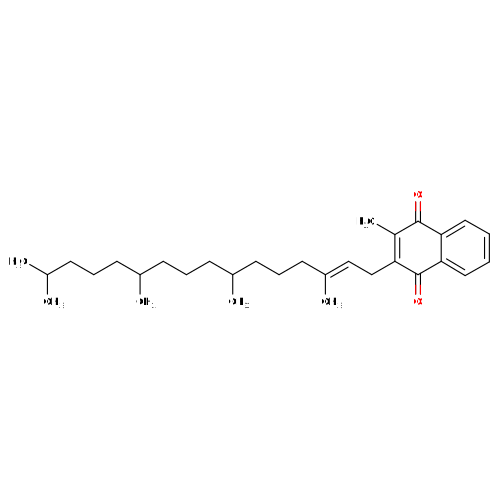
| Record Information |
|---|
| Version | 2.0 |
|---|
| Created at | 2022-09-02 02:38:13 UTC |
|---|
| Updated at | 2022-09-02 02:38:14 UTC |
|---|
| NP-MRD ID | NP0147102 |
|---|
| Secondary Accession Numbers | None |
|---|
| Natural Product Identification |
|---|
| Common Name | vitamin k |
|---|
| Description | Vitamin K1, also known as phytonadione or mephyton, belongs to the class of organic compounds known as vitamin k compounds. These are quinone lipids containing a methylated naphthoquinone ring structure, and vary in the aliphatic side chain attached at the 3-position. It is also required for the formation of anticoagulant factors protein C and S. It is commonly used to treat warfarin toxicity, and as an antidote for coumatetralyl. Vitamin K1 is an extremely weak basic (essentially neutral) compound (based on its pKa). In humans, vitamin K1 is involved in warfarin action pathway. Outside of the human body, Vitamin K1 is found, on average, in the highest concentration within a few different foods, such as highbush blueberries, common thymes, and common sages and in a lower concentration in hot chocolates, narrowleaf cattails, and napa cabbages. Vitamin K1 has also been detected, but not quantified in, several different foods, such as bamboo shoots, vanilla, green vegetables, american lobsters, and butter substitutes. This could make vitamin K1 a potential biomarker for the consumption of these foods. It is on the World Health Organization's List of Essential Medicines, the most effective and safe medicines needed in a health system. Use is typically recommended by mouth or injection under the skin. vitamin k is found in Homo sapiens, Prunus domestica and Secale cereale. vitamin k was first documented in 1982 (PMID: 7086539). Vitamin K is required for bone protein formation. |
|---|
| Structure | CC(C)CCCC(C)CCCC(C)CCC\C(C)=C\CC1=C(C)C(=O)C2=CC=CC=C2C1=O InChI=1S/C31H46O2/c1-22(2)12-9-13-23(3)14-10-15-24(4)16-11-17-25(5)20-21-27-26(6)30(32)28-18-7-8-19-29(28)31(27)33/h7-8,18-20,22-24H,9-17,21H2,1-6H3/b25-20+ |
|---|
| Synonyms | | Value | Source |
|---|
| Phytonadione | Kegg | | 2-Methyl-3-phytyl-1,4-naphthoquinone | Kegg | | Phytomenadione | Kegg | | Mephyton | Kegg | | 2',3'-trans-Vitamin K1 | HMDB | | 2-Methyl-3-phythyl-1,4-naphthochinon | HMDB | | 2-Methyl-3-phytyl-1,4-naphthochinon | HMDB | | 2-Methyl-3-phytyl-1,4-napthoquinone | HMDB | | 2-Methyl-3-[(2E,7R,11R)-3,7,11,15-tetramethylhexadec-2-en-1-yl]naphthalene-1,4-dione | HMDB | | 3-Phytylmenadione | HMDB | | a-Phylloquinone | HMDB | | alpha-Phylloquinone | HMDB | | Antihemorrhagic vitamin | HMDB | | Aqua mephyton | HMDB | | Aqua-mephytin | HMDB | | Aquamephyton | HMDB, MeSH | | Combinal K1 | HMDB | | Fitomenadiona | HMDB | | Fitomenadione | HMDB | | K-Ject | HMDB | | Kativ N | HMDB | | Kephton | HMDB | | Kinadion | HMDB | | Konakion | HMDB, MeSH | | mono-Kay | HMDB | | Monodion | HMDB | | Phyllochinon | HMDB | | Phyllochinonum | HMDB | | Phylloquinone | HMDB | | Phythyl-menadion | HMDB | | Phytomenadionum | HMDB | | Phytonadionum | HMDB | | Phytylmenadione | HMDB | | Synthex P | HMDB | | trans-Phylloquinone | HMDB | | Vitamin K 1 | MeSH, HMDB | | Phyllohydroquinone | MeSH, HMDB | | Vitamin K1 | KEGG | | Vitamin K | MeSH, HMDB |
|
|---|
| Chemical Formula | C31H46O2 |
|---|
| Average Mass | 450.6957 Da |
|---|
| Monoisotopic Mass | 450.34978 Da |
|---|
| IUPAC Name | 2-methyl-3-[(2E)-3,7,11,15-tetramethylhexadec-2-en-1-yl]-1,4-dihydronaphthalene-1,4-dione |
|---|
| Traditional Name | vitamin k1 |
|---|
| CAS Registry Number | Not Available |
|---|
| SMILES | CC(C)CCCC(C)CCCC(C)CCC\C(C)=C\CC1=C(C)C(=O)C2=CC=CC=C2C1=O |
|---|
| InChI Identifier | InChI=1S/C31H46O2/c1-22(2)12-9-13-23(3)14-10-15-24(4)16-11-17-25(5)20-21-27-26(6)30(32)28-18-7-8-19-29(28)31(27)33/h7-8,18-20,22-24H,9-17,21H2,1-6H3/b25-20+ |
|---|
| InChI Key | MBWXNTAXLNYFJB-LKUDQCMESA-N |
|---|
| Experimental Spectra |
|---|
|
| | Spectrum Type | Description | Depositor Email | Depositor Organization | Depositor | Deposition Date | View |
|---|
| 1D NMR | 1H NMR Spectrum (1D, 90 MHz, CDCl3, experimental) | Wishart Lab | Wishart Lab | David Wishart | 2021-06-20 | View Spectrum |
| | Predicted Spectra |
|---|
|
| Not Available | | Chemical Shift Submissions |
|---|
|
| Not Available | | Species |
|---|
| Species of Origin | |
|---|
| Chemical Taxonomy |
|---|
| Description | Belongs to the class of organic compounds known as vitamin k compounds. These are quinone lipids containing a methylated naphthoquinone ring structure, and vary in the aliphatic side chain attached at the 3-position. |
|---|
| Kingdom | Organic compounds |
|---|
| Super Class | Lipids and lipid-like molecules |
|---|
| Class | Prenol lipids |
|---|
| Sub Class | Quinone and hydroquinone lipids |
|---|
| Direct Parent | Vitamin K compounds |
|---|
| Alternative Parents | |
|---|
| Substituents | - Diterpenoid
- Naphthoquinone
- Naphthalene
- Aryl ketone
- Quinone
- Benzenoid
- Ketone
- Organic oxygen compound
- Organic oxide
- Hydrocarbon derivative
- Organooxygen compound
- Aromatic homopolycyclic compound
|
|---|
| Molecular Framework | Aromatic homopolycyclic compounds |
|---|
| External Descriptors | |
|---|
| Physical Properties |
|---|
| State | Not Available |
|---|
| Experimental Properties | | Property | Value | Reference |
|---|
| Melting Point | Not Available | Not Available | | Boiling Point | Not Available | Not Available | | Water Solubility | Not Available | Not Available | | LogP | Not Available | Not Available |
|
|---|
| Predicted Properties | |
|---|