| Record Information |
|---|
| Version | 2.0 |
|---|
| Created at | 2022-09-02 01:36:53 UTC |
|---|
| Updated at | 2022-09-02 01:36:53 UTC |
|---|
| NP-MRD ID | NP0146254 |
|---|
| Secondary Accession Numbers | None |
|---|
| Natural Product Identification |
|---|
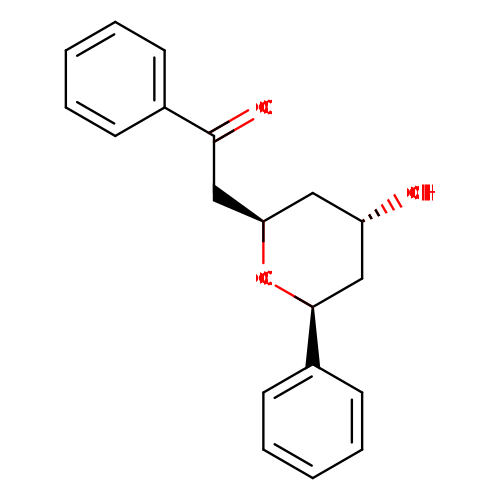
| Common Name | 2-[(2r,4s,6s)-4-hydroxy-6-phenyloxan-2-yl]-1-phenylethanone |
|---|
| Description | Diospongin A belongs to the class of organic compounds known as linear diarylheptanoids. These are diarylheptanoids with an open heptane chain. The two aromatic rings are linked only by the heptane chain. 2-[(2r,4s,6s)-4-hydroxy-6-phenyloxan-2-yl]-1-phenylethanone is found in Dioscorea spongiosa. 2-[(2r,4s,6s)-4-hydroxy-6-phenyloxan-2-yl]-1-phenylethanone was first documented in 2009 (PMID: 19824665). Based on a literature review a small amount of articles have been published on Diospongin A (PMID: 31595914) (PMID: 28451195) (PMID: 25867851) (PMID: 23168684). |
|---|
| Structure | O[C@H]1C[C@H](CC(=O)C2=CC=CC=C2)O[C@@H](C1)C1=CC=CC=C1 InChI=1S/C19H20O3/c20-16-11-17(13-18(21)14-7-3-1-4-8-14)22-19(12-16)15-9-5-2-6-10-15/h1-10,16-17,19-20H,11-13H2/t16-,17+,19-/m0/s1 |
|---|
| Synonyms | Not Available |
|---|
| Chemical Formula | C19H20O3 |
|---|
| Average Mass | 296.3660 Da |
|---|
| Monoisotopic Mass | 296.14124 Da |
|---|
| IUPAC Name | 2-[(2R,4S,6S)-4-hydroxy-6-phenyloxan-2-yl]-1-phenylethan-1-one |
|---|
| Traditional Name | 2-[(2R,4S,6S)-4-hydroxy-6-phenyloxan-2-yl]-1-phenylethanone |
|---|
| CAS Registry Number | Not Available |
|---|
| SMILES | O[C@H]1C[C@H](CC(=O)C2=CC=CC=C2)O[C@@H](C1)C1=CC=CC=C1 |
|---|
| InChI Identifier | InChI=1S/C19H20O3/c20-16-11-17(13-18(21)14-7-3-1-4-8-14)22-19(12-16)15-9-5-2-6-10-15/h1-10,16-17,19-20H,11-13H2/t16-,17+,19-/m0/s1 |
|---|
| InChI Key | HQTSVUPKAYCDEB-SCTDSRPQSA-N |
|---|
| Experimental Spectra |
|---|
|
| Not Available | | Predicted Spectra |
|---|
|
| | Spectrum Type | Description | Depositor ID | Depositor Organization | Depositor | Deposition Date | View |
|---|
| 1D NMR | 13C NMR Spectrum (1D, 25 MHz, H2O, predicted) | Wishart Lab | Wishart Lab | David Wishart | 2021-06-20 | View Spectrum | | 1D NMR | 1H NMR Spectrum (1D, 100 MHz, H2O, predicted) | Wishart Lab | Wishart Lab | David Wishart | 2021-06-20 | View Spectrum | | 1D NMR | 13C NMR Spectrum (1D, 252 MHz, H2O, predicted) | Wishart Lab | Wishart Lab | David Wishart | 2021-06-20 | View Spectrum | | 1D NMR | 1H NMR Spectrum (1D, 1000 MHz, H2O, predicted) | Wishart Lab | Wishart Lab | David Wishart | 2021-06-20 | View Spectrum | | 1D NMR | 13C NMR Spectrum (1D, 50 MHz, H2O, predicted) | Wishart Lab | Wishart Lab | David Wishart | 2021-06-20 | View Spectrum | | 1D NMR | 1H NMR Spectrum (1D, 200 MHz, H2O, predicted) | Wishart Lab | Wishart Lab | David Wishart | 2021-06-20 | View Spectrum | | 1D NMR | 13C NMR Spectrum (1D, 75 MHz, H2O, predicted) | Wishart Lab | Wishart Lab | David Wishart | 2021-06-20 | View Spectrum | | 1D NMR | 1H NMR Spectrum (1D, 300 MHz, H2O, predicted) | Wishart Lab | Wishart Lab | David Wishart | 2021-06-20 | View Spectrum | | 1D NMR | 13C NMR Spectrum (1D, 101 MHz, H2O, predicted) | Wishart Lab | Wishart Lab | David Wishart | 2021-06-20 | View Spectrum | | 1D NMR | 1H NMR Spectrum (1D, 400 MHz, H2O, predicted) | Wishart Lab | Wishart Lab | David Wishart | 2021-06-20 | View Spectrum | | 1D NMR | 13C NMR Spectrum (1D, 126 MHz, H2O, predicted) | Wishart Lab | Wishart Lab | David Wishart | 2021-06-20 | View Spectrum | | 1D NMR | 1H NMR Spectrum (1D, 500 MHz, H2O, predicted) | Wishart Lab | Wishart Lab | David Wishart | 2021-06-20 | View Spectrum | | 1D NMR | 13C NMR Spectrum (1D, 151 MHz, H2O, predicted) | Wishart Lab | Wishart Lab | David Wishart | 2021-06-20 | View Spectrum | | 1D NMR | 1H NMR Spectrum (1D, 600 MHz, H2O, predicted) | Wishart Lab | Wishart Lab | David Wishart | 2021-06-20 | View Spectrum | | 1D NMR | 13C NMR Spectrum (1D, 176 MHz, H2O, predicted) | Wishart Lab | Wishart Lab | David Wishart | 2021-06-20 | View Spectrum | | 1D NMR | 1H NMR Spectrum (1D, 700 MHz, H2O, predicted) | Wishart Lab | Wishart Lab | David Wishart | 2021-06-20 | View Spectrum | | 1D NMR | 13C NMR Spectrum (1D, 201 MHz, H2O, predicted) | Wishart Lab | Wishart Lab | David Wishart | 2021-06-20 | View Spectrum | | 1D NMR | 1H NMR Spectrum (1D, 800 MHz, H2O, predicted) | Wishart Lab | Wishart Lab | David Wishart | 2021-06-20 | View Spectrum | | 1D NMR | 13C NMR Spectrum (1D, 226 MHz, H2O, predicted) | Wishart Lab | Wishart Lab | David Wishart | 2021-06-20 | View Spectrum | | 1D NMR | 1H NMR Spectrum (1D, 900 MHz, H2O, predicted) | Wishart Lab | Wishart Lab | David Wishart | 2021-06-20 | View Spectrum |
| | Chemical Shift Submissions |
|---|
|
| Not Available | | Species |
|---|
| Species of Origin | |
|---|
| Chemical Taxonomy |
|---|
| Description | Belongs to the class of organic compounds known as linear diarylheptanoids. These are diarylheptanoids with an open heptane chain. The two aromatic rings are linked only by the heptane chain. |
|---|
| Kingdom | Organic compounds |
|---|
| Super Class | Phenylpropanoids and polyketides |
|---|
| Class | Diarylheptanoids |
|---|
| Sub Class | Linear diarylheptanoids |
|---|
| Direct Parent | Linear diarylheptanoids |
|---|
| Alternative Parents | |
|---|
| Substituents | - Linear 1,7-diphenylheptane skeleton
- Alkyl-phenylketone
- Phenylketone
- Benzoyl
- Aryl alkyl ketone
- Aryl ketone
- Monocyclic benzene moiety
- Oxane
- Benzenoid
- Ketone
- Secondary alcohol
- Dialkyl ether
- Ether
- Oxacycle
- Organoheterocyclic compound
- Alcohol
- Hydrocarbon derivative
- Organic oxygen compound
- Organooxygen compound
- Organic oxide
- Aromatic heteromonocyclic compound
|
|---|
| Molecular Framework | Aromatic heteromonocyclic compounds |
|---|
| External Descriptors | Not Available |
|---|
| Physical Properties |
|---|
| State | Not Available |
|---|
| Experimental Properties | | Property | Value | Reference |
|---|
| Melting Point | Not Available | Not Available | | Boiling Point | Not Available | Not Available | | Water Solubility | Not Available | Not Available | | LogP | Not Available | Not Available |
|
|---|
| Predicted Properties | |
|---|
| General References | - Bharath Y, Choudhury UM, Sadhana N, Mohapatra DK: The Mukaiyama type aldol reaction for the synthesis of trans-2,6-disubstituted tetrahydropyrans: synthesis of diospongin A and B. Org Biomol Chem. 2019 Oct 23;17(41):9169-9181. doi: 10.1039/c9ob01549c. [PubMed:31595914 ]
- Ermanis K, Hsiao YT, Kaya U, Jeuken A, Clarke PA: The stereodivergent formation of 2,6-cis and 2,6-trans-tetrahydropyrans: experimental and computational investigation of the mechanism of a thioester oxy-Michael cyclization. Chem Sci. 2017 Jan 1;8(1):482-490. doi: 10.1039/c6sc03478k. Epub 2016 Aug 30. [PubMed:28451195 ]
- Merad J, Borkar P, Bouyon Yenda T, Roux C, Pons JM, Parrain JL, Chuzel O, Bressy C: Highly Enantioselective Acylation of Acyclic Meso 1,3-Diols through Synergistic Isothiourea-Catalyzed Desymmetrization/Chiroablative Kinetic Resolution. Org Lett. 2015 May 1;17(9):2118-21. doi: 10.1021/acs.orglett.5b00707. Epub 2015 Apr 13. [PubMed:25867851 ]
- Yao H, Ren J, Tong R: A short and flexible route to tetrahydropyran-4-ones via conjugated nitrile oxides cycloaddition and oxa-Michael cyclization: a concise diastereoselective total synthesis of (+/-)-diospongin A. Chem Commun (Camb). 2013 Jan 7;49(2):193-5. doi: 10.1039/c2cc37772a. Epub 2012 Nov 21. [PubMed:23168684 ]
- Lee K, Kim H, Hong J: A facile and efficient synthesis of 4-hydroxy-2,6-cis-tetrahydropyrans via tandem cross-metathesis/thermal S(N)2' reaction: protecting-group-free synthesis of (+/-)-diospongin A. Org Lett. 2009 Nov 19;11(22):5202-5. doi: 10.1021/ol902125d. [PubMed:19824665 ]
- LOTUS database [Link]
|
|---|