| Record Information |
|---|
| Version | 2.0 |
|---|
| Created at | 2022-09-02 01:02:02 UTC |
|---|
| Updated at | 2022-09-02 01:02:02 UTC |
|---|
| NP-MRD ID | NP0145767 |
|---|
| Secondary Accession Numbers | None |
|---|
| Natural Product Identification |
|---|
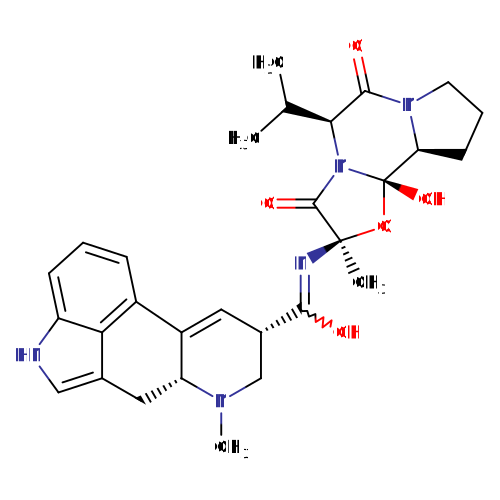
| Common Name | (4s,7r)-n-[(1s,2s,4r,7s)-2-hydroxy-7-isopropyl-4-methyl-5,8-dioxo-3-oxa-6,9-diazatricyclo[7.3.0.0²,⁶]dodecan-4-yl]-6-methyl-6,11-diazatetracyclo[7.6.1.0²,⁷.0¹²,¹⁶]hexadeca-1(16),2,9,12,14-pentaene-4-carboximidic acid |
|---|
| Description | Ergovalinine belongs to the class of organic compounds known as ergopeptines. These are ergoline derivatives that contain a tripeptide structure attached to the basic ergoline ring in the same location as the amide group of the lysergic acid derivatives. (4s,7r)-n-[(1s,2s,4r,7s)-2-hydroxy-7-isopropyl-4-methyl-5,8-dioxo-3-oxa-6,9-diazatricyclo[7.3.0.0²,⁶]dodecan-4-yl]-6-methyl-6,11-diazatetracyclo[7.6.1.0²,⁷.0¹²,¹⁶]hexadeca-1(16),2,9,12,14-pentaene-4-carboximidic acid is found in Cenchrus echinatus, Epichloe typhina and Festuca rubra. (4s,7r)-n-[(1s,2s,4r,7s)-2-hydroxy-7-isopropyl-4-methyl-5,8-dioxo-3-oxa-6,9-diazatricyclo[7.3.0.0²,⁶]dodecan-4-yl]-6-methyl-6,11-diazatetracyclo[7.6.1.0²,⁷.0¹²,¹⁶]hexadeca-1(16),2,9,12,14-pentaene-4-carboximidic acid was first documented in 2019 (PMID: 30957833). Based on a literature review a small amount of articles have been published on Ergovalinine (PMID: 35947831) (PMID: 33287449) (PMID: 33053893) (PMID: 30895321). |
|---|
| Structure | CC(C)[C@@H]1N2C(=O)[C@@](C)(O[C@@]2(O)[C@@H]2CCCN2C1=O)N=C(O)[C@@H]1CN(C)[C@@H]2CC3=CNC4=CC=CC(=C34)C2=C1 InChI=1S/C29H35N5O5/c1-15(2)24-26(36)33-10-6-9-22(33)29(38)34(24)27(37)28(3,39-29)31-25(35)17-11-19-18-7-5-8-20-23(18)16(13-30-20)12-21(19)32(4)14-17/h5,7-8,11,13,15,17,21-22,24,30,38H,6,9-10,12,14H2,1-4H3,(H,31,35)/t17-,21+,22-,24-,28+,29-/m0/s1 |
|---|
| Synonyms | Not Available |
|---|
| Chemical Formula | C29H35N5O5 |
|---|
| Average Mass | 533.6290 Da |
|---|
| Monoisotopic Mass | 533.26382 Da |
|---|
| IUPAC Name | (4S,7R)-N-[(1S,2S,4R,7S)-2-hydroxy-4-methyl-5,8-dioxo-7-(propan-2-yl)-3-oxa-6,9-diazatricyclo[7.3.0.0^{2,6}]dodecan-4-yl]-6-methyl-6,11-diazatetracyclo[7.6.1.0^{2,7}.0^{12,16}]hexadeca-1(16),2,9,12,14-pentaene-4-carboximidic acid |
|---|
| Traditional Name | (4S,7R)-N-[(1S,2S,4R,7S)-2-hydroxy-7-isopropyl-4-methyl-5,8-dioxo-3-oxa-6,9-diazatricyclo[7.3.0.0^{2,6}]dodecan-4-yl]-6-methyl-6,11-diazatetracyclo[7.6.1.0^{2,7}.0^{12,16}]hexadeca-1(16),2,9,12,14-pentaene-4-carboximidic acid |
|---|
| CAS Registry Number | Not Available |
|---|
| SMILES | CC(C)[C@@H]1N2C(=O)[C@@](C)(O[C@@]2(O)[C@@H]2CCCN2C1=O)N=C(O)[C@@H]1CN(C)[C@@H]2CC3=CNC4=CC=CC(=C34)C2=C1 |
|---|
| InChI Identifier | InChI=1S/C29H35N5O5/c1-15(2)24-26(36)33-10-6-9-22(33)29(38)34(24)27(37)28(3,39-29)31-25(35)17-11-19-18-7-5-8-20-23(18)16(13-30-20)12-21(19)32(4)14-17/h5,7-8,11,13,15,17,21-22,24,30,38H,6,9-10,12,14H2,1-4H3,(H,31,35)/t17-,21+,22-,24-,28+,29-/m0/s1 |
|---|
| InChI Key | BGHDUTQZGWOQIA-KPUJGURZSA-N |
|---|
| Experimental Spectra |
|---|
|
| Not Available | | Predicted Spectra |
|---|
|
| | Spectrum Type | Description | Depositor ID | Depositor Organization | Depositor | Deposition Date | View |
|---|
| 1D NMR | 13C NMR Spectrum (1D, 25 MHz, H2O, predicted) | Wishart Lab | Wishart Lab | David Wishart | 2021-06-20 | View Spectrum | | 1D NMR | 1H NMR Spectrum (1D, 100 MHz, H2O, predicted) | Wishart Lab | Wishart Lab | David Wishart | 2021-06-20 | View Spectrum | | 1D NMR | 13C NMR Spectrum (1D, 252 MHz, H2O, predicted) | Wishart Lab | Wishart Lab | David Wishart | 2021-06-20 | View Spectrum | | 1D NMR | 1H NMR Spectrum (1D, 1000 MHz, H2O, predicted) | Wishart Lab | Wishart Lab | David Wishart | 2021-06-20 | View Spectrum | | 1D NMR | 13C NMR Spectrum (1D, 50 MHz, H2O, predicted) | Wishart Lab | Wishart Lab | David Wishart | 2021-06-20 | View Spectrum | | 1D NMR | 1H NMR Spectrum (1D, 200 MHz, H2O, predicted) | Wishart Lab | Wishart Lab | David Wishart | 2021-06-20 | View Spectrum | | 1D NMR | 13C NMR Spectrum (1D, 75 MHz, H2O, predicted) | Wishart Lab | Wishart Lab | David Wishart | 2021-06-20 | View Spectrum | | 1D NMR | 1H NMR Spectrum (1D, 300 MHz, H2O, predicted) | Wishart Lab | Wishart Lab | David Wishart | 2021-06-20 | View Spectrum | | 1D NMR | 13C NMR Spectrum (1D, 101 MHz, H2O, predicted) | Wishart Lab | Wishart Lab | David Wishart | 2021-06-20 | View Spectrum | | 1D NMR | 1H NMR Spectrum (1D, 400 MHz, H2O, predicted) | Wishart Lab | Wishart Lab | David Wishart | 2021-06-20 | View Spectrum | | 1D NMR | 13C NMR Spectrum (1D, 126 MHz, H2O, predicted) | Wishart Lab | Wishart Lab | David Wishart | 2021-06-20 | View Spectrum | | 1D NMR | 1H NMR Spectrum (1D, 500 MHz, H2O, predicted) | Wishart Lab | Wishart Lab | David Wishart | 2021-06-20 | View Spectrum | | 1D NMR | 13C NMR Spectrum (1D, 151 MHz, H2O, predicted) | Wishart Lab | Wishart Lab | David Wishart | 2021-06-20 | View Spectrum | | 1D NMR | 1H NMR Spectrum (1D, 600 MHz, H2O, predicted) | Wishart Lab | Wishart Lab | David Wishart | 2021-06-20 | View Spectrum | | 1D NMR | 13C NMR Spectrum (1D, 176 MHz, H2O, predicted) | Wishart Lab | Wishart Lab | David Wishart | 2021-06-20 | View Spectrum | | 1D NMR | 1H NMR Spectrum (1D, 700 MHz, H2O, predicted) | Wishart Lab | Wishart Lab | David Wishart | 2021-06-20 | View Spectrum | | 1D NMR | 13C NMR Spectrum (1D, 201 MHz, H2O, predicted) | Wishart Lab | Wishart Lab | David Wishart | 2021-06-20 | View Spectrum | | 1D NMR | 1H NMR Spectrum (1D, 800 MHz, H2O, predicted) | Wishart Lab | Wishart Lab | David Wishart | 2021-06-20 | View Spectrum | | 1D NMR | 13C NMR Spectrum (1D, 226 MHz, H2O, predicted) | Wishart Lab | Wishart Lab | David Wishart | 2021-06-20 | View Spectrum | | 1D NMR | 1H NMR Spectrum (1D, 900 MHz, H2O, predicted) | Wishart Lab | Wishart Lab | David Wishart | 2021-06-20 | View Spectrum |
| | Chemical Shift Submissions |
|---|
|
| Not Available | | Species |
|---|
| Species of Origin | |
|---|
| Chemical Taxonomy |
|---|
| Description | Belongs to the class of organic compounds known as ergopeptines. These are ergoline derivatives that contain a tripeptide structure attached to the basic ergoline ring in the same location as the amide group of the lysergic acid derivatives. |
|---|
| Kingdom | Organic compounds |
|---|
| Super Class | Alkaloids and derivatives |
|---|
| Class | Ergoline and derivatives |
|---|
| Sub Class | Lysergic acids and derivatives |
|---|
| Direct Parent | Ergopeptines |
|---|
| Alternative Parents | |
|---|
| Substituents | - Hybrid peptide
- Ergopeptine
- Alpha-dipeptide
- Lysergic acid amide
- Indoloquinoline
- Benzoquinoline
- Quinoline-3-carboxamide
- Pyrroloquinoline
- N-acyl-alpha amino acid or derivatives
- 3-alkylindole
- Quinoline
- Alpha-amino acid or derivatives
- Isoindole or derivatives
- Indole or derivatives
- Indole
- Aralkylamine
- N-alkylpiperazine
- Benzenoid
- Piperazine
- Oxazolidinone
- 1,4-diazinane
- Heteroaromatic compound
- Tertiary carboxylic acid amide
- Pyrrolidine
- Pyrrole
- Oxazolidine
- Tertiary aliphatic amine
- Tertiary amine
- Secondary carboxylic acid amide
- Orthocarboxylic acid derivative
- Lactam
- Carboxamide group
- Amino acid or derivatives
- Oxacycle
- Azacycle
- Organoheterocyclic compound
- Carboxylic acid derivative
- Alkanolamine
- Organic nitrogen compound
- Organic oxygen compound
- Organopnictogen compound
- Organic oxide
- Hydrocarbon derivative
- Organooxygen compound
- Organonitrogen compound
- Carbonyl group
- Amine
- Aromatic heteropolycyclic compound
|
|---|
| Molecular Framework | Aromatic heteropolycyclic compounds |
|---|
| External Descriptors | Not Available |
|---|
| Physical Properties |
|---|
| State | Not Available |
|---|
| Experimental Properties | | Property | Value | Reference |
|---|
| Melting Point | Not Available | Not Available | | Boiling Point | Not Available | Not Available | | Water Solubility | Not Available | Not Available | | LogP | Not Available | Not Available |
|
|---|
| Predicted Properties | |
|---|
| General References | - Britt JL, Greene MA, Klotz JL, Justice SM, Powell RR, Noorai RE, Bruce TF, Duckett SK: Mycotoxin ingestion during late gestation alters placentome structure, cotyledon transcriptome, and fetal development in pregnant sheep. Hum Exp Toxicol. 2022 Jan-Dec;41:9603271221119177. doi: 10.1177/09603271221119177. [PubMed:35947831 ]
- Britt JL, Greene MA, Wilbanks SA, Bertrand JK, Klotz JL, Bridges W Jr, Aiken G, Andrae JG, Duckett SK: Feeding Tall Fescue Seed Reduces Ewe Milk Production, Lamb Birth Weight and Pre-Weaning Growth Rate. Animals (Basel). 2020 Dec 3;10(12):2291. doi: 10.3390/ani10122291. [PubMed:33287449 ]
- Greene MA, Britt JL, Bertrand JK, Klotz JL, Bridges W Jr, Andrae JG, Duckett SK: Feeding Tall Fescue Seed during Mid and Late Gestation Influences Subsequent Postnatal Growth, Puberty, and Carcass Quality of Offspring. Animals (Basel). 2020 Oct 12;10(10):1859. doi: 10.3390/ani10101859. [PubMed:33053893 ]
- Jia Y, Son K, Burris WR, Bridges PJ, Matthews JC: Forms of selenium in vitamin-mineral mixes differentially affect serum alkaline phosphatase activity, and serum albumin and blood urea nitrogen concentrations, of steers grazing endophyte-infected tall fescue. J Anim Sci. 2019 May 30;97(6):2569-2582. doi: 10.1093/jas/skz109. [PubMed:30957833 ]
- Britt JL, Greene MA, Bridges WC, Klotz JL, Aiken GE, Andrae JG, Pratt SL, Long NM, Schrick FN, Strickland JR, Wilbanks SA, Miller MF, Koch BM, Duckett SK: Ergot alkaloid exposure during gestation alters. I. Maternal characteristics and placental development of pregnant ewes1. J Anim Sci. 2019 Apr 3;97(4):1874-1890. doi: 10.1093/jas/skz068. [PubMed:30895321 ]
- LOTUS database [Link]
|
|---|