| Record Information |
|---|
| Version | 2.0 |
|---|
| Created at | 2022-09-02 00:03:53 UTC |
|---|
| Updated at | 2022-09-02 00:03:53 UTC |
|---|
| NP-MRD ID | NP0144966 |
|---|
| Secondary Accession Numbers | None |
|---|
| Natural Product Identification |
|---|
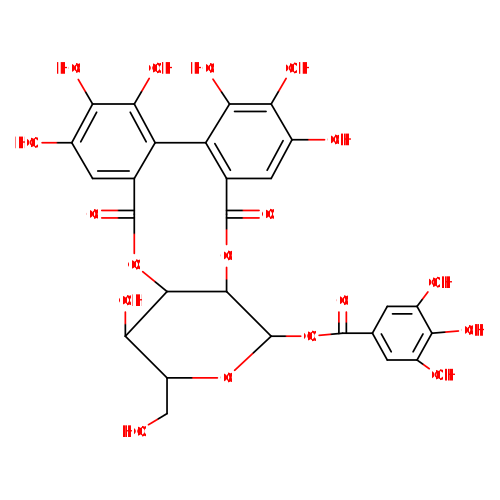
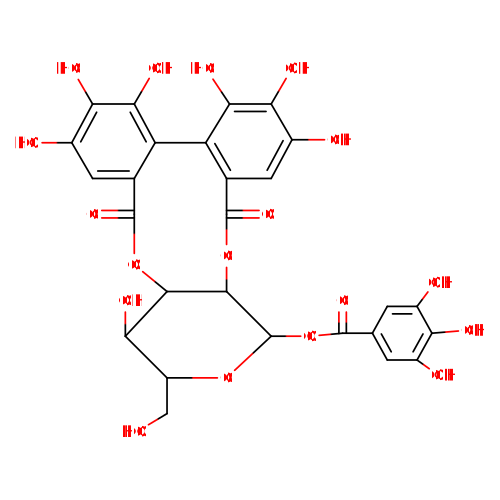
| Common Name | 3,4,5,14,20,21,22-heptahydroxy-13-(hydroxymethyl)-8,17-dioxo-9,12,16-trioxatetracyclo[16.4.0.0²,⁷.0¹⁰,¹⁵]docosa-1(22),2(7),3,5,18,20-hexaen-11-yl 3,4,5-trihydroxybenzoate |
|---|
| Description | Sanguiin H4 belongs to the class of organic compounds known as hydrolyzable tannins. These are tannins with a structure characterized by either of the following models. In model 1, the structure contains galloyl units (in some cases, shikimic acid units) that are linked to diverse polyol carbohydrate-, catechin-, or triterpenoid units. In model 2, contains at least two galloyl units C-C coupled to each other, and do not contain a glycosidically linked catechin unit. Sanguiin H4 is an extremely weak basic (essentially neutral) compound (based on its pKa). Outside of the human body, sanguiin H4 has been detected, but not quantified in, herbs and spices and tea. 3,4,5,14,20,21,22-heptahydroxy-13-(hydroxymethyl)-8,17-dioxo-9,12,16-trioxatetracyclo[16.4.0.0²,⁷.0¹⁰,¹⁵]docosa-1(22),2(7),3,5,18,20-hexaen-11-yl 3,4,5-trihydroxybenzoate is found in Camellia reticulata, Euphorbia fischeriana, Geum japonicum, Hippophae rhamnoides, Juglans regia, Pelargonium reniforme, Rosa gallica, Rosa laevigata and Rubus chingii. This could make sanguiin H4 a potential biomarker for the consumption of these foods. |
|---|
| Structure | OCC1OC(OC(=O)C2=CC(O)=C(O)C(O)=C2)C2OC(=O)C3=C(C(O)=C(O)C(O)=C3)C3=C(O)C(O)=C(O)C=C3C(=O)OC2C1O InChI=1S/C27H22O18/c28-5-13-19(36)22-23(27(42-13)45-24(39)6-1-9(29)16(33)10(30)2-6)44-26(41)8-4-12(32)18(35)21(38)15(8)14-7(25(40)43-22)3-11(31)17(34)20(14)37/h1-4,13,19,22-23,27-38H,5H2 |
|---|
| Synonyms | | Value | Source |
|---|
| 1-O-Galloyl-2,3-(S)-hexahydroxydiphenoyl-a-D-glucopyranose | HMDB | | 3,4,5,14,20,21,22-Heptahydroxy-13-(hydroxymethyl)-8,17-dioxo-9,12,16-trioxatetracyclo[16.4.0.0²,⁷.0¹⁰,¹⁵]docosa-1(22),2,4,6,18,20-hexaen-11-yl 3,4,5-trihydroxybenzoic acid | Generator |
|
|---|
| Chemical Formula | C27H22O18 |
|---|
| Average Mass | 634.4528 Da |
|---|
| Monoisotopic Mass | 634.08061 Da |
|---|
| IUPAC Name | 3,4,5,14,20,21,22-heptahydroxy-13-(hydroxymethyl)-8,17-dioxo-9,12,16-trioxatetracyclo[16.4.0.0²,⁷.0¹⁰,¹⁵]docosa-1(22),2(7),3,5,18,20-hexaen-11-yl 3,4,5-trihydroxybenzoate |
|---|
| Traditional Name | 3,4,5,14,20,21,22-heptahydroxy-13-(hydroxymethyl)-8,17-dioxo-9,12,16-trioxatetracyclo[16.4.0.0²,⁷.0¹⁰,¹⁵]docosa-1(22),2(7),3,5,18,20-hexaen-11-yl 3,4,5-trihydroxybenzoate |
|---|
| CAS Registry Number | Not Available |
|---|
| SMILES | OCC1OC(OC(=O)C2=CC(O)=C(O)C(O)=C2)C2OC(=O)C3=C(C(O)=C(O)C(O)=C3)C3=C(O)C(O)=C(O)C=C3C(=O)OC2C1O |
|---|
| InChI Identifier | InChI=1S/C27H22O18/c28-5-13-19(36)22-23(27(42-13)45-24(39)6-1-9(29)16(33)10(30)2-6)44-26(41)8-4-12(32)18(35)21(38)15(8)14-7(25(40)43-22)3-11(31)17(34)20(14)37/h1-4,13,19,22-23,27-38H,5H2 |
|---|
| InChI Key | MBPYHNAWMKVREM-UHFFFAOYSA-N |
|---|
| Experimental Spectra |
|---|
|
| Not Available | | Predicted Spectra |
|---|
|
| | Spectrum Type | Description | Depositor ID | Depositor Organization | Depositor | Deposition Date | View |
|---|
| 1D NMR | 13C NMR Spectrum (1D, 25 MHz, H2O, predicted) | Wishart Lab | Wishart Lab | David Wishart | 2021-06-20 | View Spectrum | | 1D NMR | 1H NMR Spectrum (1D, 100 MHz, H2O, predicted) | Wishart Lab | Wishart Lab | David Wishart | 2021-06-20 | View Spectrum | | 1D NMR | 13C NMR Spectrum (1D, 252 MHz, H2O, predicted) | Wishart Lab | Wishart Lab | David Wishart | 2021-06-20 | View Spectrum | | 1D NMR | 1H NMR Spectrum (1D, 1000 MHz, H2O, predicted) | Wishart Lab | Wishart Lab | David Wishart | 2021-06-20 | View Spectrum | | 1D NMR | 13C NMR Spectrum (1D, 50 MHz, H2O, predicted) | Wishart Lab | Wishart Lab | David Wishart | 2021-06-20 | View Spectrum | | 1D NMR | 1H NMR Spectrum (1D, 200 MHz, H2O, predicted) | Wishart Lab | Wishart Lab | David Wishart | 2021-06-20 | View Spectrum | | 1D NMR | 13C NMR Spectrum (1D, 75 MHz, H2O, predicted) | Wishart Lab | Wishart Lab | David Wishart | 2021-06-20 | View Spectrum | | 1D NMR | 1H NMR Spectrum (1D, 300 MHz, H2O, predicted) | Wishart Lab | Wishart Lab | David Wishart | 2021-06-20 | View Spectrum | | 1D NMR | 13C NMR Spectrum (1D, 101 MHz, H2O, predicted) | Wishart Lab | Wishart Lab | David Wishart | 2021-06-20 | View Spectrum | | 1D NMR | 1H NMR Spectrum (1D, 400 MHz, H2O, predicted) | Wishart Lab | Wishart Lab | David Wishart | 2021-06-20 | View Spectrum | | 1D NMR | 13C NMR Spectrum (1D, 126 MHz, H2O, predicted) | Wishart Lab | Wishart Lab | David Wishart | 2021-06-20 | View Spectrum | | 1D NMR | 1H NMR Spectrum (1D, 500 MHz, H2O, predicted) | Wishart Lab | Wishart Lab | David Wishart | 2021-06-20 | View Spectrum | | 1D NMR | 13C NMR Spectrum (1D, 151 MHz, H2O, predicted) | Wishart Lab | Wishart Lab | David Wishart | 2021-06-20 | View Spectrum | | 1D NMR | 1H NMR Spectrum (1D, 600 MHz, H2O, predicted) | Wishart Lab | Wishart Lab | David Wishart | 2021-06-20 | View Spectrum | | 1D NMR | 13C NMR Spectrum (1D, 176 MHz, H2O, predicted) | Wishart Lab | Wishart Lab | David Wishart | 2021-06-20 | View Spectrum | | 1D NMR | 1H NMR Spectrum (1D, 700 MHz, H2O, predicted) | Wishart Lab | Wishart Lab | David Wishart | 2021-06-20 | View Spectrum | | 1D NMR | 13C NMR Spectrum (1D, 201 MHz, H2O, predicted) | Wishart Lab | Wishart Lab | David Wishart | 2021-06-20 | View Spectrum | | 1D NMR | 1H NMR Spectrum (1D, 800 MHz, H2O, predicted) | Wishart Lab | Wishart Lab | David Wishart | 2021-06-20 | View Spectrum | | 1D NMR | 13C NMR Spectrum (1D, 226 MHz, H2O, predicted) | Wishart Lab | Wishart Lab | David Wishart | 2021-06-20 | View Spectrum | | 1D NMR | 1H NMR Spectrum (1D, 900 MHz, H2O, predicted) | Wishart Lab | Wishart Lab | David Wishart | 2021-06-20 | View Spectrum |
| | Chemical Shift Submissions |
|---|
|
| Not Available | | Species |
|---|
| Species of Origin | |
|---|
| Chemical Taxonomy |
|---|
| Description | Belongs to the class of organic compounds known as hydrolyzable tannins. These are tannins with a structure characterized by either of the following models. In model 1, the structure contains galloyl units (in some cases, shikimic acid units) that are linked to diverse polyol carbohydrate-, catechin-, or triterpenoid units. In model 2, contains at least two galloyl units C-C coupled to each other, and do not contain a glycosidically linked catechin unit. |
|---|
| Kingdom | Organic compounds |
|---|
| Super Class | Phenylpropanoids and polyketides |
|---|
| Class | Tannins |
|---|
| Sub Class | Hydrolyzable tannins |
|---|
| Direct Parent | Hydrolyzable tannins |
|---|
| Alternative Parents | Not Available |
|---|
| Substituents | Not Available |
|---|
| Molecular Framework | Aromatic heteropolycyclic compounds |
|---|
| External Descriptors | Not Available |
|---|
| Physical Properties |
|---|
| State | Not Available |
|---|
| Experimental Properties | | Property | Value | Reference |
|---|
| Melting Point | Not Available | Not Available | | Boiling Point | Not Available | Not Available | | Water Solubility | Not Available | Not Available | | LogP | Not Available | Not Available |
|
|---|
| Predicted Properties | |
|---|