| Record Information |
|---|
| Version | 2.0 |
|---|
| Created at | 2022-09-01 23:22:36 UTC |
|---|
| Updated at | 2022-09-01 23:22:36 UTC |
|---|
| NP-MRD ID | NP0144409 |
|---|
| Secondary Accession Numbers | None |
|---|
| Natural Product Identification |
|---|
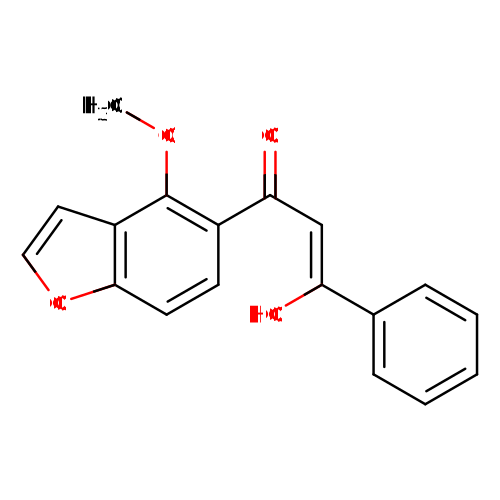
| Common Name | (2z)-3-hydroxy-1-(4-methoxy-1-benzofuran-5-yl)-3-phenylprop-2-en-1-one |
|---|
| Description | Pongamol belongs to the class of organic compounds known as furanochalcones. Furanochalcones are compounds containing a furan ring fused to either ring of a chalcone moiety. Thus, pongamol is considered to be a flavonoid. (2z)-3-hydroxy-1-(4-methoxy-1-benzofuran-5-yl)-3-phenylprop-2-en-1-one is found in Millettia pulchra, Pongamia pinnata and Tephrosia purpurea. (2z)-3-hydroxy-1-(4-methoxy-1-benzofuran-5-yl)-3-phenylprop-2-en-1-one was first documented in 2007 (PMID: 17768528). Based on a literature review a significant number of articles have been published on Pongamol (PMID: 32840388) (PMID: 32147928) (PMID: 25116833) (PMID: 34203624) (PMID: 30448188) (PMID: 26426474). |
|---|
| Structure | COC1=C2C=COC2=CC=C1C(=O)\C=C(/O)C1=CC=CC=C1 InChI=1S/C18H14O4/c1-21-18-13(7-8-17-14(18)9-10-22-17)16(20)11-15(19)12-5-3-2-4-6-12/h2-11,19H,1H3/b15-11- |
|---|
| Synonyms | Not Available |
|---|
| Chemical Formula | C18H14O4 |
|---|
| Average Mass | 294.3060 Da |
|---|
| Monoisotopic Mass | 294.08921 Da |
|---|
| IUPAC Name | (2Z)-3-hydroxy-1-(4-methoxy-1-benzofuran-5-yl)-3-phenylprop-2-en-1-one |
|---|
| Traditional Name | (2Z)-3-hydroxy-1-(4-methoxy-1-benzofuran-5-yl)-3-phenylprop-2-en-1-one |
|---|
| CAS Registry Number | Not Available |
|---|
| SMILES | COC1=C2C=COC2=CC=C1C(=O)\C=C(/O)C1=CC=CC=C1 |
|---|
| InChI Identifier | InChI=1S/C18H14O4/c1-21-18-13(7-8-17-14(18)9-10-22-17)16(20)11-15(19)12-5-3-2-4-6-12/h2-11,19H,1H3/b15-11- |
|---|
| InChI Key | IHWPQGIYXJKCOV-PTNGSMBKSA-N |
|---|
| Experimental Spectra |
|---|
|
| Not Available | | Predicted Spectra |
|---|
|
| | Spectrum Type | Description | Depositor ID | Depositor Organization | Depositor | Deposition Date | View |
|---|
| 1D NMR | 13C NMR Spectrum (1D, 25 MHz, H2O, predicted) | Wishart Lab | Wishart Lab | David Wishart | 2021-06-20 | View Spectrum | | 1D NMR | 1H NMR Spectrum (1D, 100 MHz, H2O, predicted) | Wishart Lab | Wishart Lab | David Wishart | 2021-06-20 | View Spectrum | | 1D NMR | 13C NMR Spectrum (1D, 252 MHz, H2O, predicted) | Wishart Lab | Wishart Lab | David Wishart | 2021-06-20 | View Spectrum | | 1D NMR | 1H NMR Spectrum (1D, 1000 MHz, H2O, predicted) | Wishart Lab | Wishart Lab | David Wishart | 2021-06-20 | View Spectrum | | 1D NMR | 13C NMR Spectrum (1D, 50 MHz, H2O, predicted) | Wishart Lab | Wishart Lab | David Wishart | 2021-06-20 | View Spectrum | | 1D NMR | 1H NMR Spectrum (1D, 200 MHz, H2O, predicted) | Wishart Lab | Wishart Lab | David Wishart | 2021-06-20 | View Spectrum | | 1D NMR | 13C NMR Spectrum (1D, 75 MHz, H2O, predicted) | Wishart Lab | Wishart Lab | David Wishart | 2021-06-20 | View Spectrum | | 1D NMR | 1H NMR Spectrum (1D, 300 MHz, H2O, predicted) | Wishart Lab | Wishart Lab | David Wishart | 2021-06-20 | View Spectrum | | 1D NMR | 13C NMR Spectrum (1D, 101 MHz, H2O, predicted) | Wishart Lab | Wishart Lab | David Wishart | 2021-06-20 | View Spectrum | | 1D NMR | 1H NMR Spectrum (1D, 400 MHz, H2O, predicted) | Wishart Lab | Wishart Lab | David Wishart | 2021-06-20 | View Spectrum | | 1D NMR | 13C NMR Spectrum (1D, 126 MHz, H2O, predicted) | Wishart Lab | Wishart Lab | David Wishart | 2021-06-20 | View Spectrum | | 1D NMR | 1H NMR Spectrum (1D, 500 MHz, H2O, predicted) | Wishart Lab | Wishart Lab | David Wishart | 2021-06-20 | View Spectrum | | 1D NMR | 13C NMR Spectrum (1D, 151 MHz, H2O, predicted) | Wishart Lab | Wishart Lab | David Wishart | 2021-06-20 | View Spectrum | | 1D NMR | 1H NMR Spectrum (1D, 600 MHz, H2O, predicted) | Wishart Lab | Wishart Lab | David Wishart | 2021-06-20 | View Spectrum | | 1D NMR | 13C NMR Spectrum (1D, 176 MHz, H2O, predicted) | Wishart Lab | Wishart Lab | David Wishart | 2021-06-20 | View Spectrum | | 1D NMR | 1H NMR Spectrum (1D, 700 MHz, H2O, predicted) | Wishart Lab | Wishart Lab | David Wishart | 2021-06-20 | View Spectrum | | 1D NMR | 13C NMR Spectrum (1D, 201 MHz, H2O, predicted) | Wishart Lab | Wishart Lab | David Wishart | 2021-06-20 | View Spectrum | | 1D NMR | 1H NMR Spectrum (1D, 800 MHz, H2O, predicted) | Wishart Lab | Wishart Lab | David Wishart | 2021-06-20 | View Spectrum | | 1D NMR | 13C NMR Spectrum (1D, 226 MHz, H2O, predicted) | Wishart Lab | Wishart Lab | David Wishart | 2021-06-20 | View Spectrum | | 1D NMR | 1H NMR Spectrum (1D, 900 MHz, H2O, predicted) | Wishart Lab | Wishart Lab | David Wishart | 2021-06-20 | View Spectrum |
| | Chemical Shift Submissions |
|---|
|
| Not Available | | Species |
|---|
| Species of Origin | |
|---|
| Chemical Taxonomy |
|---|
| Description | Belongs to the class of organic compounds known as furanochalcones. Furanochalcones are compounds containing a furan ring fused to either ring of a chalcone moiety. |
|---|
| Kingdom | Organic compounds |
|---|
| Super Class | Phenylpropanoids and polyketides |
|---|
| Class | Linear 1,3-diarylpropanoids |
|---|
| Sub Class | Chalcones and dihydrochalcones |
|---|
| Direct Parent | Furanochalcones |
|---|
| Alternative Parents | |
|---|
| Substituents | - Furanochalcone
- Cinnamic acid or derivatives
- Benzofuran
- Anisole
- Styrene
- Aryl ketone
- Alkyl aryl ether
- Monocyclic benzene moiety
- Benzenoid
- Acryloyl-group
- Heteroaromatic compound
- Enone
- Furan
- Vinylogous acid
- Alpha,beta-unsaturated ketone
- Ketone
- Ether
- Enol
- Oxacycle
- Organoheterocyclic compound
- Organic oxygen compound
- Aldehyde
- Organic oxide
- Organooxygen compound
- Hydrocarbon derivative
- Aromatic heteropolycyclic compound
|
|---|
| Molecular Framework | Aromatic heteropolycyclic compounds |
|---|
| External Descriptors | Not Available |
|---|
| Physical Properties |
|---|
| State | Not Available |
|---|
| Experimental Properties | | Property | Value | Reference |
|---|
| Melting Point | Not Available | Not Available | | Boiling Point | Not Available | Not Available | | Water Solubility | Not Available | Not Available | | LogP | Not Available | Not Available |
|
|---|
| Predicted Properties | |
|---|
| General References | - Sahayaraj K, Kombiah P, Rathi JAM: A chalcone (Pongamol) and phytoconstituents of Tephrosia purpurea. Nat Prod Res. 2022 Apr;36(7):1870-1873. doi: 10.1080/14786419.2020.1808640. Epub 2020 Aug 25. [PubMed:32840388 ]
- Rao AS, Yadav SS, Singh P, Nandal A, Singh N, Ganaie SA, Yadav N, Kumar R, Bhandoria MS, Bansal P: A comprehensive review on ethnomedicine, phytochemistry, pharmacology, and toxicity of Tephrosia purpurea (L.) Pers. Phytother Res. 2020 Aug;34(8):1902-1925. doi: 10.1002/ptr.6657. Epub 2020 Mar 8. [PubMed:32147928 ]
- Peng Y, Chen Y, Gao C, Yan T, Cao W, Huang R: A new 1,2-ethanedione benzofurane derivative from Tephrosia purpurea. Nat Prod Res. 2014;28(20):1705-8. doi: 10.1080/14786419.2014.940587. Epub 2014 Aug 12. [PubMed:25116833 ]
- Vo TH, Liaw CC, Lin YC, Nguyen DH, Nguyen TTN, Lee CK, Kuo YH: Quantification and Optimization of Ethanolic Extract Containing the Bioactive Flavonoids from Millettia pulchra Radix. Molecules. 2021 Jun 15;26(12):3641. doi: 10.3390/molecules26123641. [PubMed:34203624 ]
- Sharma R, Williams IS, Gatchie L, Sonawane VR, Chaudhuri B, Bharate SB: Furanoflavones pongapin and lanceolatin B blocks the cell cycle and induce senescence in CYP1A1-overexpressing breast cancer cells. Bioorg Med Chem. 2018 Dec 15;26(23-24):6076-6086. doi: 10.1016/j.bmc.2018.11.013. Epub 2018 Nov 10. [PubMed:30448188 ]
- Magalhaes AF, Tozzi AM, Magalhaes EG, Sannomiya M, Soriano Mdel P, Perez MA: Flavonoids of Lonchocarpus montanus A.M.G. Azevedo and biological activity. An Acad Bras Cienc. 2007 Sep;79(3):351-67. doi: 10.1590/s0001-37652007000300001. [PubMed:17768528 ]
- Sharma R, Vishwakarma RA, Bharate SB: An efficient transformation of furano-hydroxychalcones to furanoflavones via base mediated intramolecular tandem O-arylation and C-O bond cleavage: a new approach for the synthesis of furanoflavones. Org Biomol Chem. 2015 Nov 14;13(42):10461-5. doi: 10.1039/c5ob01802a. Epub 2015 Oct 1. [PubMed:26426474 ]
- Putri HE, Sritularak B, Chanvorachote P: Pongamol Inhibits Epithelial to Mesenchymal Transition Through Suppression of FAK/Akt-mTOR Signaling. Anticancer Res. 2021 Dec;41(12):6147-6154. doi: 10.21873/anticanres.15434. [PubMed:34848469 ]
- Jahan S, Mahmud MH, Khan Z, Alam A, Khalil AA, Rauf A, Tareq AM, Nainu F, Tareq SM, Emran TB, Khan M, Khan IN, Wilairatana P, Mubarak MS: Health promoting benefits of pongamol: An overview. Biomed Pharmacother. 2021 Oct;142:112109. doi: 10.1016/j.biopha.2021.112109. Epub 2021 Aug 27. [PubMed:34470730 ]
- Lodhi S, Jain A, Jain AP, Pawar RS, Singhai AK: Effects of flavonoids from Martynia annua and Tephrosia purpurea on cutaneous wound healing. Avicenna J Phytomed. 2016 Sep-Oct;6(5):578-591. [PubMed:27761428 ]
- Perumalsamy H, Jang MJ, Kim JR, Kadarkarai M, Ahn YJ: Larvicidal activity and possible mode of action of four flavonoids and two fatty acids identified in Millettia pinnata seed toward three mosquito species. Parasit Vectors. 2015 Apr 19;8:237. doi: 10.1186/s13071-015-0848-8. [PubMed:25928224 ]
- Rao EV, Sudheer P: Revisiting curcumin chemistry part I: a new strategy for the synthesis of curcuminoids. Indian J Pharm Sci. 2011 May;73(3):262-70. doi: 10.4103/0250-474X.93508. [PubMed:22457548 ]
- Tamrakar AK, Jaiswal N, Yadav PP, Maurya R, Srivastava AK: Pongamol from Pongamia pinnata stimulates glucose uptake by increasing surface GLUT4 level in skeletal muscle cells. Mol Cell Endocrinol. 2011 Jun 6;339(1-2):98-104. doi: 10.1016/j.mce.2011.03.023. Epub 2011 Apr 8. [PubMed:21497640 ]
- Ranga Rao R, Tiwari AK, Prabhakar Reddy P, Suresh Babu K, Ali AZ, Madhusudana K, Madhusudana Rao J: New furanoflavanoids, intestinal alpha-glucosidase inhibitory and free-radical (DPPH) scavenging, activity from antihyperglycemic root extract of Derris indica (Lam.). Bioorg Med Chem. 2009 Jul 15;17(14):5170-5. doi: 10.1016/j.bmc.2009.05.051. Epub 2009 May 28. [PubMed:19515570 ]
- Tamrakar AK, Yadav PP, Tiwari P, Maurya R, Srivastava AK: Identification of pongamol and karanjin as lead compounds with antihyperglycemic activity from Pongamia pinnata fruits. J Ethnopharmacol. 2008 Aug 13;118(3):435-9. doi: 10.1016/j.jep.2008.05.008. Epub 2008 May 15. [PubMed:18572336 ]
- LOTUS database [Link]
|
|---|