| Record Information |
|---|
| Version | 2.0 |
|---|
| Created at | 2022-09-01 22:50:46 UTC |
|---|
| Updated at | 2022-09-01 22:50:46 UTC |
|---|
| NP-MRD ID | NP0143976 |
|---|
| Secondary Accession Numbers | None |
|---|
| Natural Product Identification |
|---|
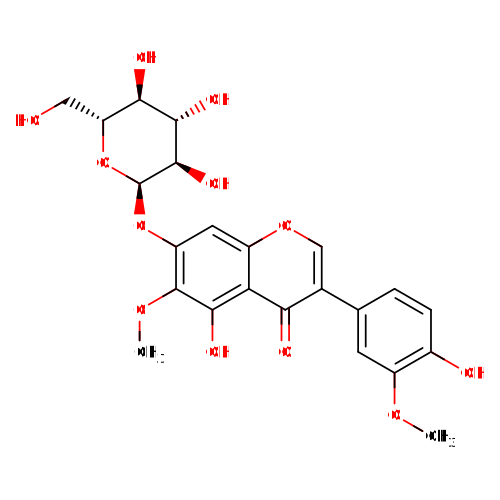
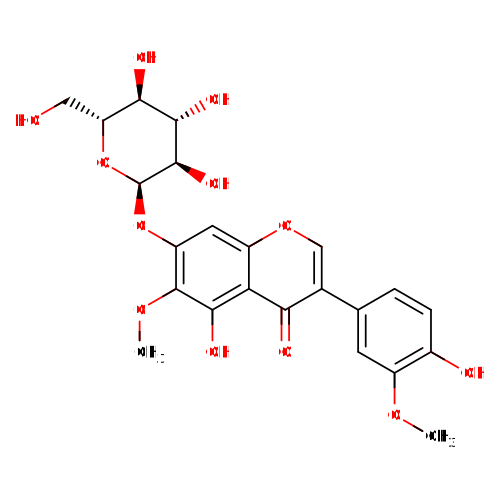
| Common Name | 5-hydroxy-3-(4-hydroxy-3-methoxyphenyl)-6-methoxy-7-{[(2r,3r,4s,5s,6r)-3,4,5-trihydroxy-6-(hydroxymethyl)oxan-2-yl]oxy}chromen-4-one |
|---|
| Description | Iristectorin B belongs to the class of organic compounds known as isoflavonoid o-glycosides. These are o-glycosylated derivatives of isoflavonoids, which are natural products derived from 3-phenylchromen-4-one. 5-hydroxy-3-(4-hydroxy-3-methoxyphenyl)-6-methoxy-7-{[(2r,3r,4s,5s,6r)-3,4,5-trihydroxy-6-(hydroxymethyl)oxan-2-yl]oxy}chromen-4-one is found in Iris domestica. 5-hydroxy-3-(4-hydroxy-3-methoxyphenyl)-6-methoxy-7-{[(2r,3r,4s,5s,6r)-3,4,5-trihydroxy-6-(hydroxymethyl)oxan-2-yl]oxy}chromen-4-one was first documented in 2005 (PMID: 15787436). Based on a literature review a significant number of articles have been published on Iristectorin B (PMID: 21552369) (PMID: 21355241) (PMID: 33001505) (PMID: 30196209) (PMID: 21715119) (PMID: 21444254). |
|---|
| Structure | COC1=CC(=CC=C1O)C1=COC2=CC(O[C@H]3O[C@H](CO)[C@@H](O)[C@H](O)[C@H]3O)=C(OC)C(O)=C2C1=O InChI=1S/C23H24O12/c1-31-12-5-9(3-4-11(12)25)10-8-33-13-6-14(22(32-2)19(28)16(13)17(10)26)34-23-21(30)20(29)18(27)15(7-24)35-23/h3-6,8,15,18,20-21,23-25,27-30H,7H2,1-2H3/t15-,18-,20+,21-,23+/m1/s1 |
|---|
| Synonyms | Not Available |
|---|
| Chemical Formula | C23H24O12 |
|---|
| Average Mass | 492.4330 Da |
|---|
| Monoisotopic Mass | 492.12678 Da |
|---|
| IUPAC Name | 5-hydroxy-3-(4-hydroxy-3-methoxyphenyl)-6-methoxy-7-{[(2R,3R,4S,5S,6R)-3,4,5-trihydroxy-6-(hydroxymethyl)oxan-2-yl]oxy}-4H-chromen-4-one |
|---|
| Traditional Name | 5-hydroxy-3-(4-hydroxy-3-methoxyphenyl)-6-methoxy-7-{[(2R,3R,4S,5S,6R)-3,4,5-trihydroxy-6-(hydroxymethyl)oxan-2-yl]oxy}chromen-4-one |
|---|
| CAS Registry Number | Not Available |
|---|
| SMILES | COC1=CC(=CC=C1O)C1=COC2=CC(O[C@H]3O[C@H](CO)[C@@H](O)[C@H](O)[C@H]3O)=C(OC)C(O)=C2C1=O |
|---|
| InChI Identifier | InChI=1S/C23H24O12/c1-31-12-5-9(3-4-11(12)25)10-8-33-13-6-14(22(32-2)19(28)16(13)17(10)26)34-23-21(30)20(29)18(27)15(7-24)35-23/h3-6,8,15,18,20-21,23-25,27-30H,7H2,1-2H3/t15-,18-,20+,21-,23+/m1/s1 |
|---|
| InChI Key | XVNKSNSGLVWSFS-IJLXDYNCSA-N |
|---|
| Experimental Spectra |
|---|
|
| Not Available | | Predicted Spectra |
|---|
|
| | Spectrum Type | Description | Depositor ID | Depositor Organization | Depositor | Deposition Date | View |
|---|
| 1D NMR | 13C NMR Spectrum (1D, 25 MHz, H2O, predicted) | Wishart Lab | Wishart Lab | David Wishart | 2021-06-20 | View Spectrum | | 1D NMR | 1H NMR Spectrum (1D, 100 MHz, H2O, predicted) | Wishart Lab | Wishart Lab | David Wishart | 2021-06-20 | View Spectrum | | 1D NMR | 13C NMR Spectrum (1D, 252 MHz, H2O, predicted) | Wishart Lab | Wishart Lab | David Wishart | 2021-06-20 | View Spectrum | | 1D NMR | 1H NMR Spectrum (1D, 1000 MHz, H2O, predicted) | Wishart Lab | Wishart Lab | David Wishart | 2021-06-20 | View Spectrum | | 1D NMR | 13C NMR Spectrum (1D, 50 MHz, H2O, predicted) | Wishart Lab | Wishart Lab | David Wishart | 2021-06-20 | View Spectrum | | 1D NMR | 1H NMR Spectrum (1D, 200 MHz, H2O, predicted) | Wishart Lab | Wishart Lab | David Wishart | 2021-06-20 | View Spectrum | | 1D NMR | 13C NMR Spectrum (1D, 75 MHz, H2O, predicted) | Wishart Lab | Wishart Lab | David Wishart | 2021-06-20 | View Spectrum | | 1D NMR | 1H NMR Spectrum (1D, 300 MHz, H2O, predicted) | Wishart Lab | Wishart Lab | David Wishart | 2021-06-20 | View Spectrum | | 1D NMR | 13C NMR Spectrum (1D, 101 MHz, H2O, predicted) | Wishart Lab | Wishart Lab | David Wishart | 2021-06-20 | View Spectrum | | 1D NMR | 1H NMR Spectrum (1D, 400 MHz, H2O, predicted) | Wishart Lab | Wishart Lab | David Wishart | 2021-06-20 | View Spectrum | | 1D NMR | 13C NMR Spectrum (1D, 126 MHz, H2O, predicted) | Wishart Lab | Wishart Lab | David Wishart | 2021-06-20 | View Spectrum | | 1D NMR | 1H NMR Spectrum (1D, 500 MHz, H2O, predicted) | Wishart Lab | Wishart Lab | David Wishart | 2021-06-20 | View Spectrum | | 1D NMR | 13C NMR Spectrum (1D, 151 MHz, H2O, predicted) | Wishart Lab | Wishart Lab | David Wishart | 2021-06-20 | View Spectrum | | 1D NMR | 1H NMR Spectrum (1D, 600 MHz, H2O, predicted) | Wishart Lab | Wishart Lab | David Wishart | 2021-06-20 | View Spectrum | | 1D NMR | 13C NMR Spectrum (1D, 176 MHz, H2O, predicted) | Wishart Lab | Wishart Lab | David Wishart | 2021-06-20 | View Spectrum | | 1D NMR | 1H NMR Spectrum (1D, 700 MHz, H2O, predicted) | Wishart Lab | Wishart Lab | David Wishart | 2021-06-20 | View Spectrum | | 1D NMR | 13C NMR Spectrum (1D, 201 MHz, H2O, predicted) | Wishart Lab | Wishart Lab | David Wishart | 2021-06-20 | View Spectrum | | 1D NMR | 1H NMR Spectrum (1D, 800 MHz, H2O, predicted) | Wishart Lab | Wishart Lab | David Wishart | 2021-06-20 | View Spectrum | | 1D NMR | 13C NMR Spectrum (1D, 226 MHz, H2O, predicted) | Wishart Lab | Wishart Lab | David Wishart | 2021-06-20 | View Spectrum | | 1D NMR | 1H NMR Spectrum (1D, 900 MHz, H2O, predicted) | Wishart Lab | Wishart Lab | David Wishart | 2021-06-20 | View Spectrum |
| | Chemical Shift Submissions |
|---|
|
| Not Available | | Species |
|---|
| Species of Origin | |
|---|
| Chemical Taxonomy |
|---|
| Description | Belongs to the class of organic compounds known as isoflavonoid o-glycosides. These are o-glycosylated derivatives of isoflavonoids, which are natural products derived from 3-phenylchromen-4-one. |
|---|
| Kingdom | Organic compounds |
|---|
| Super Class | Phenylpropanoids and polyketides |
|---|
| Class | Isoflavonoids |
|---|
| Sub Class | Isoflavonoid O-glycosides |
|---|
| Direct Parent | Isoflavonoid O-glycosides |
|---|
| Alternative Parents | |
|---|
| Substituents | - Isoflavonoid-7-o-glycoside
- Isoflavonoid o-glycoside
- 3p-methoxyisoflavone
- Hydroxyisoflavonoid
- Isoflavone
- Phenolic glycoside
- Hexose monosaccharide
- O-glycosyl compound
- Glycosyl compound
- Chromone
- 1-benzopyran
- Methoxyphenol
- Benzopyran
- Phenoxy compound
- Methoxybenzene
- Phenol ether
- Anisole
- 1-hydroxy-4-unsubstituted benzenoid
- 1-hydroxy-2-unsubstituted benzenoid
- Pyranone
- Phenol
- Alkyl aryl ether
- Benzenoid
- Pyran
- Oxane
- Monosaccharide
- Monocyclic benzene moiety
- Heteroaromatic compound
- Vinylogous acid
- Secondary alcohol
- Oxacycle
- Organoheterocyclic compound
- Polyol
- Ether
- Acetal
- Organic oxygen compound
- Organic oxide
- Hydrocarbon derivative
- Primary alcohol
- Organooxygen compound
- Alcohol
- Aromatic heteropolycyclic compound
|
|---|
| Molecular Framework | Aromatic heteropolycyclic compounds |
|---|
| External Descriptors | Not Available |
|---|
| Physical Properties |
|---|
| State | Not Available |
|---|
| Experimental Properties | | Property | Value | Reference |
|---|
| Melting Point | Not Available | Not Available | | Boiling Point | Not Available | Not Available | | Water Solubility | Not Available | Not Available | | LogP | Not Available | Not Available |
|
|---|
| Predicted Properties | |
|---|
| General References | - Monthakantirat O, De-Eknamkul W, Umehara K, Yoshinaga Y, Miyase T, Warashina T, Noguchi H: Phenolic constituents of the rhizomes of the Thai medicinal plant Belamcanda chinensis with proliferative activity for two breast cancer cell lines. J Nat Prod. 2005 Mar;68(3):361-4. doi: 10.1021/np040175c. [PubMed:15787436 ]
- Wang X, Liang Y, Peng C, Xie H, Pan M, Zhang T, Ito Y: PREPARATIVE ISOLATION AND PURIFICATION OF CHEMICAL CONSTITUENTS OF BELAMCANDA BY MPLC, HSCCC AND PREP-HPLC. J Liq Chromatogr Relat Technol. 2011;34(4):241-257. doi: 10.1080/10826076.2011.547058. [PubMed:21552369 ]
- Huang L, Yang J, Peng Y, Xiao P: [Chemical constituents of Iris dichotoma]. Zhongguo Zhong Yao Za Zhi. 2010 Dec;35(23):3168-71. [PubMed:21355241 ]
- Gao B, Ma Y, Zhang LT, Ren Q: Identification and characterization of the chemical components of Iris tectorum Maxim. and evaluation of their nitric oxide inhibitory activity. Rapid Commun Mass Spectrom. 2021 Jan 15;35(1):e8959. doi: 10.1002/rcm.8959. [PubMed:33001505 ]
- Wen Y, He L, Peng R, Lin Y, Zhao L, Li X, Ye L, Yang J: A novel strategy to evaluate the quality of herbal products based on the chemical profiling, efficacy evaluation and pharmacokinetics. J Pharm Biomed Anal. 2018 Nov 30;161:326-335. doi: 10.1016/j.jpba.2018.08.047. Epub 2018 Aug 26. [PubMed:30196209 ]
- Zhang YY, Wang Q, Qi LW, Qin XY, Qin MJ: Characterization and determination of the major constituents in Belamcandae Rhizoma by HPLC-DAD-ESI-MS(n). J Pharm Biomed Anal. 2011 Sep 10;56(2):304-14. doi: 10.1016/j.jpba.2011.05.040. Epub 2011 Jun 6. [PubMed:21715119 ]
- Sun Y, Li W, Wang J: Ionic liquid based ultrasonic assisted extraction of isoflavones from Iris tectorum Maxim and subsequently separation and purification by high-speed counter-current chromatography. J Chromatogr B Analyt Technol Biomed Life Sci. 2011 Apr 15;879(13-14):975-80. doi: 10.1016/j.jchromb.2011.03.010. Epub 2011 Mar 12. [PubMed:21444254 ]
- Sun Y, Liu Z, Wang J: Ultrasound-assisted extraction of five isoflavones from Iris tectorum Maxim. Sep Purif Technol. 2011 Mar 24;78(1):49-54. doi: 10.1016/j.seppur.2011.01.017. Epub 2011 Jan 25. [PubMed:32288612 ]
- Qiu QH, Zhang ZG, Wang JH, Lv TS: [Studies on the isoflavonoids of Iris tectorum]. Zhong Yao Cai. 2009 Sep;32(9):1392-4. [PubMed:20034214 ]
- LOTUS database [Link]
|
|---|